Event submissions
EventsMOL2NET'18, Conference on Molecular, Biomed., Comput. & Network Science and Engineering, 4th ed.
Published

This submission belongs to the session 09. NICEXSM-04: North-Ibero-American Congress on Exp. and Simul. Methods., Valencia, Spain-Talca, Chile-Miami, USA, 2018-2019 of the event MOL2NET'18, Conference on Molecular, Biomed., Comput. & Network Science and Engineering, 4th ed.
Published date
08 May, 2018
Citation
Sebastián Silva, Marta Fernández, IDENTIFICATION OF GENES ASSOCIATED TO COLD ACCLIMATION IN Eucalyptus nitens BY ANALYSIS OF GENE EXPRESSION in silico., in Proceedings of MOL2NET'18, Conference on Molecular, Biomed., Comput. & Network Science and Engineering, 4th ed., 15 January 2018–20 January 2019, MDPI: Basel, Switzerland, doi: 10.3390/mol2net-04-05205
Share
Email
Facebook
Twitter
LinkedIn
IDENTIFICATION OF GENES ASSOCIATED TO COLD ACCLIMATION IN Eucalyptus nitens BY ANALYSIS OF GENE EXPRESSION in silico.
'%3e%3cpath%20d='M12.6647%2010.9104C12.4176%2010.325%2012.0589%209.7933%2011.6088%209.34485C11.16%208.89511%2010.6283%208.53653%2010.0432%208.28891C10.038%208.28629%2010.0327%208.28498%2010.0275%208.28236C10.8437%207.69282%2011.3743%206.73252%2011.3743%205.64907C11.3743%203.85423%209.92005%202.40002%208.12522%202.40002C6.33038%202.40002%204.87618%203.85423%204.87618%205.64907C4.87618%206.73252%205.40677%207.69282%206.22296%208.28367C6.21772%208.28629%206.21248%208.2876%206.20724%208.29022C5.62031%208.53783%205.09365%208.89287%204.64167%209.34616C4.19192%209.79496%203.83334%2010.3266%203.58573%2010.9117C3.34247%2011.4846%203.21128%2012.0987%203.19925%2012.721C3.1989%2012.735%203.20135%2012.7489%203.20646%2012.7619C3.21157%2012.7749%203.21924%2012.7868%203.22901%2012.7968C3.23877%2012.8068%203.25045%2012.8148%203.26334%2012.8202C3.27623%2012.8256%203.29007%2012.8284%203.30406%2012.8284H4.09012C4.14776%2012.8284%204.19362%2012.7825%204.19493%2012.7262C4.22113%2011.7148%204.62726%2010.7676%205.34519%2010.0497C6.08802%209.30686%207.07452%208.89811%208.12522%208.89811C9.17592%208.89811%2010.1624%209.30686%2010.9052%2010.0497C11.6232%2010.7676%2012.0293%2011.7148%2012.0555%2012.7262C12.0568%2012.7839%2012.1027%2012.8284%2012.1603%2012.8284H12.9464C12.9604%2012.8284%2012.9742%2012.8256%2012.9871%2012.8202C13%2012.8148%2013.0117%2012.8068%2013.0214%2012.7968C13.0312%2012.7868%2013.0389%2012.7749%2013.044%2012.7619C13.0491%2012.7489%2013.0515%2012.735%2013.0512%2012.721C13.0381%2012.0947%2012.9084%2011.4856%2012.6647%2010.9104ZM8.12522%207.90243C7.52388%207.90243%206.95792%207.66793%206.53214%207.24215C6.10636%206.81636%205.87185%206.2504%205.87185%205.64907C5.87185%205.04773%206.10636%204.48177%206.53214%204.05599C6.95792%203.63021%207.52388%203.3957%208.12522%203.3957C8.72655%203.3957%209.29252%203.63021%209.7183%204.05599C10.1441%204.48177%2010.3786%205.04773%2010.3786%205.64907C10.3786%206.2504%2010.1441%206.81636%209.7183%207.24215C9.29252%207.66793%208.72655%207.90243%208.12522%207.90243Z'%20fill='%235D1EE1'/%3e%3c/g%3e%3c/svg%3e)
Sebastián Silva 1
Marta Fernández 1
1. Centro de Biotecnologia, UdeC.
Abstract
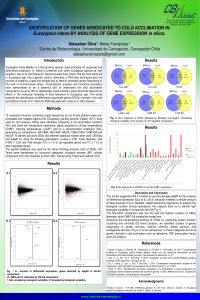
Eucalyptus nitens Maiden is a fast growing species used principally for pulpwood and solid-wood production, it is preferred over other Eucalyptus species at high elevation, due its cold tolerance. Studies show that the frost tolerance in Eucalyptus spp. is controlled by genetic factor. One tools that has been used in recent years to analyze gene expression is the transcriptomic analysis of sequences obtained by RNA-seq. There are many bioinformatics tools that allow this analysis, however, not all have the same precision. Among the most used in the detection of differentially expressed genes, are DEGseq and edgeR, so the objective was to identify by in silico analysis, genes differentially expressed during the low temperature acclimatization of E. nitens, associating these to tolerance to freezing. Three treatment conditions was used: acclimated before freezing (CABF), cold acclimated after freezing (CAAF), deacclimated (DA) and the control, non- acclimated (NA). The results obtained suggest that it is better to use the package edgeR for the analysis of differential expression, because it detects a smaller amount of false positives, it is when there are a few biological replicates and increases its fidelity when analyzing the biological variability of the samples. The NA-ADH comparison was the one with the most genes detected, while the AAH-DA was the lowest. In all comparisons we found a greater amount of negatively regulated genes than positively regulated genes. Within the differentially expressed genes with significance for the key comparisons we found proteins dehydrins and CBF transcription factors, important in the process of acclimatization at low temperature. Through the analysis of differentially expressed genes and genetic ontology LEA (Late embryogenesis abundant) genes were identified, within which EniDHN1 and EniDHN2, hydrophilic proteins and the CBF (C-repeat binding factor) transcription factor can be highlighted as genes asssociated with tolerance to low temperatures.
Keywords
Eucalyptus nitens
RNA-seq
in silico analysis
cold tolerance
edgeR.
Poster
Poster SSilva.pdf
Structure Based docking studies for the identification of small molecule targeting mTOR for the treatment of Breast cancer
MOTIVATOR PROGRAM IMPLEMENTATION FOR VOLUNTARY BLOOD DONORS: "RED JUNE - USE YOUR INNER BEAUTY"