Event submissions
Published

This submission belongs to the session E. Nano- and Two-Dimensional Crystals of the event The 1st International Electronic Conference on Crystals
Published date
21 May, 2018
Citation
Sergio Manzetti, An electronic investigation into the physical, chemical and thermochemical properties of Niobium nanoclusters., in Proceedings of The 1st International Electronic Conference on Crystals, 21 May–31 May 2018, MDPI: Basel, Switzerland, doi: 10.3390/IECC_2018-05248
Share
Email
Facebook
Twitter
LinkedIn
An electronic investigation into the physical, chemical and thermochemical properties of Niobium nanoclusters.
'%3e%3cpath%20d='M12.6647%2010.9104C12.4176%2010.325%2012.0589%209.7933%2011.6088%209.34485C11.16%208.89511%2010.6283%208.53653%2010.0432%208.28891C10.038%208.28629%2010.0327%208.28498%2010.0275%208.28236C10.8437%207.69282%2011.3743%206.73252%2011.3743%205.64907C11.3743%203.85423%209.92005%202.40002%208.12522%202.40002C6.33038%202.40002%204.87618%203.85423%204.87618%205.64907C4.87618%206.73252%205.40677%207.69282%206.22296%208.28367C6.21772%208.28629%206.21248%208.2876%206.20724%208.29022C5.62031%208.53783%205.09365%208.89287%204.64167%209.34616C4.19192%209.79496%203.83334%2010.3266%203.58573%2010.9117C3.34247%2011.4846%203.21128%2012.0987%203.19925%2012.721C3.1989%2012.735%203.20135%2012.7489%203.20646%2012.7619C3.21157%2012.7749%203.21924%2012.7868%203.22901%2012.7968C3.23877%2012.8068%203.25045%2012.8148%203.26334%2012.8202C3.27623%2012.8256%203.29007%2012.8284%203.30406%2012.8284H4.09012C4.14776%2012.8284%204.19362%2012.7825%204.19493%2012.7262C4.22113%2011.7148%204.62726%2010.7676%205.34519%2010.0497C6.08802%209.30686%207.07452%208.89811%208.12522%208.89811C9.17592%208.89811%2010.1624%209.30686%2010.9052%2010.0497C11.6232%2010.7676%2012.0293%2011.7148%2012.0555%2012.7262C12.0568%2012.7839%2012.1027%2012.8284%2012.1603%2012.8284H12.9464C12.9604%2012.8284%2012.9742%2012.8256%2012.9871%2012.8202C13%2012.8148%2013.0117%2012.8068%2013.0214%2012.7968C13.0312%2012.7868%2013.0389%2012.7749%2013.044%2012.7619C13.0491%2012.7489%2013.0515%2012.735%2013.0512%2012.721C13.0381%2012.0947%2012.9084%2011.4856%2012.6647%2010.9104ZM8.12522%207.90243C7.52388%207.90243%206.95792%207.66793%206.53214%207.24215C6.10636%206.81636%205.87185%206.2504%205.87185%205.64907C5.87185%205.04773%206.10636%204.48177%206.53214%204.05599C6.95792%203.63021%207.52388%203.3957%208.12522%203.3957C8.72655%203.3957%209.29252%203.63021%209.7183%204.05599C10.1441%204.48177%2010.3786%205.04773%2010.3786%205.64907C10.3786%206.2504%2010.1441%206.81636%209.7183%207.24215C9.29252%207.66793%208.72655%207.90243%208.12522%207.90243Z'%20fill='%235D1EE1'/%3e%3c/g%3e%3c/svg%3e)
Sergio Manzetti 1,2
1. Uppsala University, Disciplinary Domain of Science and Technology, Biology, Department of Cell and Molecular Biology, Computational Biology and Bioinformatics. Uppsala, Husargatan 3, SE-75124 Uppsala, Sweden
2. Fjordforsk A.S., Bygdavegen 155, 6894 Vangsnes
Abstract
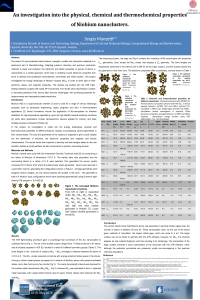
The search for spin-polarized metal clusters, energetic crystals and conductive materials is a paramount part of Nanotechnology. Adapting quantum chemistry and quantum mechanics methods to study and endeavor the electronic and lattice properties of groups of atoms in nanoclusters is a central approach, which aids in revealing crucial electronic properties that serve to develop and synthesize nanomaterials, nanometals and metal clusters. This project investigates the energy landscape of Niobium clusters (Nbn), in order to shed light on its electronic, dipole, and magnetic properties. The clusters are studied with the XTB Tight-binding software coupled with hybrid DFT functionals. The results show that Niobium clusters in nanosized particles (10-61 atoms) bear ultra-low orbital gaps, with promising properties for hyperconnects and nanoparticle based electronics.
Keywords
Niobium
nanoclusters
nanometals
DFT
tight-binding
studies
Manuscript
iecc2018_Postertemplate.pdf
Poster
iecc2018_Postertemplate.pdf
2D supramolecular structure for a chiral heterotrinuclear ZnII2HoIII complex through varied H-bonds connecting solvates and counterions
Synthesis and Structural Assessment of Methyl 2-((4-phenyl-5-(pyridin-2-yl)-4H-1,2,4-triazol-3-yl)thio)acetate (phpy2NS) and its complex with HgCl2.