Event submissions
Published

This submission belongs to the session A. Liquid Crystals of the event The 1st International Electronic Conference on Crystals
Published date
21 May, 2018
Citation
I.E Lezova, G.E Polushina, S.G Polushin, CONFINEMENT EFFECT IN A THICK LAYER OF NEMATIC LANTHANIDE COMPLEX, in Proceedings of The 1st International Electronic Conference on Crystals, 21 May–31 May 2018, MDPI: Basel, Switzerland, doi: 10.3390/IECC_2018-05252
Share
Email
Facebook
Twitter
LinkedIn
CONFINEMENT EFFECT IN A THICK LAYER OF NEMATIC LANTHANIDE COMPLEX
'%3e%3cpath%20d='M12.6647%2010.9104C12.4176%2010.325%2012.0589%209.7933%2011.6088%209.34485C11.16%208.89511%2010.6283%208.53653%2010.0432%208.28891C10.038%208.28629%2010.0327%208.28498%2010.0275%208.28236C10.8437%207.69282%2011.3743%206.73252%2011.3743%205.64907C11.3743%203.85423%209.92005%202.40002%208.12522%202.40002C6.33038%202.40002%204.87618%203.85423%204.87618%205.64907C4.87618%206.73252%205.40677%207.69282%206.22296%208.28367C6.21772%208.28629%206.21248%208.2876%206.20724%208.29022C5.62031%208.53783%205.09365%208.89287%204.64167%209.34616C4.19192%209.79496%203.83334%2010.3266%203.58573%2010.9117C3.34247%2011.4846%203.21128%2012.0987%203.19925%2012.721C3.1989%2012.735%203.20135%2012.7489%203.20646%2012.7619C3.21157%2012.7749%203.21924%2012.7868%203.22901%2012.7968C3.23877%2012.8068%203.25045%2012.8148%203.26334%2012.8202C3.27623%2012.8256%203.29007%2012.8284%203.30406%2012.8284H4.09012C4.14776%2012.8284%204.19362%2012.7825%204.19493%2012.7262C4.22113%2011.7148%204.62726%2010.7676%205.34519%2010.0497C6.08802%209.30686%207.07452%208.89811%208.12522%208.89811C9.17592%208.89811%2010.1624%209.30686%2010.9052%2010.0497C11.6232%2010.7676%2012.0293%2011.7148%2012.0555%2012.7262C12.0568%2012.7839%2012.1027%2012.8284%2012.1603%2012.8284H12.9464C12.9604%2012.8284%2012.9742%2012.8256%2012.9871%2012.8202C13%2012.8148%2013.0117%2012.8068%2013.0214%2012.7968C13.0312%2012.7868%2013.0389%2012.7749%2013.044%2012.7619C13.0491%2012.7489%2013.0515%2012.735%2013.0512%2012.721C13.0381%2012.0947%2012.9084%2011.4856%2012.6647%2010.9104ZM8.12522%207.90243C7.52388%207.90243%206.95792%207.66793%206.53214%207.24215C6.10636%206.81636%205.87185%206.2504%205.87185%205.64907C5.87185%205.04773%206.10636%204.48177%206.53214%204.05599C6.95792%203.63021%207.52388%203.3957%208.12522%203.3957C8.72655%203.3957%209.29252%203.63021%209.7183%204.05599C10.1441%204.48177%2010.3786%205.04773%2010.3786%205.64907C10.3786%206.2504%2010.1441%206.81636%209.7183%207.24215C9.29252%207.66793%208.72655%207.90243%208.12522%207.90243Z'%20fill='%235D1EE1'/%3e%3c/g%3e%3c/svg%3e)
I.E Lezova 1
G.E Polushina 1
S.G Polushin 1
1. Faculty of Physics, St. Petersburg State University, St. Petersburg
Abstract
The structure of metallomesogens complexes differs essentially from that of calamitic liquid crystals that emerges in their physical properties. We studied anomalous features of the transition from nematic to isotropic phase (N-I) in the ytterbium-based liquid crystal complex. For this, two approaches were used. At first approach, we showed that the experimental values of the dielectric and optical anisotropies measured near the phase transition turned out to be substantially smaller than their calculated values. This is evidently taken place because the phase transition temperature in the deep of the experimental cell differs from that near the surface of the cell. Secondly, the temperature of N-I transitions in metallomesogenic layers being within glass sandwich cells is obtained directly by means of the polarization microscope method. It was found that the phase transition temperature drops in more than ten degrees when reducing of metallomesogenic layer thick form 200 to 5 microns. The calamite liquid crystals show the confinement effect only within interstice of the specific size smaller than one micron. An anomalous confinement effect can be caused by a strong interaction of the complexes with each other.
Keywords
confinement effect
metallomesogens complexes
Manuscript
paper_Irina_Lezova(1).pdf
Poster
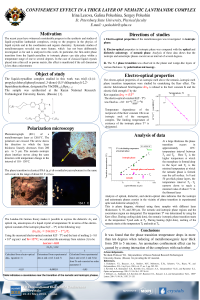
iecc2018_Poster_Irina_Lezova_fin.pdf
Quasicrystal model as framework for an order to disorder transitions in 2D systems.
Exploiting superspace to enable DFT calculations of modulated structures with disordered sites using the example of mullite