Event submissions
EventsMOL2NET'18, Conference on Molecular, Biomed., Comput. & Network Science and Engineering, 4th ed.
Published

This submission belongs to the session 02. USEDAT-04: USA-Europe Data Analysis Training Program Workshop, Cambridge, UK-Bilbao, Spain-Miami, USA, 2018 of the event MOL2NET'18, Conference on Molecular, Biomed., Comput. & Network Science and Engineering, 4th ed.
Published date
07 Jun, 2018
Citation
Laura Machin, Luis Alberto Torres-Gomez, Prediction of pH-dependent aqueous solubility of druglike molecules of different chemical behavior, in Proceedings of MOL2NET'18, Conference on Molecular, Biomed., Comput. & Network Science and Engineering, 4th ed., 15 January 2018–20 January 2019, MDPI: Basel, Switzerland, doi: 10.3390/mol2net-04-05308
Share
Email
Facebook
Twitter
LinkedIn
Prediction of pH-dependent aqueous solubility of druglike molecules of different chemical behavior

Laura Machin 1
'%3e%3cpath%20d='M12.6647%2010.9104C12.4176%2010.325%2012.0589%209.7933%2011.6088%209.34485C11.16%208.89511%2010.6283%208.53653%2010.0432%208.28891C10.038%208.28629%2010.0327%208.28498%2010.0275%208.28236C10.8437%207.69282%2011.3743%206.73252%2011.3743%205.64907C11.3743%203.85423%209.92005%202.40002%208.12522%202.40002C6.33038%202.40002%204.87618%203.85423%204.87618%205.64907C4.87618%206.73252%205.40677%207.69282%206.22296%208.28367C6.21772%208.28629%206.21248%208.2876%206.20724%208.29022C5.62031%208.53783%205.09365%208.89287%204.64167%209.34616C4.19192%209.79496%203.83334%2010.3266%203.58573%2010.9117C3.34247%2011.4846%203.21128%2012.0987%203.19925%2012.721C3.1989%2012.735%203.20135%2012.7489%203.20646%2012.7619C3.21157%2012.7749%203.21924%2012.7868%203.22901%2012.7968C3.23877%2012.8068%203.25045%2012.8148%203.26334%2012.8202C3.27623%2012.8256%203.29007%2012.8284%203.30406%2012.8284H4.09012C4.14776%2012.8284%204.19362%2012.7825%204.19493%2012.7262C4.22113%2011.7148%204.62726%2010.7676%205.34519%2010.0497C6.08802%209.30686%207.07452%208.89811%208.12522%208.89811C9.17592%208.89811%2010.1624%209.30686%2010.9052%2010.0497C11.6232%2010.7676%2012.0293%2011.7148%2012.0555%2012.7262C12.0568%2012.7839%2012.1027%2012.8284%2012.1603%2012.8284H12.9464C12.9604%2012.8284%2012.9742%2012.8256%2012.9871%2012.8202C13%2012.8148%2013.0117%2012.8068%2013.0214%2012.7968C13.0312%2012.7868%2013.0389%2012.7749%2013.044%2012.7619C13.0491%2012.7489%2013.0515%2012.735%2013.0512%2012.721C13.0381%2012.0947%2012.9084%2011.4856%2012.6647%2010.9104ZM8.12522%207.90243C7.52388%207.90243%206.95792%207.66793%206.53214%207.24215C6.10636%206.81636%205.87185%206.2504%205.87185%205.64907C5.87185%205.04773%206.10636%204.48177%206.53214%204.05599C6.95792%203.63021%207.52388%203.3957%208.12522%203.3957C8.72655%203.3957%209.29252%203.63021%209.7183%204.05599C10.1441%204.48177%2010.3786%205.04773%2010.3786%205.64907C10.3786%206.2504%2010.1441%206.81636%209.7183%207.24215C9.29252%207.66793%208.72655%207.90243%208.12522%207.90243Z'%20fill='%235D1EE1'/%3e%3c/g%3e%3c/svg%3e)
Luis Alberto Torres-Gomez 1
1. Department of Pharmacy. Institute of Pharmacy and Foods. University of the Havana
Abstract
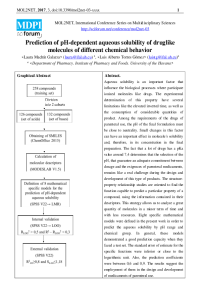
Aqueous solubility is an important factor that influence the biological processes where participate ionized molecules like drugs. The experimental determination of this property have several limitations like the elevated inverted time, as well as the consumption of considerable quantities of product. Among the requirements of the drugs of parenteral use, the pH of the final formulation must be close to normality. Small changes in this factor can have an important effect in molecule´s solubility and, therefore, in its concentration in the final preparation. The fact that a lot of drugs has a pKa value around 7,4 determines that the selection of the pH, that guarantee an adequate commitment between dosage and the exigences of parenteral medicaments, remains like a real challenge during the design and development of this type of products. The structure-property relationship studies are oriented to find the function capable to predict a particular property of a compound, using the information contained in their descriptors. This strategy allows us to analyze a great quantity of molecules in a minor term of time and with less resources. Fourteen local models and four global ones were defined in the present work in order to predict the aqueous solubility by pH range and chemical group. In general, the local models demonstrated a better prediction capacity with respect to the global ones. The standard error of estimate for the local functions were inferior or close to the logarithmic unit. Also, the prediction coefficients were between 0,6 and 0,9. The results suggest the employment of them in the design and development of medicaments of parenteral use.
Keywords
solubility
pH
prediction
drugs
Poster
mol2net-03_MOL2NET-2018-Laura Machin, Luis A. Torres.pdf
LA PERSEGUIBILIDAD DE LOS DELITOS SEMIPÚBLICOS Y SU INJERENCIA EN EL ÁMBITO DE LOS DELITOS DE ABUSO Y AGRESIÓN SEXUAL: UNA REFLEXIÓN
Multivariate classification of a series of organic compounds of pharmaceutical interest using MODESLAB methodology