Event submissions
Published

This submission belongs to the session E. Non-Destructive Characterization of Geologic Materials of the event 1st International Electronic Conference on Geosciences
Published date
13 Jun, 2018
Citation
Carlos Figueiredo, Carlos Alves, Principal Components Analysis (PCA) of Monument Stone Decay by Rainwater: a case study of “Basílica da Estrela” church, Portugal, in Proceedings of 1st International Electronic Conference on Geosciences, 15 June–30 June 2018, MDPI: Basel, Switzerland, doi: 10.3390/IECG_2018-05339
Share
Email
Facebook
Twitter
LinkedIn
Principal Components Analysis (PCA) of Monument Stone Decay by Rainwater: a case study of “Basílica da Estrela” church, Portugal
'%3e%3cpath%20d='M12.6647%2010.9104C12.4176%2010.325%2012.0589%209.7933%2011.6088%209.34485C11.16%208.89511%2010.6283%208.53653%2010.0432%208.28891C10.038%208.28629%2010.0327%208.28498%2010.0275%208.28236C10.8437%207.69282%2011.3743%206.73252%2011.3743%205.64907C11.3743%203.85423%209.92005%202.40002%208.12522%202.40002C6.33038%202.40002%204.87618%203.85423%204.87618%205.64907C4.87618%206.73252%205.40677%207.69282%206.22296%208.28367C6.21772%208.28629%206.21248%208.2876%206.20724%208.29022C5.62031%208.53783%205.09365%208.89287%204.64167%209.34616C4.19192%209.79496%203.83334%2010.3266%203.58573%2010.9117C3.34247%2011.4846%203.21128%2012.0987%203.19925%2012.721C3.1989%2012.735%203.20135%2012.7489%203.20646%2012.7619C3.21157%2012.7749%203.21924%2012.7868%203.22901%2012.7968C3.23877%2012.8068%203.25045%2012.8148%203.26334%2012.8202C3.27623%2012.8256%203.29007%2012.8284%203.30406%2012.8284H4.09012C4.14776%2012.8284%204.19362%2012.7825%204.19493%2012.7262C4.22113%2011.7148%204.62726%2010.7676%205.34519%2010.0497C6.08802%209.30686%207.07452%208.89811%208.12522%208.89811C9.17592%208.89811%2010.1624%209.30686%2010.9052%2010.0497C11.6232%2010.7676%2012.0293%2011.7148%2012.0555%2012.7262C12.0568%2012.7839%2012.1027%2012.8284%2012.1603%2012.8284H12.9464C12.9604%2012.8284%2012.9742%2012.8256%2012.9871%2012.8202C13%2012.8148%2013.0117%2012.8068%2013.0214%2012.7968C13.0312%2012.7868%2013.0389%2012.7749%2013.044%2012.7619C13.0491%2012.7489%2013.0515%2012.735%2013.0512%2012.721C13.0381%2012.0947%2012.9084%2011.4856%2012.6647%2010.9104ZM8.12522%207.90243C7.52388%207.90243%206.95792%207.66793%206.53214%207.24215C6.10636%206.81636%205.87185%206.2504%205.87185%205.64907C5.87185%205.04773%206.10636%204.48177%206.53214%204.05599C6.95792%203.63021%207.52388%203.3957%208.12522%203.3957C8.72655%203.3957%209.29252%203.63021%209.7183%204.05599C10.1441%204.48177%2010.3786%205.04773%2010.3786%205.64907C10.3786%206.2504%2010.1441%206.81636%209.7183%207.24215C9.29252%207.66793%208.72655%207.90243%208.12522%207.90243Z'%20fill='%235D1EE1'/%3e%3c/g%3e%3c/svg%3e)
Carlos Figueiredo 1

Carlos Alves 2
1. CERENA - Centro de Recursos Naturais e Ambiente, Instituto Superior Técnico, University of Lisbon, Portugal
2. LandS/Lab2PT and Earth Sciences Department, School of Sciences, University of Minho, Portugal
Abstract
An extended version of Principal Components Analysis (PCA) of monument stone decay phenomena occurring at “Basilica da Estrela” church, Lisbon, Portugal, is now presented. This one results from previous studies based mainly on a combined application of multivariate statistical analysis and some traditional geochemical tools. The rationale and the general methodological procedures used in PCA will now be presented, as a first step of a stepwise approach to the eigenvector methods of data analysis. With the insights gained we hope to be able to understand and interpret better the results so obtained. PCA, as others “factor analysis” and Eigenvector Methods”, seeks to reveals the presumably simple underlying structure that might exist within a set of multivariate observations. This knowledge could help us to strengthen, supplement and validate the conclusions obtained from the traditional geochemical approach and can be considered a NDT tool for the characterization of alteration of geologic materials in the built environment as it does not involve the extraction of samples from those materials. The data set studied gathers information on seepage water samples collected over three years inside “Basilica da Estrela” (seepage waters derived from rainwater that penetrated and percolate the monument changing its composition through water-rock interactions). Precipitation of some of their dissolved components due saturation and/or evaporation along the monument percolating system contributed also for their final chemical and physical properties. Temperature, pH, electrical conductivity, SiO2 and main ionic species were measured on each sample.
Keywords
Built environment
water-induced alteration processes
monument stone decay
multivariate data
Principal Components Analysis.
Manuscript
E-conference_Figueiredo_&_Alves_IECG_2018_NDT.pdf
Poster
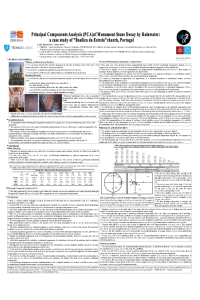
sciforum-019194_E-conference_Figueiredo_&_Alves_IECG_2018_NDT_final.pdf
Multi-cycle statistical analysis of laboratory salt weathering tests
In defense of stamp collecting: the importance of case studies for Geology teaching