Event submissions
Published

This submission belongs to the session C. Planetary Geology and Earth Analogs of the event 1st International Electronic Conference on Geosciences
Published date
29 Jun, 2018
Citation
Mayssa El Yazidi, Matteo Massironi, Riccardo Pozzobon, Stefano Debei, Faults mapping in Noctis Labyrinthus area, in Proceedings of 1st International Electronic Conference on Geosciences, 15 June–30 June 2018, MDPI: Basel, Switzerland, doi: 10.3390/IECG_2018-05410
Share
Email
Facebook
Twitter
LinkedIn
Faults mapping in Noctis Labyrinthus area
'%3e%3cpath%20d='M12.6647%2010.9104C12.4176%2010.325%2012.0589%209.7933%2011.6088%209.34485C11.16%208.89511%2010.6283%208.53653%2010.0432%208.28891C10.038%208.28629%2010.0327%208.28498%2010.0275%208.28236C10.8437%207.69282%2011.3743%206.73252%2011.3743%205.64907C11.3743%203.85423%209.92005%202.40002%208.12522%202.40002C6.33038%202.40002%204.87618%203.85423%204.87618%205.64907C4.87618%206.73252%205.40677%207.69282%206.22296%208.28367C6.21772%208.28629%206.21248%208.2876%206.20724%208.29022C5.62031%208.53783%205.09365%208.89287%204.64167%209.34616C4.19192%209.79496%203.83334%2010.3266%203.58573%2010.9117C3.34247%2011.4846%203.21128%2012.0987%203.19925%2012.721C3.1989%2012.735%203.20135%2012.7489%203.20646%2012.7619C3.21157%2012.7749%203.21924%2012.7868%203.22901%2012.7968C3.23877%2012.8068%203.25045%2012.8148%203.26334%2012.8202C3.27623%2012.8256%203.29007%2012.8284%203.30406%2012.8284H4.09012C4.14776%2012.8284%204.19362%2012.7825%204.19493%2012.7262C4.22113%2011.7148%204.62726%2010.7676%205.34519%2010.0497C6.08802%209.30686%207.07452%208.89811%208.12522%208.89811C9.17592%208.89811%2010.1624%209.30686%2010.9052%2010.0497C11.6232%2010.7676%2012.0293%2011.7148%2012.0555%2012.7262C12.0568%2012.7839%2012.1027%2012.8284%2012.1603%2012.8284H12.9464C12.9604%2012.8284%2012.9742%2012.8256%2012.9871%2012.8202C13%2012.8148%2013.0117%2012.8068%2013.0214%2012.7968C13.0312%2012.7868%2013.0389%2012.7749%2013.044%2012.7619C13.0491%2012.7489%2013.0515%2012.735%2013.0512%2012.721C13.0381%2012.0947%2012.9084%2011.4856%2012.6647%2010.9104ZM8.12522%207.90243C7.52388%207.90243%206.95792%207.66793%206.53214%207.24215C6.10636%206.81636%205.87185%206.2504%205.87185%205.64907C5.87185%205.04773%206.10636%204.48177%206.53214%204.05599C6.95792%203.63021%207.52388%203.3957%208.12522%203.3957C8.72655%203.3957%209.29252%203.63021%209.7183%204.05599C10.1441%204.48177%2010.3786%205.04773%2010.3786%205.64907C10.3786%206.2504%2010.1441%206.81636%209.7183%207.24215C9.29252%207.66793%208.72655%207.90243%208.12522%207.90243Z'%20fill='%235D1EE1'/%3e%3c/g%3e%3c/svg%3e)
Mayssa El Yazidi 1

Matteo Massironi 1,2
Riccardo Pozzobon 1,2
Stefano Debei 1
1. Centro di Ateneo di Studi e Attività Spaziali "Giuseppe Colombo" - CISAS. Via Venezia 15, 35131Padova, Italy.
2. Dipartimento di Geoscienze, Universita degli Studi di Padova, via Gradenigo 6, 35131 Padova, Italy.
Abstract
Noctis Labyrinthus is a region located in the western part of Valles Marineris, bordering Syria Planum to the north and it’s a part of the Phoenicis Lacus quadrangle on Mars. The faulting of this region is not yet well understood being made up of intersecting canyons and complex branched networks of faults and extensional grabens. We have mapped all the lineaments on a given portion of the Noctis Labyrinthus (Defined by the coordinates ''6.36 ° S, 258.81 ° ''E on the surface of Mars and bordered with Noctis Fossae on NE and with Syria Planum and Syria Colles on S-SE) on images from the CTX camera of Mars Reconnaissance Orbiter. In particular , we have drawn on different scales faults, scarps and grabens and we have checked their orientation using rose diagrams. The Rose diagrams show at all scales two main trends of faults: ENE-WSW and N-S that do not show a preferential cross-cutting relationship of one direction over the other. This seems to support a coeval development of the two systems potentially generated in response of a bidirectional or a radial extension. Particularly relevant are the pits which can be find within the tip and at the margin of the Noctis Labyrinthus grabens. They seem due to the tectonics process of graben propagation more than cratering phenomena and thus might give hints on the rheological subsurface layering which underwent the extensional deformation.
Keywords
Mars
Noctis Labyrinthus
Faults
Grabens
Rose diagrams
Cross-cutting relationship
Extension
Pits
Manuscript
Faults Mapping in Noctis Labyrinthus Area - IECG.pdf
Poster
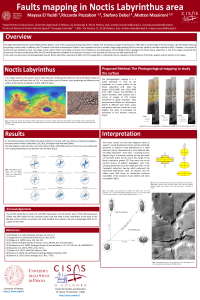
Faults Mapping in Noctis Labyrinthus Area - IECG.pdf
Martian Analogue of Pampas de La Joya: an update and future implications