Event submissions
Published

This submission belongs to the session C. Mineral Deposits of the event The 1st International Electronic Conference on Mineral Science
Published date
26 Jul, 2018
Citation
Michalis Fitros, Stylianos Tombros, Xenofon Christos Simos, Sotirios Kokkalas, Konstanin Hatzipanagiotou, Formation of Mn-skarn Ores at Thapsana Mines, Paros Island, Attico-Cycladic Metallogenetic Massif, Greece , in Proceedings of The 1st International Electronic Conference on Mineral Science, 16 July–31 July 2018, MDPI: Basel, Switzerland, doi: 10.3390/IECMS2018-05461
Share
Email
Facebook
Twitter
LinkedIn
Formation of Mn-skarn Ores at Thapsana Mines, Paros Island, Attico-Cycladic Metallogenetic Massif, Greece
'%3e%3cpath%20d='M12.6647%2010.9104C12.4176%2010.325%2012.0589%209.7933%2011.6088%209.34485C11.16%208.89511%2010.6283%208.53653%2010.0432%208.28891C10.038%208.28629%2010.0327%208.28498%2010.0275%208.28236C10.8437%207.69282%2011.3743%206.73252%2011.3743%205.64907C11.3743%203.85423%209.92005%202.40002%208.12522%202.40002C6.33038%202.40002%204.87618%203.85423%204.87618%205.64907C4.87618%206.73252%205.40677%207.69282%206.22296%208.28367C6.21772%208.28629%206.21248%208.2876%206.20724%208.29022C5.62031%208.53783%205.09365%208.89287%204.64167%209.34616C4.19192%209.79496%203.83334%2010.3266%203.58573%2010.9117C3.34247%2011.4846%203.21128%2012.0987%203.19925%2012.721C3.1989%2012.735%203.20135%2012.7489%203.20646%2012.7619C3.21157%2012.7749%203.21924%2012.7868%203.22901%2012.7968C3.23877%2012.8068%203.25045%2012.8148%203.26334%2012.8202C3.27623%2012.8256%203.29007%2012.8284%203.30406%2012.8284H4.09012C4.14776%2012.8284%204.19362%2012.7825%204.19493%2012.7262C4.22113%2011.7148%204.62726%2010.7676%205.34519%2010.0497C6.08802%209.30686%207.07452%208.89811%208.12522%208.89811C9.17592%208.89811%2010.1624%209.30686%2010.9052%2010.0497C11.6232%2010.7676%2012.0293%2011.7148%2012.0555%2012.7262C12.0568%2012.7839%2012.1027%2012.8284%2012.1603%2012.8284H12.9464C12.9604%2012.8284%2012.9742%2012.8256%2012.9871%2012.8202C13%2012.8148%2013.0117%2012.8068%2013.0214%2012.7968C13.0312%2012.7868%2013.0389%2012.7749%2013.044%2012.7619C13.0491%2012.7489%2013.0515%2012.735%2013.0512%2012.721C13.0381%2012.0947%2012.9084%2011.4856%2012.6647%2010.9104ZM8.12522%207.90243C7.52388%207.90243%206.95792%207.66793%206.53214%207.24215C6.10636%206.81636%205.87185%206.2504%205.87185%205.64907C5.87185%205.04773%206.10636%204.48177%206.53214%204.05599C6.95792%203.63021%207.52388%203.3957%208.12522%203.3957C8.72655%203.3957%209.29252%203.63021%209.7183%204.05599C10.1441%204.48177%2010.3786%205.04773%2010.3786%205.64907C10.3786%206.2504%2010.1441%206.81636%209.7183%207.24215C9.29252%207.66793%208.72655%207.90243%208.12522%207.90243Z'%20fill='%235D1EE1'/%3e%3c/g%3e%3c/svg%3e)
Michalis Fitros 1
Stylianos Tombros 1
Xenofon Christos Simos 1
Sotirios Kokkalas 2
Konstanin Hatzipanagiotou 1
1. Department of Geology, University of Patras, Rion, 26500, Patras, Greece
2. Department of Geology, University of Patras, Rion, 26500, Patras, Greece and Department of Geosciences, The Petroleum Institute, Khalifa University of Science and Technology, 2533, Abu Dhabi, UAE
Abstract
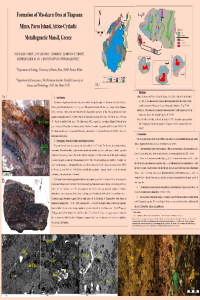
Mn-skarn ore deposits are relatively infrequent worldwide. A typical example of a Mn-skarn in the Attico-Cycladic Metallogenetic Massif is located at the mining area of Thapsana, Paros Island. The skarn occurs adjusted to the Thapsana biotite-garnet-tourmaline-lepidolite, highly sericitized, leucogranite apophyses of the Paros granitoid and related pegmatites and aplites dated from 11.5 to 7.5 Ma. The Mn-skarns orebodies occur as lenses and NE-trending veins hosted in the Cyclades Blueschist Unit (CBU) marbles and intercalated calcic schists. They comprise two discontinuous paragenetic zones (with widths of ≤ 10 m): A zone contain vesuvianite, Mn-enriched salite to johannsenite-diopside and spessartine with cores enriched in grossular component (Sps~75Grs~15) placed close to the Thapsana leucogranite and a zone of grossular (Sps~85Grs~5), actinolite to Mn-cummingtonite (with Mn ~ 0.6 apfu) and phlogopite more distal from the leucogranite. The Mn-skarns are crosscut by later WNW- to W-trending veins filled with Ca-K-Mg-bearing pyrolusite, manganite, rhodonite and rhodochrosite, carbonates, hydroxylapatite and johnbaumite.
The Mn-ores occur as massive aggregates or disseminated comprising jacobsite, hausmannite, Mn- enriched magnetite, braunite and hollandite (with crystals of ≤ 4cm). Occasionally jacobsite and hausmanite display oriented intergrowths. The ore paragenesis also includes secondary pyrolusite, manganite, rhodonite, rhodochrosite, cryptomelane, manjiroite, vernadite and supergene Fe-oxides. Geothermo-oxygen-barometry suggests that the main zones of the Mn-skarns at Thapsana have been formed at temperatures ranging from ~ 440º to ~ 510ºC, pressures of 0.11 to 0.12 GPa and logfO2 values just below the magnetite-hematite buffer. Almost constant average isotopic compositions obtained from the Mn-ores (n = 10) of δ44CaBSE and δ26MgDSM-3 of 0.5 ± 0.05 and -0.6 ± 0.1 and δ18O and δD of 7.2 ± 0.5 and -92 ± 2 per mil, suggest a magmatic source for the metasomatic ore fluids related to the Thapsana leucogranite which have also interacted and isotopically equilibrated with the host CBU marbles.
Keywords
Mn-skarn ores
Thapsana
Paros Island
Cyclades
Manuscript
020851.pdf
Poster
poster-7.26.pdf
Cr release from Cr-substituted goethite during the aqueous Fe(II)-induced recrystallization
Nano precipitates formed during the dissolution of calcite incorporated with Cu and Mn