Event submissions
Published

This submission belongs to the session F. Posters of the event The 1st International Online Conference on Nanomaterials
Published date
03 Sep, 2018
Citation
Violeta-Carolina Niculescu, Nicolae Aldea, Vasile Rednic, Simona Somacescu, Viorica Parvulescu, Design and use of nanostructured heterogeneous catalysts for the unsaturated alcohols selective oxidation, in Proceedings of The 1st International Online Conference on Nanomaterials, 1 September–15 September 2018, MDPI: Basel, Switzerland, doi: 10.3390/IOCN_2018-1-05496
Share
Email
Facebook
Twitter
LinkedIn
Design and use of nanostructured heterogeneous catalysts for the unsaturated alcohols selective oxidation

Violeta-Carolina Niculescu 1
'%3e%3cpath%20d='M12.6647%2010.9104C12.4176%2010.325%2012.0589%209.7933%2011.6088%209.34485C11.16%208.89511%2010.6283%208.53653%2010.0432%208.28891C10.038%208.28629%2010.0327%208.28498%2010.0275%208.28236C10.8437%207.69282%2011.3743%206.73252%2011.3743%205.64907C11.3743%203.85423%209.92005%202.40002%208.12522%202.40002C6.33038%202.40002%204.87618%203.85423%204.87618%205.64907C4.87618%206.73252%205.40677%207.69282%206.22296%208.28367C6.21772%208.28629%206.21248%208.2876%206.20724%208.29022C5.62031%208.53783%205.09365%208.89287%204.64167%209.34616C4.19192%209.79496%203.83334%2010.3266%203.58573%2010.9117C3.34247%2011.4846%203.21128%2012.0987%203.19925%2012.721C3.1989%2012.735%203.20135%2012.7489%203.20646%2012.7619C3.21157%2012.7749%203.21924%2012.7868%203.22901%2012.7968C3.23877%2012.8068%203.25045%2012.8148%203.26334%2012.8202C3.27623%2012.8256%203.29007%2012.8284%203.30406%2012.8284H4.09012C4.14776%2012.8284%204.19362%2012.7825%204.19493%2012.7262C4.22113%2011.7148%204.62726%2010.7676%205.34519%2010.0497C6.08802%209.30686%207.07452%208.89811%208.12522%208.89811C9.17592%208.89811%2010.1624%209.30686%2010.9052%2010.0497C11.6232%2010.7676%2012.0293%2011.7148%2012.0555%2012.7262C12.0568%2012.7839%2012.1027%2012.8284%2012.1603%2012.8284H12.9464C12.9604%2012.8284%2012.9742%2012.8256%2012.9871%2012.8202C13%2012.8148%2013.0117%2012.8068%2013.0214%2012.7968C13.0312%2012.7868%2013.0389%2012.7749%2013.044%2012.7619C13.0491%2012.7489%2013.0515%2012.735%2013.0512%2012.721C13.0381%2012.0947%2012.9084%2011.4856%2012.6647%2010.9104ZM8.12522%207.90243C7.52388%207.90243%206.95792%207.66793%206.53214%207.24215C6.10636%206.81636%205.87185%206.2504%205.87185%205.64907C5.87185%205.04773%206.10636%204.48177%206.53214%204.05599C6.95792%203.63021%207.52388%203.3957%208.12522%203.3957C8.72655%203.3957%209.29252%203.63021%209.7183%204.05599C10.1441%204.48177%2010.3786%205.04773%2010.3786%205.64907C10.3786%206.2504%2010.1441%206.81636%209.7183%207.24215C9.29252%207.66793%208.72655%207.90243%208.12522%207.90243Z'%20fill='%235D1EE1'/%3e%3c/g%3e%3c/svg%3e)
Nicolae Aldea 2
Vasile Rednic 2
Simona Somacescu 3
Viorica Parvulescu 4
1. National Research and Development for Cryogenics and Isotopic Technologies -ICSI Ramnicu Valcea
2. National Institute for Research and Development of Isotopic and Molecular Technologies
3. ”Ilie Murgulescu” Institute of Physical Chemistry, Romanian Academy
4. “Ilie Murgulescu” Institute of Physical Chemistry, Bucharest, Romania
Abstract
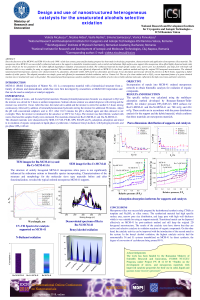
Since the discovery of the MCM-41 and FSM-16 in the early 1990`s of the last century, great and fascinating progress has been made in the design, preparation, characterisation and application of mesoporous silica materials. The mesoporous silica MCM-41 was successfully synthesized and used as the support to immobilize transition metals, such as nickel and ruthenium. High-surface-area supports like mesoporous silica afford highly dispersed metal oxide species which are the key parameter in the rather difficult liquid-phase oxidation of cyclohexene. The synthesized material has high specific surface area, narrow pore size distribution, and large pore with high wall thickness which is very suitable for using as support material. The transitional metals were effectively dispersed on MCM-41 by the direct synthesis method and kept the original 2D hexagonal mesostructure. The obtained nanostructured heterogeneous catalysts were characterized by N2 adsorption, ultraviolet-visible, XPS and X-ray absorption spectroscopy. X-ray absorption spectroscopy showed the presence of Ru-O bonds, suggesting a higher number of oxidic species. The adopted procedure was simple, green and efficient for unsaturated alcohols oxidation, such as 1-buten-3-ol. The use of a clean oxidant such as H2O2, was an important feature of a green chemical reaction since it resulted only water as by-product. The nanostructured heterogeneous catalysts enabled a better accessibility of active sites to bulky substrate molecules, reflected in the high conversions and better selectivity.
Keywords
alcohol
catalyst
mesoporous silica
nanostructure
selective oxidation
Poster
V_Niculescu.pdf
Structural and Optical characteristics of PVA:C-Dot composites: Tuning the absorption of Ultra Violet (UV) region
Efficient and eco-friendly mechanical milling preparation of anatase/rutile TiO2-Glucose composite with energy gap enhancement