Event submissions
EventsMOL2NET'18, Conference on Molecular, Biomed., Comput. & Network Science and Engineering, 4th ed.
Published

This submission belongs to the session 05. MODEC-03: Workshop on Natural Products and Agro-Industrial Procesess in Amazon, UEA, Puyo, Ecuador, 2018 of the event MOL2NET'18, Conference on Molecular, Biomed., Comput. & Network Science and Engineering, 4th ed.
Published date
14 Sep, 2018
Citation
Francisca Sabrina Lins, Josean Fechine Tavares, Marcelo Sobral da Silva, José Iranildo de Melo, George Luis Santos, Joanda Paolla Silva, Laiane Caline Pereira, Lucas Silva Abreu, Chemical constituents isolated from Mandevilla dardonoi (Apocynaceae), in Proceedings of MOL2NET'18, Conference on Molecular, Biomed., Comput. & Network Science and Engineering, 4th ed., 15 January 2018–20 January 2019, MDPI: Basel, Switzerland, doi: 10.3390/mol2net-04-05510
Share
Email
Facebook
Twitter
LinkedIn
Chemical constituents isolated from Mandevilla dardonoi (Apocynaceae)
'%3e%3cpath%20d='M12.6647%2010.9104C12.4176%2010.325%2012.0589%209.7933%2011.6088%209.34485C11.16%208.89511%2010.6283%208.53653%2010.0432%208.28891C10.038%208.28629%2010.0327%208.28498%2010.0275%208.28236C10.8437%207.69282%2011.3743%206.73252%2011.3743%205.64907C11.3743%203.85423%209.92005%202.40002%208.12522%202.40002C6.33038%202.40002%204.87618%203.85423%204.87618%205.64907C4.87618%206.73252%205.40677%207.69282%206.22296%208.28367C6.21772%208.28629%206.21248%208.2876%206.20724%208.29022C5.62031%208.53783%205.09365%208.89287%204.64167%209.34616C4.19192%209.79496%203.83334%2010.3266%203.58573%2010.9117C3.34247%2011.4846%203.21128%2012.0987%203.19925%2012.721C3.1989%2012.735%203.20135%2012.7489%203.20646%2012.7619C3.21157%2012.7749%203.21924%2012.7868%203.22901%2012.7968C3.23877%2012.8068%203.25045%2012.8148%203.26334%2012.8202C3.27623%2012.8256%203.29007%2012.8284%203.30406%2012.8284H4.09012C4.14776%2012.8284%204.19362%2012.7825%204.19493%2012.7262C4.22113%2011.7148%204.62726%2010.7676%205.34519%2010.0497C6.08802%209.30686%207.07452%208.89811%208.12522%208.89811C9.17592%208.89811%2010.1624%209.30686%2010.9052%2010.0497C11.6232%2010.7676%2012.0293%2011.7148%2012.0555%2012.7262C12.0568%2012.7839%2012.1027%2012.8284%2012.1603%2012.8284H12.9464C12.9604%2012.8284%2012.9742%2012.8256%2012.9871%2012.8202C13%2012.8148%2013.0117%2012.8068%2013.0214%2012.7968C13.0312%2012.7868%2013.0389%2012.7749%2013.044%2012.7619C13.0491%2012.7489%2013.0515%2012.735%2013.0512%2012.721C13.0381%2012.0947%2012.9084%2011.4856%2012.6647%2010.9104ZM8.12522%207.90243C7.52388%207.90243%206.95792%207.66793%206.53214%207.24215C6.10636%206.81636%205.87185%206.2504%205.87185%205.64907C5.87185%205.04773%206.10636%204.48177%206.53214%204.05599C6.95792%203.63021%207.52388%203.3957%208.12522%203.3957C8.72655%203.3957%209.29252%203.63021%209.7183%204.05599C10.1441%204.48177%2010.3786%205.04773%2010.3786%205.64907C10.3786%206.2504%2010.1441%206.81636%209.7183%207.24215C9.29252%207.66793%208.72655%207.90243%208.12522%207.90243Z'%20fill='%235D1EE1'/%3e%3c/g%3e%3c/svg%3e)
Francisca Sabrina Lins 1
Josean Fechine Tavares 1
Marcelo Sobral da Silva 1
José Iranildo de Melo 2
George Luis Santos 1
Joanda Paolla Silva 1
Laiane Caline Pereira 1

Lucas Silva Abreu 1
1. Federal University of Paraiba
2. State University of Paraiba
Abstract
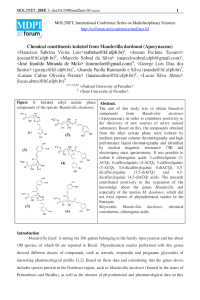
Mandevilla Lindl. is among the 366 genera belonging to the family Apocynaceae and has about 190 species, of which 66 are reported in Brazil. Phytochemical studies of extracts of the tuberous roots of species of this genus showed different classes of compounds, such as steroids, terpenoids and pregnane glycosides of interesting pharmacological profile, such as in vivo anti-inflammatory activity. Based on this, a phytochemical study of the roots of Mandevilla dardonoi, found in the Northeast region of the country, was carried out . The botanical material was collected in Serra do Jatobá (Serra Branca-Paraíba, 07◦29'00 ''S, 36◦39'54 "), identified by Prof. Dr. José Iranildo Miranda de Melo, Department of Biological Sciences, State University of Paraíba and deposited in the Herbarium Manuel de Arruda Câmara (exsicata number 1663). The roots were dried in an air circulation oven at an average temperature of 40 ° C, ground in a mechanical mill and subjected to maceration with 95% EtOH, giving the ethanolic extract of M. dardonoi (EEBMd-303g). The extract was partitioned and 2.8 g of the AcOEt phase were chromatographed on a silica gel 60 column, giving 32 fractions. The fractions 22-30 (35mg) were pooled and subjected to semi-preparative High Performance Liquid Chromatography (mobile phase water acidified with 0.1% formic acid / methanol), from which 6 substances were isolated. Afterwards, the data were analyzed using the following methods: ¹H-NMR (Brucker, 400 MHz, CD3OD) and Mass Spectrometry by Electrospray (Bruker, microTOF II-Ion-Trap AmazonX), which allowed the identification of 6 chlorogenic acids: 3-O-caffeoylquinic acid, 4-O-caffeoylquinic acid, 5-O-caffeoylquinic acid, 3,4-dicaffeoylquinic acid, 4,5- dicaffeoylquinic acid and 5,6- dicaffeoylquinic acid.
Keywords
Apocynaceae
Mandevilla dardonoi
chlorogenic acids
Poster
Tamplate sabrina.pdf
SUSTAINABILITY TRANSFORMATION IN TEACHING ORGANIC CHEMISTRY LABORATORY AT UNIVERSITY OF THE BASQUE COUNTRY
PREDICTIVE LIGNIN DEGRADATION STATISTICAL MODEL