Event submissions
EventsMOL2NET'18, Conference on Molecular, Biomed., Comput. & Network Science and Engineering, 4th ed.
Published

This submission belongs to the session 06. CHEMBIOMOL-04: Chem. Biol. & Med. Chem. Workshop, Paraiba, Porto, Rostock, Germany-Galveston, Texas, USA, 2018 of the event MOL2NET'18, Conference on Molecular, Biomed., Comput. & Network Science and Engineering, 4th ed.
Published date
25 Oct, 2018
Citation
Laiane Batista Gonçalves, Brenda de Oliveira Tavares, Fernanda Silva Galdino, José Isaac Alves de Andrade, Letícia Rodrigues de Abrantes, Maria Rita Araruna de Sousa, Paula Gabriela Figueiredo Lira, Lázaro Robson de Aráujo Brito Pereira, CARQUEJA: CHEMICAL COMPOSITION AND FRAMACOLOGICAL EFFECTS, in Proceedings of MOL2NET'18, Conference on Molecular, Biomed., Comput. & Network Science and Engineering, 4th ed., 15 January 2018–20 January 2019, MDPI: Basel, Switzerland, doi: 10.3390/mol2net-04-05540
Share
Email
Facebook
Twitter
LinkedIn
CARQUEJA: CHEMICAL COMPOSITION AND FRAMACOLOGICAL EFFECTS
'%3e%3cpath%20d='M12.6647%2010.9104C12.4176%2010.325%2012.0589%209.7933%2011.6088%209.34485C11.16%208.89511%2010.6283%208.53653%2010.0432%208.28891C10.038%208.28629%2010.0327%208.28498%2010.0275%208.28236C10.8437%207.69282%2011.3743%206.73252%2011.3743%205.64907C11.3743%203.85423%209.92005%202.40002%208.12522%202.40002C6.33038%202.40002%204.87618%203.85423%204.87618%205.64907C4.87618%206.73252%205.40677%207.69282%206.22296%208.28367C6.21772%208.28629%206.21248%208.2876%206.20724%208.29022C5.62031%208.53783%205.09365%208.89287%204.64167%209.34616C4.19192%209.79496%203.83334%2010.3266%203.58573%2010.9117C3.34247%2011.4846%203.21128%2012.0987%203.19925%2012.721C3.1989%2012.735%203.20135%2012.7489%203.20646%2012.7619C3.21157%2012.7749%203.21924%2012.7868%203.22901%2012.7968C3.23877%2012.8068%203.25045%2012.8148%203.26334%2012.8202C3.27623%2012.8256%203.29007%2012.8284%203.30406%2012.8284H4.09012C4.14776%2012.8284%204.19362%2012.7825%204.19493%2012.7262C4.22113%2011.7148%204.62726%2010.7676%205.34519%2010.0497C6.08802%209.30686%207.07452%208.89811%208.12522%208.89811C9.17592%208.89811%2010.1624%209.30686%2010.9052%2010.0497C11.6232%2010.7676%2012.0293%2011.7148%2012.0555%2012.7262C12.0568%2012.7839%2012.1027%2012.8284%2012.1603%2012.8284H12.9464C12.9604%2012.8284%2012.9742%2012.8256%2012.9871%2012.8202C13%2012.8148%2013.0117%2012.8068%2013.0214%2012.7968C13.0312%2012.7868%2013.0389%2012.7749%2013.044%2012.7619C13.0491%2012.7489%2013.0515%2012.735%2013.0512%2012.721C13.0381%2012.0947%2012.9084%2011.4856%2012.6647%2010.9104ZM8.12522%207.90243C7.52388%207.90243%206.95792%207.66793%206.53214%207.24215C6.10636%206.81636%205.87185%206.2504%205.87185%205.64907C5.87185%205.04773%206.10636%204.48177%206.53214%204.05599C6.95792%203.63021%207.52388%203.3957%208.12522%203.3957C8.72655%203.3957%209.29252%203.63021%209.7183%204.05599C10.1441%204.48177%2010.3786%205.04773%2010.3786%205.64907C10.3786%206.2504%2010.1441%206.81636%209.7183%207.24215C9.29252%207.66793%208.72655%207.90243%208.12522%207.90243Z'%20fill='%235D1EE1'/%3e%3c/g%3e%3c/svg%3e)
Laiane Batista Gonçalves 1
Brenda de Oliveira Tavares 1
Fernanda Silva Galdino 1
José Isaac Alves de Andrade 1
Letícia Rodrigues de Abrantes 1
Maria Rita Araruna de Sousa 1
Paula Gabriela Figueiredo Lira 1
Lázaro Robson de Aráujo Brito Pereira 1
1. Faculdade Santa Maria
Abstract
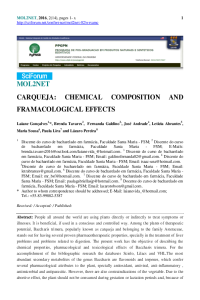
People all around the world are using plants directly or indirectly to treat symptoms or illnesses. It is beneficial, if used in a conscious and controlled way. Among the plants of therapeutic potential, Baccharis trimera, popularly known as carqueja and belonging to the family Asteraceae, stands out for having several proven pharmacotherapeutic properties, specially in the treatment of liver problems and problems related to digestion. The present work has the objective of describing the chemical properties, pharmacological and toxicological effects of Baccharis trimera. For the accomplishment of the bibliographic research the databases Scielo, Lilacs and VHL.The most abundant secondary metabolites of the genus Baccharis are flavonoids and terpenes, which confer several pharmacological attributes to the plant, specially antioxidant, antiviral, anti-inflammatory , antimicrobial and antiparasitic. However, there are also contraindications of the vegetable. Due to the abortive effect, the plant should not be consumed during gestation or lactation periods and, because of the hypotensive property, its consumption by hypotensive people is not recommended. Like other vegetables, the carqueja has benefits and harms. Therefore, before consuming plants and derivatives, one must be aware of its chemical properties and pharmacological effects, being necessary the orientation by a qualified professional to ensure a responsible and beneficial use.
Keywords
Baccharis
Asteraceae
Pharmacology.
Poster
MOL2NET-02_MOL2NET-pnsb-template .pdf
In silico analysis of cytotoxicity, rate of absorption and molecular docking of natural products against protease, integrase and HIV-1 reverse transcriptase
Synthesis of Lophirone C using coconut peroxidase