Event submissions
EventsMOL2NET'18, Conference on Molecular, Biomed., Comput. & Network Science and Engineering, 4th ed.
Published

This submission belongs to the session 05. MODEC-03: Workshop on Natural Products and Agro-Industrial Procesess in Amazon, UEA, Puyo, Ecuador, 2018 of the event MOL2NET'18, Conference on Molecular, Biomed., Comput. & Network Science and Engineering, 4th ed.
Published date
25 Oct, 2018
Citation
Bárbara Cabral, Jovelina Samara Ferreira Alves, Tays Amanda Felisberto Gonçalves, Priscilla Maria Pereira Maciel, Isac Almeida Medeiros, Silvana Maria Zucolotto, Phytochemical analysis of the hydroethanolic extract of peels from Passiflora edulis fo. flavicarpa Degener and potential vasorelaxant effect ex vivo., in Proceedings of MOL2NET'18, Conference on Molecular, Biomed., Comput. & Network Science and Engineering, 4th ed., 15 January 2018–20 January 2019, MDPI: Basel, Switzerland, doi: 10.3390/mol2net-04-05549
Share
Email
Facebook
Twitter
LinkedIn
Phytochemical analysis of the hydroethanolic extract of peels from Passiflora edulis fo. flavicarpa Degener and potential vasorelaxant effect ex vivo.
'%3e%3cpath%20d='M12.6647%2010.9104C12.4176%2010.325%2012.0589%209.7933%2011.6088%209.34485C11.16%208.89511%2010.6283%208.53653%2010.0432%208.28891C10.038%208.28629%2010.0327%208.28498%2010.0275%208.28236C10.8437%207.69282%2011.3743%206.73252%2011.3743%205.64907C11.3743%203.85423%209.92005%202.40002%208.12522%202.40002C6.33038%202.40002%204.87618%203.85423%204.87618%205.64907C4.87618%206.73252%205.40677%207.69282%206.22296%208.28367C6.21772%208.28629%206.21248%208.2876%206.20724%208.29022C5.62031%208.53783%205.09365%208.89287%204.64167%209.34616C4.19192%209.79496%203.83334%2010.3266%203.58573%2010.9117C3.34247%2011.4846%203.21128%2012.0987%203.19925%2012.721C3.1989%2012.735%203.20135%2012.7489%203.20646%2012.7619C3.21157%2012.7749%203.21924%2012.7868%203.22901%2012.7968C3.23877%2012.8068%203.25045%2012.8148%203.26334%2012.8202C3.27623%2012.8256%203.29007%2012.8284%203.30406%2012.8284H4.09012C4.14776%2012.8284%204.19362%2012.7825%204.19493%2012.7262C4.22113%2011.7148%204.62726%2010.7676%205.34519%2010.0497C6.08802%209.30686%207.07452%208.89811%208.12522%208.89811C9.17592%208.89811%2010.1624%209.30686%2010.9052%2010.0497C11.6232%2010.7676%2012.0293%2011.7148%2012.0555%2012.7262C12.0568%2012.7839%2012.1027%2012.8284%2012.1603%2012.8284H12.9464C12.9604%2012.8284%2012.9742%2012.8256%2012.9871%2012.8202C13%2012.8148%2013.0117%2012.8068%2013.0214%2012.7968C13.0312%2012.7868%2013.0389%2012.7749%2013.044%2012.7619C13.0491%2012.7489%2013.0515%2012.735%2013.0512%2012.721C13.0381%2012.0947%2012.9084%2011.4856%2012.6647%2010.9104ZM8.12522%207.90243C7.52388%207.90243%206.95792%207.66793%206.53214%207.24215C6.10636%206.81636%205.87185%206.2504%205.87185%205.64907C5.87185%205.04773%206.10636%204.48177%206.53214%204.05599C6.95792%203.63021%207.52388%203.3957%208.12522%203.3957C8.72655%203.3957%209.29252%203.63021%209.7183%204.05599C10.1441%204.48177%2010.3786%205.04773%2010.3786%205.64907C10.3786%206.2504%2010.1441%206.81636%209.7183%207.24215C9.29252%207.66793%208.72655%207.90243%208.12522%207.90243Z'%20fill='%235D1EE1'/%3e%3c/g%3e%3c/svg%3e)
Bárbara Cabral 1
Jovelina Samara Ferreira Alves 1
Tays Amanda Felisberto Gonçalves 2
Priscilla Maria Pereira Maciel 2
Isac Almeida Medeiros 2

Silvana Maria Zucolotto 1
1. Universidade Federal do Rio Grande do Norte
2. Universidade Federal da Paraíba
Abstract
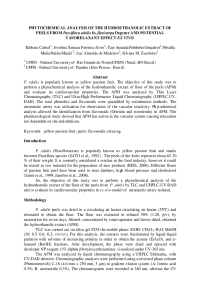
P. edulis fo. flavicarpa Degener (Passifloraceae) is popularly known as yellow passion. Peels of the fruits represent about 65-70 % of their weight. It is currently considered a residue in the food industry, however it could be reused as raw material for the preparation of new products. So, the objective of this study was to perform a phytochemical analysis of the hydroethanolic extract of the flour of the peels from P. edulis by TLC and HPLC-UV-DAD and to evaluate its cardiovascular properties in ex vivo model. The flour was extracted in ethanol 50%, by maceration for seven days, obtained the extract AFM. The AFM was analyzed by Thin Layer Chromatography (TLC) and liquid chromatography using a UHPLC, with UV-DAD detector. The total phenolics and flavonoids of the AFM extract was quantified by UV spectroscopy. The evaluation of the vasorelaxant effect of the extract was realized using superior mesenteric artery for observation of the vascular reactivity. Through TLC analyse was possible observe the presence of phenolic compounds, flavonoids and terpene derivatives. Some reference standards as orientin and isoorientin were used in TLC analyse and spots with Rf similar these compounds were observed in AFM extract. The qualitative analysis by UHPLC confirmed the presence of the flavonoids orientin and isoorientin when compared the TR with the reference standards. A phenolic content of 7.71 ± 0.12 mg/g and a flavonoid content of 3.5 ± 0.14 mg/g in AFM extract was verified. The pharmacological assays showed that AFM extract it has a relaxing effect in the artery containing functional endothelium (E+) reaching a (
Keywords
yellow passion fruit
peels
flavonoids
relaxing.
Poster
Resumo- Simpósio.pdf
Phytochemical study of Psidium araça Raddi
Antioxidant effects of chemical compounds in black tea