Event submissions
EventsMOL2NET'18, Conference on Molecular, Biomed., Comput. & Network Science and Engineering, 4th ed.
Published

This submission belongs to the session 09. NICEXSM-04: North-Ibero-American Congress on Exp. and Simul. Methods., Valencia, Spain-Talca, Chile-Miami, USA, 2018-2019 of the event MOL2NET'18, Conference on Molecular, Biomed., Comput. & Network Science and Engineering, 4th ed.
Published date
26 Oct, 2018
Citation
Ignacio Rosa-Pardo, Lorena Andrés-Olmos Andrés-Olmos, Alex Barreras-Peñalver, Jorge Gálvez, Ramón García-Domenech, Application of molecular topology to the research of analogues to the E-β-Farnesene for plant louse pest control, in Proceedings of MOL2NET'18, Conference on Molecular, Biomed., Comput. & Network Science and Engineering, 4th ed., 15 January 2018–20 January 2019, MDPI: Basel, Switzerland, doi: 10.3390/mol2net-04-05561
Share
Email
Facebook
Twitter
LinkedIn
Application of molecular topology to the research of analogues to the E-β-Farnesene for plant louse pest control
'%3e%3cpath%20d='M12.6647%2010.9104C12.4176%2010.325%2012.0589%209.7933%2011.6088%209.34485C11.16%208.89511%2010.6283%208.53653%2010.0432%208.28891C10.038%208.28629%2010.0327%208.28498%2010.0275%208.28236C10.8437%207.69282%2011.3743%206.73252%2011.3743%205.64907C11.3743%203.85423%209.92005%202.40002%208.12522%202.40002C6.33038%202.40002%204.87618%203.85423%204.87618%205.64907C4.87618%206.73252%205.40677%207.69282%206.22296%208.28367C6.21772%208.28629%206.21248%208.2876%206.20724%208.29022C5.62031%208.53783%205.09365%208.89287%204.64167%209.34616C4.19192%209.79496%203.83334%2010.3266%203.58573%2010.9117C3.34247%2011.4846%203.21128%2012.0987%203.19925%2012.721C3.1989%2012.735%203.20135%2012.7489%203.20646%2012.7619C3.21157%2012.7749%203.21924%2012.7868%203.22901%2012.7968C3.23877%2012.8068%203.25045%2012.8148%203.26334%2012.8202C3.27623%2012.8256%203.29007%2012.8284%203.30406%2012.8284H4.09012C4.14776%2012.8284%204.19362%2012.7825%204.19493%2012.7262C4.22113%2011.7148%204.62726%2010.7676%205.34519%2010.0497C6.08802%209.30686%207.07452%208.89811%208.12522%208.89811C9.17592%208.89811%2010.1624%209.30686%2010.9052%2010.0497C11.6232%2010.7676%2012.0293%2011.7148%2012.0555%2012.7262C12.0568%2012.7839%2012.1027%2012.8284%2012.1603%2012.8284H12.9464C12.9604%2012.8284%2012.9742%2012.8256%2012.9871%2012.8202C13%2012.8148%2013.0117%2012.8068%2013.0214%2012.7968C13.0312%2012.7868%2013.0389%2012.7749%2013.044%2012.7619C13.0491%2012.7489%2013.0515%2012.735%2013.0512%2012.721C13.0381%2012.0947%2012.9084%2011.4856%2012.6647%2010.9104ZM8.12522%207.90243C7.52388%207.90243%206.95792%207.66793%206.53214%207.24215C6.10636%206.81636%205.87185%206.2504%205.87185%205.64907C5.87185%205.04773%206.10636%204.48177%206.53214%204.05599C6.95792%203.63021%207.52388%203.3957%208.12522%203.3957C8.72655%203.3957%209.29252%203.63021%209.7183%204.05599C10.1441%204.48177%2010.3786%205.04773%2010.3786%205.64907C10.3786%206.2504%2010.1441%206.81636%209.7183%207.24215C9.29252%207.66793%208.72655%207.90243%208.12522%207.90243Z'%20fill='%235D1EE1'/%3e%3c/g%3e%3c/svg%3e)
Ignacio Rosa-Pardo 1
Lorena Andrés-Olmos Andrés-Olmos 2
Alex Barreras-Peñalver 3
Jorge Gálvez 4
Ramón García-Domenech 5
1. Institute of Molecular Science (ICMOL). University of Valencia
2. Institute of Molecular Science (ICMOL). University of Valencia.
3. Institute of Chemical Technology (ITQ). Polytechnic University of Valencia.
4. Jorge.galvez@uv.es
5. Department of Physical Chemistry, Faculty of Pharmacy, University of Valencia.
Abstract
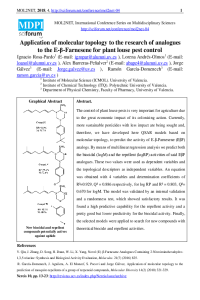
The control of plant louse pests is very important for agriculture due to the great economic impact of its colonizing action. Currently, more sustainable pesticides with less impact are being sought and, therefore, we have developed here QSAR models based on molceular topology, to predict the activity of E-β-Farnesene (EβF) analogs. By means of multilinear regression analysis we predict both the biocidal (logM) and the repellent (logRP) activities of said EβF analogues. These two values were used as dependent variables and the topological descriptors as independent variables. An equation was obtained with 4 variables and determination coefficients of R²=0.929, Q² = 0.886 respectively, for log RP and R² = 0.803, Q²= 0.670 for logM. The model was validated by an internal validation and a randomness test, which showed satisfactory results. It was found a high predictive capability for the repellent activity and a pretty good but lower predictivity for the biocidal activity. Finally, the selected models were applied to search for new compounds with theoretical biocide and repellent activities.
Keywords
molecular topology
pest control
biocidal activity
repelent activity
Manuscript
mol2net-04-MOL2NET-2018-Control-Plagas-OK.pdf
Poster
mol2net-04-MOL2NET-2018-Control-Plagas-OK.pdf
Phytochemicals of Punica granatum L. in inflammatory bowel diseases: a overview
Polyphenols of chuchuhuazo (Maytenus macrocarpa bark) as antioxidant and preservative in fresh sausage.