Event submissions
Published

This submission belongs to the session B. Posters of the event 4th International Electronic Conference on Medicinal Chemistry
Published date
31 Oct, 2018
Citation
Jean Guillon, François Hallé, Solène Savrimoutou, Stéphane Moreau, Daniel-Henri Caignard, Pascal Sonnet, Synthesis and Evaluation of New 6-formyl-oxazolo[3,2-a]pyrimidine derivatives as Potential Src Kinase Inhibitors, in Proceedings of 4th International Electronic Conference on Medicinal Chemistry, 1 November–30 November 2018, MDPI: Basel, Switzerland, doi: 10.3390/ecmc-4-05566
Share
Email
Facebook
Twitter
LinkedIn
Synthesis and Evaluation of New 6-formyl-oxazolo[3,2-a]pyrimidine derivatives as Potential Src Kinase Inhibitors

Jean Guillon 1
'%3e%3cpath%20d='M12.6647%2010.9104C12.4176%2010.325%2012.0589%209.7933%2011.6088%209.34485C11.16%208.89511%2010.6283%208.53653%2010.0432%208.28891C10.038%208.28629%2010.0327%208.28498%2010.0275%208.28236C10.8437%207.69282%2011.3743%206.73252%2011.3743%205.64907C11.3743%203.85423%209.92005%202.40002%208.12522%202.40002C6.33038%202.40002%204.87618%203.85423%204.87618%205.64907C4.87618%206.73252%205.40677%207.69282%206.22296%208.28367C6.21772%208.28629%206.21248%208.2876%206.20724%208.29022C5.62031%208.53783%205.09365%208.89287%204.64167%209.34616C4.19192%209.79496%203.83334%2010.3266%203.58573%2010.9117C3.34247%2011.4846%203.21128%2012.0987%203.19925%2012.721C3.1989%2012.735%203.20135%2012.7489%203.20646%2012.7619C3.21157%2012.7749%203.21924%2012.7868%203.22901%2012.7968C3.23877%2012.8068%203.25045%2012.8148%203.26334%2012.8202C3.27623%2012.8256%203.29007%2012.8284%203.30406%2012.8284H4.09012C4.14776%2012.8284%204.19362%2012.7825%204.19493%2012.7262C4.22113%2011.7148%204.62726%2010.7676%205.34519%2010.0497C6.08802%209.30686%207.07452%208.89811%208.12522%208.89811C9.17592%208.89811%2010.1624%209.30686%2010.9052%2010.0497C11.6232%2010.7676%2012.0293%2011.7148%2012.0555%2012.7262C12.0568%2012.7839%2012.1027%2012.8284%2012.1603%2012.8284H12.9464C12.9604%2012.8284%2012.9742%2012.8256%2012.9871%2012.8202C13%2012.8148%2013.0117%2012.8068%2013.0214%2012.7968C13.0312%2012.7868%2013.0389%2012.7749%2013.044%2012.7619C13.0491%2012.7489%2013.0515%2012.735%2013.0512%2012.721C13.0381%2012.0947%2012.9084%2011.4856%2012.6647%2010.9104ZM8.12522%207.90243C7.52388%207.90243%206.95792%207.66793%206.53214%207.24215C6.10636%206.81636%205.87185%206.2504%205.87185%205.64907C5.87185%205.04773%206.10636%204.48177%206.53214%204.05599C6.95792%203.63021%207.52388%203.3957%208.12522%203.3957C8.72655%203.3957%209.29252%203.63021%209.7183%204.05599C10.1441%204.48177%2010.3786%205.04773%2010.3786%205.64907C10.3786%206.2504%2010.1441%206.81636%209.7183%207.24215C9.29252%207.66793%208.72655%207.90243%208.12522%207.90243Z'%20fill='%235D1EE1'/%3e%3c/g%3e%3c/svg%3e)
François Hallé 2
Solène Savrimoutou 2
Stéphane Moreau 2
Daniel-Henri Caignard 3
Pascal Sonnet 4
1. Univ. Bordeaux, CNRS, INSERM, ARNA, UMR 5320, U1212, F-33000 Bordeaux, France
2. Université de Bordeaux, UFR des Sciences Pharmaceutiques, INSERM U1212 / UMR CNRS 5320, Laboratoire ARNA, 146 rue Léo Saignat, F-33076 Bordeaux cedex, France
3. Institut de Recherches Servier, Centre de Recherches de Croissy, 125 chemin de ronde, F-78290 Croissy-sur-Seine, France
4. Université de Picardie Jules Verne, UFR des Sciences Pharmaceutiques, AGIR - EA4294, 1 rue des Louvels, F-80037 Amiens cedex 1, France
Abstract
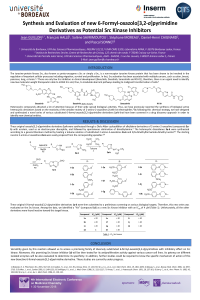
The tyrosine-protein kinase Src, also known as proto-oncogene c-Src or simply c-Src, is a non-receptor tyrosine kinase protein that has been shown to be involved in the regulation of important cellular processes including migration, survival and proliferation. In fact, Src activation has been associated with multiple cancers, such as colon, breast, pancreas, lung, or brain (Roskoski, R. Jr. Pharmacol. Res. 2015, 94, 9-25; Creedon, H., et al., Crit. Rev. Oncog. 2012, 17, 145-159). There are only few Src inhibitors in clinical development, therefore, there is an urgent need to identify new low molecular weight therapeutics able to inhibit Src and, thus, to modulate aberrant pathways leading to malignant transformation of cells (Lu, X.L., et al., Curr. Med. Chem. 2012, 19, 1821-1829). Heterocyclic compounds attracted a lot of attention because of their wide spread biological activities. Thus, we have previously reported the synthesis of biological active heterocyclic derivatives based on the reactivity of the amidine moiety of 2-amino-2-oxazolines 2 with bis-electrophiles (Massip, S., et al., Bioorg. Med. Chem. 2006, 14, 2697-2719).
https://ibb.co/hzkMnJ
In a preliminary screening testing our heterocycles library, we have identified a “hit” (compound 1d) derived from various substituted 6-formyl-oxazolo[3,2-a]pyrimidines as a new Src kinase inhibitor (IC50 = 4 µM). These original oxazolo[3,2-a]pyrimidine derivatives 1a-k were synthesized through a Diels-Alder cycloaddition of alkylidene derivatives of 2-amino-2-oxazoline (compounds 3a-k) with acrolein, as an electron-poor dienophile, a reaction previously described by our group (Guillon, J., et al., Synlett 2002, 8, 1249-1252). Versatility given by this reaction allowed us to access a promising family of diversely substituted 6-formyl-oxazolo[3,2-a]pyrimidines with inhibitory effect on Src kinase.
Acknowledgments: This work was supported by a grant from Ligue Contre le Cancer (Gironde, Bordeaux, France).
Keywords
oxazolo[3,2-a]pyrimidines | Src kinase | Diels-Alder
Poster
ecmc-4 - J Guillon et al 2018.pdf
Impact of different geometrical structures of copper(II) complexes on interactions with bio-relevant nucleophiles under physiological conditions
The effects of polar and non polar compounds from endophytic actinomycetes in Ocmium tenuiflorum (Tulsi) and Azadirachta indica (Neem) on veterinary and human pathogens