Event submissions
Published

This submission belongs to the session B. Posters of the event 4th International Electronic Conference on Medicinal Chemistry
Published date
31 Oct, 2018
Citation
Marius Emil Rusu, Andrei Mocan, Ana-Maria Gheldiu, Ioan Tomuta, Laurian Vlase, Daniela-Saveta Popa, Method optimization for enhanced bioactive compounds extraction from hazelnut (Corylus avellana L.) involucre: Phytochemical profile and antioxidant activity, in Proceedings of 4th International Electronic Conference on Medicinal Chemistry, 1 November–30 November 2018, MDPI: Basel, Switzerland, doi: 10.3390/ecmc-4-05570
Share
Email
Facebook
Twitter
LinkedIn
Method optimization for enhanced bioactive compounds extraction from hazelnut (Corylus avellana L.) involucre: Phytochemical profile and antioxidant activity

Marius Emil Rusu 1

Andrei Mocan 2

Ana-Maria Gheldiu 2

Ioan Tomuta 1

Laurian Vlase 1

Daniela-Saveta Popa 3
1. Department of Pharmaceutical Technology and Biopharmaceutics, Faculty of Pharmacy, “Iuliu Hatieganu” University of Medicine and Pharmacy, 8 Victor Babes, 400012 Cluj-Napoca, Romania.
2. Department of Pharmaceutical Botany, Faculty of Pharmacy, “Iuliu Hatieganu” University of Medicine and Pharmacy, 8 Victor Babes, 400012 Cluj-Napoca, Romania.
3. Department of Toxicology, Faculty of Pharmacy, “Iuliu Hatieganu” University of Medicine and Pharmacy, 8 Victor Babes, 400012 Cluj-Napoca, Romania.
Abstract
The increasing use of healthy unsaturated fats, more prone to oxidation, the understanding of the pathology of oxidative stress in the organisms, and the negative side-effects of some synthetic antioxidant compounds point to the research of natural antioxidants of plant origin which could be used in pharma or food industry.
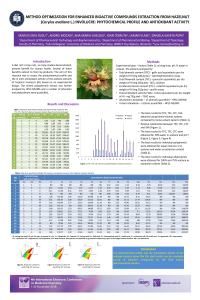
In this study, the polyphenolic composition and in vitro antioxidant activity of the acetone extracts of hazelnut involucre (HI) were assayed. Optimum extraction conditions, based on an experimental design, were developed to obtain HI extracts rich in bioactive compounds. The best responses per gram of dry weight (dw) HI were in the range of 332 – 377 mg GAE (gallic acid equivalents) for total phenolic content (TPC); 37 – 43 mg QE (quercetin equivalents) for total flavonoid content (TFC); 24 – 28 mg CE (catechin equivalents) for condensed tannin content (CTC). The highest values for total antioxidant activity (TAA), determined by TEAC method, were in the range of 1,296 to 1,811 mg TE (Trolox equivalents) per gram of dw HI. A good relationship was observed between TPC, TFC, CTC, and TAA, the best results were found for the equal mixture (1:1) of acetone and water, as the extraction solvent. Further, for the richest polyphenolic HI extract, the phytochemical profile was examined by HPLC-MS/MS and several phenolics (epicatechin, catechin, syringic acid, gallic acid, protocatechuic acid, vanillic acid, hyperoside, quercitrin, isoquercitrin) and phytosterols (stigmasterol, campesterol, beta-sitosterol) were quantified.
To the best of our knowledge, this is the first study to assay the detailed composition in both hydrophilic and lipophilic bioactive compounds in hazelnut involucre. The phytochemical profile and the biological activity of the analyzed extract prove that this plant matrix can be a valuable source of bioactive compounds for food and/or pharmaceutical industry.
Keywords
hazelnut involucre
phytochemicals
antioxidant
HPLC-MS/MS
polyphenols
phytosterols
experimental design
Poster
Marius_Rusu_Poster.pdf
Antiproliferative activity of steroidal oxime and its O-alkylated derivatives
Comparison of the metabolomic signature of diabetes and the oral glucose tolerance test