Event submissions
Published

This submission belongs to the session B. Posters of the event 4th International Electronic Conference on Medicinal Chemistry
Published date
31 Oct, 2018
Citation
Rahma Ait Hammou, Yassine Kasmi, Moulay Mustapha Ennaji, Competing interactions of miRNAs and proteins: miR10b, miR335, miR21 in breast cancer, in Proceedings of 4th International Electronic Conference on Medicinal Chemistry, 1 November–30 November 2018, MDPI: Basel, Switzerland, doi: 10.3390/ecmc-4-05592
Share
Email
Facebook
Twitter
LinkedIn
Competing interactions of miRNAs and proteins: miR10b, miR335, miR21 in breast cancer
'%3e%3cpath%20d='M12.6647%2010.9104C12.4176%2010.325%2012.0589%209.7933%2011.6088%209.34485C11.16%208.89511%2010.6283%208.53653%2010.0432%208.28891C10.038%208.28629%2010.0327%208.28498%2010.0275%208.28236C10.8437%207.69282%2011.3743%206.73252%2011.3743%205.64907C11.3743%203.85423%209.92005%202.40002%208.12522%202.40002C6.33038%202.40002%204.87618%203.85423%204.87618%205.64907C4.87618%206.73252%205.40677%207.69282%206.22296%208.28367C6.21772%208.28629%206.21248%208.2876%206.20724%208.29022C5.62031%208.53783%205.09365%208.89287%204.64167%209.34616C4.19192%209.79496%203.83334%2010.3266%203.58573%2010.9117C3.34247%2011.4846%203.21128%2012.0987%203.19925%2012.721C3.1989%2012.735%203.20135%2012.7489%203.20646%2012.7619C3.21157%2012.7749%203.21924%2012.7868%203.22901%2012.7968C3.23877%2012.8068%203.25045%2012.8148%203.26334%2012.8202C3.27623%2012.8256%203.29007%2012.8284%203.30406%2012.8284H4.09012C4.14776%2012.8284%204.19362%2012.7825%204.19493%2012.7262C4.22113%2011.7148%204.62726%2010.7676%205.34519%2010.0497C6.08802%209.30686%207.07452%208.89811%208.12522%208.89811C9.17592%208.89811%2010.1624%209.30686%2010.9052%2010.0497C11.6232%2010.7676%2012.0293%2011.7148%2012.0555%2012.7262C12.0568%2012.7839%2012.1027%2012.8284%2012.1603%2012.8284H12.9464C12.9604%2012.8284%2012.9742%2012.8256%2012.9871%2012.8202C13%2012.8148%2013.0117%2012.8068%2013.0214%2012.7968C13.0312%2012.7868%2013.0389%2012.7749%2013.044%2012.7619C13.0491%2012.7489%2013.0515%2012.735%2013.0512%2012.721C13.0381%2012.0947%2012.9084%2011.4856%2012.6647%2010.9104ZM8.12522%207.90243C7.52388%207.90243%206.95792%207.66793%206.53214%207.24215C6.10636%206.81636%205.87185%206.2504%205.87185%205.64907C5.87185%205.04773%206.10636%204.48177%206.53214%204.05599C6.95792%203.63021%207.52388%203.3957%208.12522%203.3957C8.72655%203.3957%209.29252%203.63021%209.7183%204.05599C10.1441%204.48177%2010.3786%205.04773%2010.3786%205.64907C10.3786%206.2504%2010.1441%206.81636%209.7183%207.24215C9.29252%207.66793%208.72655%207.90243%208.12522%207.90243Z'%20fill='%235D1EE1'/%3e%3c/g%3e%3c/svg%3e)
Rahma Ait Hammou 1
Yassine Kasmi 1
Moulay Mustapha Ennaji 1
1. Laboratory of Virology, Microbiology, Quality and Biotechnologies/Eco-toxicology and biodiversity, Faculty of Sciences and Techniques, Mohammedia, University Hassan II of Casablanca, BP: 146 Mohammedia 20650, Morocco
Abstract
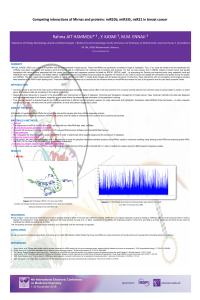
MiR10b, miR335, miR21 are a class of microRNAs that are overexpressed in breast cancer. These microRNAs are significantly correlated to stage of metastasis. Thus, in our study we aimed to test the hypothesis that miRNAs have direct interactions with proteins and that they are able to inhibit/active the functional site of proteins and enzymes.
For that, we have chosen this 3 miRNAs related to breast cancer and studied interactions with some proteins associated with this cancer (onco-protein and suppressor proteins) included the BRCA1, BRCA2, palb2.., by processing the Docking and matching tools using especially Hex8 and HADDOCK sever. Mathematically, The Hidden Markov models were realized using Matlab script according the algorithm of Harrison et al.in order to study and validate the interactions and bonds among the protein and miRNAs.
The main results demonstrated the ability of miR10, miR335 and miR21 to create direct linkages with 3D protein structures. Furthermore, these interactions with viro-oncogenic and oncogenic proteins were observed at the RNA-Protein docking level.
These direct interactions allowed us to conclude that the influence levels of microRNAs are marked not only at the genomic level but can reach proteomic levels. Such direct interactions between the microRNAs and proteins can influence the direct regulation of the mechanisms of action in the biological systems. The strength of the interactions between the crystallized structures and the microRNAs is very large compared to those observed with the same crystal structures and the DNA fragments obtained during the crystallization, essentially those located at the promoter regions.
Keywords
miR
Breast cancer
Interaction
Docking
Modeling
Poster
VF_Poster_ Rahma-ecmc-4-PDF.pdf
An extended study on quantitative structure-antitrypanosomal activity relationships of sesquiterpene lactones
3D Structure modeling & analysis of transmembrane protein EVI2A from Homo sapiens