Event submissions
Published

This submission belongs to the session B. Posters of the event 4th International Electronic Conference on Medicinal Chemistry
Published date
31 Oct, 2018
Citation
Miroslav Sovrlić, Marina Tomović, Jovana Bradić, Aleksandar Kočović, Anica Petković, Optimization of phenolic compounds extraction conditions from lady's bedstraw (Galium verum L.) using historical data design, in Proceedings of 4th International Electronic Conference on Medicinal Chemistry, 1 November–30 November 2018, MDPI: Basel, Switzerland, doi: 10.3390/ecmc-4-05600
Share
Email
Facebook
Twitter
LinkedIn
Optimization of phenolic compounds extraction conditions from lady's bedstraw (Galium verum L.) using historical data design

Miroslav Sovrlić 1
'%3e%3cpath%20d='M12.6647%2010.9104C12.4176%2010.325%2012.0589%209.7933%2011.6088%209.34485C11.16%208.89511%2010.6283%208.53653%2010.0432%208.28891C10.038%208.28629%2010.0327%208.28498%2010.0275%208.28236C10.8437%207.69282%2011.3743%206.73252%2011.3743%205.64907C11.3743%203.85423%209.92005%202.40002%208.12522%202.40002C6.33038%202.40002%204.87618%203.85423%204.87618%205.64907C4.87618%206.73252%205.40677%207.69282%206.22296%208.28367C6.21772%208.28629%206.21248%208.2876%206.20724%208.29022C5.62031%208.53783%205.09365%208.89287%204.64167%209.34616C4.19192%209.79496%203.83334%2010.3266%203.58573%2010.9117C3.34247%2011.4846%203.21128%2012.0987%203.19925%2012.721C3.1989%2012.735%203.20135%2012.7489%203.20646%2012.7619C3.21157%2012.7749%203.21924%2012.7868%203.22901%2012.7968C3.23877%2012.8068%203.25045%2012.8148%203.26334%2012.8202C3.27623%2012.8256%203.29007%2012.8284%203.30406%2012.8284H4.09012C4.14776%2012.8284%204.19362%2012.7825%204.19493%2012.7262C4.22113%2011.7148%204.62726%2010.7676%205.34519%2010.0497C6.08802%209.30686%207.07452%208.89811%208.12522%208.89811C9.17592%208.89811%2010.1624%209.30686%2010.9052%2010.0497C11.6232%2010.7676%2012.0293%2011.7148%2012.0555%2012.7262C12.0568%2012.7839%2012.1027%2012.8284%2012.1603%2012.8284H12.9464C12.9604%2012.8284%2012.9742%2012.8256%2012.9871%2012.8202C13%2012.8148%2013.0117%2012.8068%2013.0214%2012.7968C13.0312%2012.7868%2013.0389%2012.7749%2013.044%2012.7619C13.0491%2012.7489%2013.0515%2012.735%2013.0512%2012.721C13.0381%2012.0947%2012.9084%2011.4856%2012.6647%2010.9104ZM8.12522%207.90243C7.52388%207.90243%206.95792%207.66793%206.53214%207.24215C6.10636%206.81636%205.87185%206.2504%205.87185%205.64907C5.87185%205.04773%206.10636%204.48177%206.53214%204.05599C6.95792%203.63021%207.52388%203.3957%208.12522%203.3957C8.72655%203.3957%209.29252%203.63021%209.7183%204.05599C10.1441%204.48177%2010.3786%205.04773%2010.3786%205.64907C10.3786%206.2504%2010.1441%206.81636%209.7183%207.24215C9.29252%207.66793%208.72655%207.90243%208.12522%207.90243Z'%20fill='%235D1EE1'/%3e%3c/g%3e%3c/svg%3e)
Marina Tomović 1
Jovana Bradić 1
Aleksandar Kočović 2
Anica Petković 1
1. Department of Pharmacy, Faculty of Medical Sciences, University of Kragujevac
2. Faculty of Medical Sciences, Department of Pharmacy, University of Kragujevac, Svetozara Markovića 69, 34000 Kragujevac, Serbia
Abstract
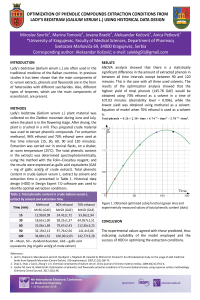
Lady's bedstraw (Galium verum L.) are often used in the traditional medicine of the Balkan countries. In previous studies it has been shown that the main components of G. verum extracts, phenols and flavonoids are in the form of heterosides with different saccharides. Also, different types of terpenes, which are the main components of essential oil, are present. In this study, we wanted to identify the optimal conditions for the extraction of phenolic compounds from G. verum. For extraction we used methanol, 96% ethanol and 70% ethanol at five time intervals (15, 30, 60, 90 and 120 minutes). Extraction was carried out in conical flasks, on a shaker, at room temperature (25°C). The total phenolic content in the extracts was determined spectrophotometrically, using the standard method with the Folin–Ciocalteu reagent, and the results were expressed as gallic acid equivalents (GAE – mg of gallic acid/g of crude extract). The total phenolic content when 70% ethanol was used were 33.36±1.94, 64.06±1.51, 112.36±3.23, 141.40±3.06 and 142.77±3.28 GAE in 15, 30, 60, 90 and 120 minute respectively. We used historical data design (HDD) in Design Expert 7.0 software to identify optimal extraction conditions. ANOVA analysis showed that there is a statistically significant difference in the amount of extracted phenols in between all time intervals except between 90 and 120 minutes. The results of the optimization analysis showed that the highest yield of total phenols (145.78 GAE) was obtained using 70% ethanol as a solvent in a time of 107.03 minutes (desirability level = 0.996), while the lowest yield was obtained using methanol as a solvent. Equation of model when 70% ethanol is used as a solvent is: Total phenols = 0.26 + 2.30 ∗time + 4.74^−3 ∗ time^2 − 3.70^−5 ∗ time^3. The experimental values agreed with those predicted, thus indicating suitability of the model employed and the success of HDD in optimizing the extraction conditions.
Keywords
Galium verum L.
Total phenolic content
Optimization
Experimental design
Poster
Poster HDD.pdf
Evaluation of protective effects of Cuscuta reflexa Roxb. against FCA induced arthritis in rats
Synthesis and biological screening of analogues of bioactive acid constituents from the traditional Chinese medicinal plant Liquidambar Formosana