Event submissions
Published

This submission belongs to the session B. Posters of the event 4th International Electronic Conference on Medicinal Chemistry
Published date
03 Nov, 2018
Citation
Pietro Spanu, Maria Pia Fuggetta, Fausta Ulgheri, Francesco Deligia, Giovanni Loriga, Paola Carta, Alberto Mannu, Veronica Trotta, Rosanna De Cicco, Adriano Barra, Enrica Zona, Franco Morelli, A new synthetic spiroketal: studies on antitumor activity on murine melanoma model In vivo and mechanism of action In vitro, in Proceedings of 4th International Electronic Conference on Medicinal Chemistry, 1 November–30 November 2018, MDPI: Basel, Switzerland, doi: 10.3390/ecmc-4-05621
Share
Email
Facebook
Twitter
LinkedIn
A new synthetic spiroketal: studies on antitumor activity on murine melanoma model In vivo and mechanism of action In vitro
'%3e%3cpath%20d='M12.6647%2010.9104C12.4176%2010.325%2012.0589%209.7933%2011.6088%209.34485C11.16%208.89511%2010.6283%208.53653%2010.0432%208.28891C10.038%208.28629%2010.0327%208.28498%2010.0275%208.28236C10.8437%207.69282%2011.3743%206.73252%2011.3743%205.64907C11.3743%203.85423%209.92005%202.40002%208.12522%202.40002C6.33038%202.40002%204.87618%203.85423%204.87618%205.64907C4.87618%206.73252%205.40677%207.69282%206.22296%208.28367C6.21772%208.28629%206.21248%208.2876%206.20724%208.29022C5.62031%208.53783%205.09365%208.89287%204.64167%209.34616C4.19192%209.79496%203.83334%2010.3266%203.58573%2010.9117C3.34247%2011.4846%203.21128%2012.0987%203.19925%2012.721C3.1989%2012.735%203.20135%2012.7489%203.20646%2012.7619C3.21157%2012.7749%203.21924%2012.7868%203.22901%2012.7968C3.23877%2012.8068%203.25045%2012.8148%203.26334%2012.8202C3.27623%2012.8256%203.29007%2012.8284%203.30406%2012.8284H4.09012C4.14776%2012.8284%204.19362%2012.7825%204.19493%2012.7262C4.22113%2011.7148%204.62726%2010.7676%205.34519%2010.0497C6.08802%209.30686%207.07452%208.89811%208.12522%208.89811C9.17592%208.89811%2010.1624%209.30686%2010.9052%2010.0497C11.6232%2010.7676%2012.0293%2011.7148%2012.0555%2012.7262C12.0568%2012.7839%2012.1027%2012.8284%2012.1603%2012.8284H12.9464C12.9604%2012.8284%2012.9742%2012.8256%2012.9871%2012.8202C13%2012.8148%2013.0117%2012.8068%2013.0214%2012.7968C13.0312%2012.7868%2013.0389%2012.7749%2013.044%2012.7619C13.0491%2012.7489%2013.0515%2012.735%2013.0512%2012.721C13.0381%2012.0947%2012.9084%2011.4856%2012.6647%2010.9104ZM8.12522%207.90243C7.52388%207.90243%206.95792%207.66793%206.53214%207.24215C6.10636%206.81636%205.87185%206.2504%205.87185%205.64907C5.87185%205.04773%206.10636%204.48177%206.53214%204.05599C6.95792%203.63021%207.52388%203.3957%208.12522%203.3957C8.72655%203.3957%209.29252%203.63021%209.7183%204.05599C10.1441%204.48177%2010.3786%205.04773%2010.3786%205.64907C10.3786%206.2504%2010.1441%206.81636%209.7183%207.24215C9.29252%207.66793%208.72655%207.90243%208.12522%207.90243Z'%20fill='%235D1EE1'/%3e%3c/g%3e%3c/svg%3e)
Pietro Spanu 1
Maria Pia Fuggetta 2
Fausta Ulgheri 3
Francesco Deligia 3
Giovanni Loriga 4
Paola Carta 3

Alberto Mannu 4
Veronica Trotta 5
Rosanna De Cicco 6
Adriano Barra 6
Enrica Zona 6
Franco Morelli 6
1. Istituto di Chimica Biomolecolare - Consiglio Nazionale delle Ricerche Italy
2. Istituto di Farmacologia Traslazionale - Consiglio Nazionale delle Ricerche, Italy
3. Istituto di Chimica Biomolecolare - Consiglio Nazionale delle Ricerche, Italy
4. Istituto di Chimica Biomolecolare - Consiglio Nazionale delle Ricerche, Italy
5. Istituto di Genetica e Biofisica A. Buzzati Traverso - Consiglio Nazionale delle Ricerche, Italy
6. Istituto di Genetica e Biofisica A. Buzzati Traverso - Consiglio Nazionale delle Ricerche, Italy
Abstract
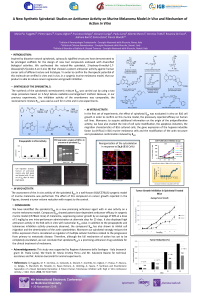
The natural-like spiroketal, 2-hydroxy-8-methyl-1,7-dioxaspiro[5.5]undec-3-en-5-one (1) has been synthesised and has shown a potent antitumor activity against human tumor cells of different nature and histotype. We have now performed studies to verify its in vivo activity on a murine melanoma model and in vitro studies to shed some light on the mechanism of action. Spiroketal 1 have shown a potent dose-dependent antitumor efficacy in vivo in a syngenic murine model (C57Black mice) of melanoma (B16). The compound suppressed the tumor growth by an average of 90% at a dose of 5 mg/kg by intra-peritoneum administration at alternate days for 15 days. It also displayed high antitumor activity in vitro in the B16 cells with nanomolar IC50 value. In addition to the proapoptotic and telomerase inhibition activities, compound 1 has shown to inhibit cell migration and to strongly reduce the HIF1alfa expression, that is considered a regulator of multiple cellular functions related to the progression from primary to metastatic cancer disease. Therefore, although the full mechanism of action of this molecule has yet to be completely elucidated, spiroketal 1 is a promising antitumor drug candidate for the clinical treatment of melanoma and various cancers.
References: Fuggetta, M. P.; De Mico, A.; Cottarelli, A.; Morelli, F.; Zonfrillo, M.; Ulgheri, F.; Peluso, P.; Mannu, A.; Deligia, F.; Marchetti, M.; Roviello, G.; Reyes Romero, A.; Dömling, A.; Spanu, P. Synthesis and Enantiomeric Separation of a Novel Spiroketal Derivative: A Potent Human Telomerase Inhibitor with High in Vitro Anticancer Activity. J. Med. Chem. 2016, 59, 9140−9149 and references quoted therein
Keywords
Spiroketal
anticancer
telomerase inhibitor
Poster
ECMC-4-poster-Spanu.pdf
High Efficiency Drug Repurposing for New Antifungal Agents
New multifunctional diamine AGE/ALE inhibitors to prevent oxidative and carbonyl stress exacerbation in Alzheimer's disease