Event submissions
Published

This submission belongs to the session B. Posters of the event 4th International Electronic Conference on Medicinal Chemistry
Published date
03 Nov, 2018
Citation
James Patrick Mc Keown, Clara Charleton, Keith Ferris, Sara Noorani, Niamh M O'Boyle, Mary J Meegan, Ethanoanthracenes: Potential chemotherapeutics for chronic lymphocytic leukaemia (CLL), in Proceedings of 4th International Electronic Conference on Medicinal Chemistry, 1 November–30 November 2018, MDPI: Basel, Switzerland, doi: 10.3390/ecmc-4-05623
Share
Email
Facebook
Twitter
LinkedIn
Ethanoanthracenes: Potential chemotherapeutics for chronic lymphocytic leukaemia (CLL)
'%3e%3cpath%20d='M12.6647%2010.9104C12.4176%2010.325%2012.0589%209.7933%2011.6088%209.34485C11.16%208.89511%2010.6283%208.53653%2010.0432%208.28891C10.038%208.28629%2010.0327%208.28498%2010.0275%208.28236C10.8437%207.69282%2011.3743%206.73252%2011.3743%205.64907C11.3743%203.85423%209.92005%202.40002%208.12522%202.40002C6.33038%202.40002%204.87618%203.85423%204.87618%205.64907C4.87618%206.73252%205.40677%207.69282%206.22296%208.28367C6.21772%208.28629%206.21248%208.2876%206.20724%208.29022C5.62031%208.53783%205.09365%208.89287%204.64167%209.34616C4.19192%209.79496%203.83334%2010.3266%203.58573%2010.9117C3.34247%2011.4846%203.21128%2012.0987%203.19925%2012.721C3.1989%2012.735%203.20135%2012.7489%203.20646%2012.7619C3.21157%2012.7749%203.21924%2012.7868%203.22901%2012.7968C3.23877%2012.8068%203.25045%2012.8148%203.26334%2012.8202C3.27623%2012.8256%203.29007%2012.8284%203.30406%2012.8284H4.09012C4.14776%2012.8284%204.19362%2012.7825%204.19493%2012.7262C4.22113%2011.7148%204.62726%2010.7676%205.34519%2010.0497C6.08802%209.30686%207.07452%208.89811%208.12522%208.89811C9.17592%208.89811%2010.1624%209.30686%2010.9052%2010.0497C11.6232%2010.7676%2012.0293%2011.7148%2012.0555%2012.7262C12.0568%2012.7839%2012.1027%2012.8284%2012.1603%2012.8284H12.9464C12.9604%2012.8284%2012.9742%2012.8256%2012.9871%2012.8202C13%2012.8148%2013.0117%2012.8068%2013.0214%2012.7968C13.0312%2012.7868%2013.0389%2012.7749%2013.044%2012.7619C13.0491%2012.7489%2013.0515%2012.735%2013.0512%2012.721C13.0381%2012.0947%2012.9084%2011.4856%2012.6647%2010.9104ZM8.12522%207.90243C7.52388%207.90243%206.95792%207.66793%206.53214%207.24215C6.10636%206.81636%205.87185%206.2504%205.87185%205.64907C5.87185%205.04773%206.10636%204.48177%206.53214%204.05599C6.95792%203.63021%207.52388%203.3957%208.12522%203.3957C8.72655%203.3957%209.29252%203.63021%209.7183%204.05599C10.1441%204.48177%2010.3786%205.04773%2010.3786%205.64907C10.3786%206.2504%2010.1441%206.81636%209.7183%207.24215C9.29252%207.66793%208.72655%207.90243%208.12522%207.90243Z'%20fill='%235D1EE1'/%3e%3c/g%3e%3c/svg%3e)
James Patrick Mc Keown 1
Clara Charleton 1
Keith Ferris 1
Sara Noorani 1
Niamh M O'Boyle 1

Mary J Meegan 1
1. School of Pharmacy and Pharmaceutical Sciences, Trinity College Dublin, Dublin 2, Ireland
Abstract
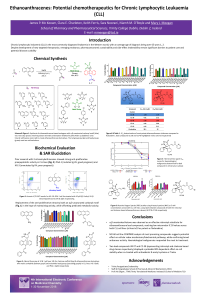
CLL (Chronic Lymphocytic Leukaemia) is the most common leukaemia in the Western world. Classed as a clonal disorder of mature B-lymphocytes, CLL patient prognoses are broadly subdivided by the mutational status of the Immunoglobulin G Heavy Chain Variable region (IGHV) (with unmutated IGHV holding a better patient prognosis than the wild type variant)1.
Structures related to tricyclic and tetracyclic anti-depressants (fluoxetine,maprotiline respectively) have previously been shown to exert potent, selective antiproliferative and pro-apoptotic effects in vitro and were met with marked success in related B cell malignancy cell lines, namely Burkitt’s Lymphoma (BL) cell lines DG-75 and MUTU-12.
Based on these preliminary studies, libraries of structurally related novel ethanoanthracene compounds were designed, based on the proven effectiveness of nitrostyrene core moiety derivatives and literature evidence of selective toxicity of chalcone moieties in leukaemic cell lines3.
The antiproliferative activity of each compound was determined using Alamar Blue assays on the two types of CLL cell lines: HG-3 and PGA-1, representative of bad and good prognosis respectively. The most promising activity was observed with maleimide dienophile based ethanoanthracene chalcones, particularly at a 10 µM across both cell lines. A ROS (reactive oxygen species) dependant activity was noted as both nitrostyrene and chalcone based analog biological activity markedly decreased on addition of NAC (N- acetyl cysteine) or Trolox (6-hydroxy-2,5,7,8-tetramethylchroman-2-carboxylic acid).
References
- Scarfò, L.; Ferreri, A. J. M.; Ghia, P., Critical Reviews in Oncology/Hematology, 2016, 104, 169-182.
- Mc Namara, Y. M., Bright, S.A., Byrne, A.J., Williams, D.C., Meegan, M.J., European Journal of Medicinal Chemistry 2014, 71, 333.
- Zhuang, C.; Zhang, W.; Sheng, C.; Zhang, W.; Xing, C.; Miao, Z., Chemical Reviews, 2017, 117(12):7762-7810.
Keywords
Leukaemia
Cancer
Drug Discovery
Reactive Oxygen Species
Ethanoanthracenes
Medicinal Chemistry
Poster
ecmc-4_ James Mc Keown.pdf
New multifunctional diamine AGE/ALE inhibitors to prevent oxidative and carbonyl stress exacerbation in Alzheimer's disease
Hepatoprotective and antioxidant effects of oligoribonucleotides-D-mannitol complexes against thioacetamide-induced liver fibrosis