Event submissions
Published

This submission belongs to the session ECWS-3. Submission of the event The 3rd International Electronic Conference on Water Sciences
Published date
15 Nov, 2018
Citation
Jose-Luis Molina, Santiago Zazo, Ana-María Martín, CAUSAL REASONING: AN ADAPTIVE/PREDICTIVE APPROACH FOR RUNOFF TEMPORAL BEHAVIOUR OF HIGH DEPENDENCE RIVERS, in Proceedings of The 3rd International Electronic Conference on Water Sciences, 15 November–30 November 2018, MDPI: Basel, Switzerland, doi: 10.3390/ECWS-3-05810
Share
Email
Facebook
Twitter
LinkedIn
CAUSAL REASONING: AN ADAPTIVE/PREDICTIVE APPROACH FOR RUNOFF TEMPORAL BEHAVIOUR OF HIGH DEPENDENCE RIVERS

Jose-Luis Molina 1

Santiago Zazo 2
'%3e%3cpath%20d='M12.6647%2010.9104C12.4176%2010.325%2012.0589%209.7933%2011.6088%209.34485C11.16%208.89511%2010.6283%208.53653%2010.0432%208.28891C10.038%208.28629%2010.0327%208.28498%2010.0275%208.28236C10.8437%207.69282%2011.3743%206.73252%2011.3743%205.64907C11.3743%203.85423%209.92005%202.40002%208.12522%202.40002C6.33038%202.40002%204.87618%203.85423%204.87618%205.64907C4.87618%206.73252%205.40677%207.69282%206.22296%208.28367C6.21772%208.28629%206.21248%208.2876%206.20724%208.29022C5.62031%208.53783%205.09365%208.89287%204.64167%209.34616C4.19192%209.79496%203.83334%2010.3266%203.58573%2010.9117C3.34247%2011.4846%203.21128%2012.0987%203.19925%2012.721C3.1989%2012.735%203.20135%2012.7489%203.20646%2012.7619C3.21157%2012.7749%203.21924%2012.7868%203.22901%2012.7968C3.23877%2012.8068%203.25045%2012.8148%203.26334%2012.8202C3.27623%2012.8256%203.29007%2012.8284%203.30406%2012.8284H4.09012C4.14776%2012.8284%204.19362%2012.7825%204.19493%2012.7262C4.22113%2011.7148%204.62726%2010.7676%205.34519%2010.0497C6.08802%209.30686%207.07452%208.89811%208.12522%208.89811C9.17592%208.89811%2010.1624%209.30686%2010.9052%2010.0497C11.6232%2010.7676%2012.0293%2011.7148%2012.0555%2012.7262C12.0568%2012.7839%2012.1027%2012.8284%2012.1603%2012.8284H12.9464C12.9604%2012.8284%2012.9742%2012.8256%2012.9871%2012.8202C13%2012.8148%2013.0117%2012.8068%2013.0214%2012.7968C13.0312%2012.7868%2013.0389%2012.7749%2013.044%2012.7619C13.0491%2012.7489%2013.0515%2012.735%2013.0512%2012.721C13.0381%2012.0947%2012.9084%2011.4856%2012.6647%2010.9104ZM8.12522%207.90243C7.52388%207.90243%206.95792%207.66793%206.53214%207.24215C6.10636%206.81636%205.87185%206.2504%205.87185%205.64907C5.87185%205.04773%206.10636%204.48177%206.53214%204.05599C6.95792%203.63021%207.52388%203.3957%208.12522%203.3957C8.72655%203.3957%209.29252%203.63021%209.7183%204.05599C10.1441%204.48177%2010.3786%205.04773%2010.3786%205.64907C10.3786%206.2504%2010.1441%206.81636%209.7183%207.24215C9.29252%207.66793%208.72655%207.90243%208.12522%207.90243Z'%20fill='%235D1EE1'/%3e%3c/g%3e%3c/svg%3e)
Ana-María Martín 3
1. Salamanca University, High Polytechnic School of Engineering, Ávila. Area of Hydraulic Engineering, Av. de los Hornos Caleros 50, 05003 Ávila, Spain
2. Salamanca University, TIDOP Research Group, Av. de los Hornos Caleros 50, 05003 Ávila, Spain
3. Salamanca University, High Polytechnic School of Engineering, Ávila. Department of Statistics, Av. de los Hornos Caleros 50, 05003 Ávila, Spain
Abstract
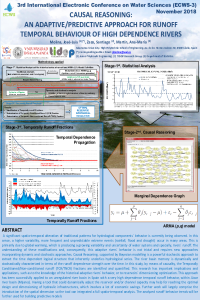
A significant spatio-temporal alteration of traditional patterns for hydrological components´ behavior is currently being observed. In this sense, a higher variability, more frequent and unpredictable extreme events (rainfall, flood and drought) occur in many areas. This is primarily due to global warming, which is producing a growing variability and uncertainty of water systems and specially, rivers´ runoff. The understanding of these modifications and, consequently, this adaptive rivers´ behavior is not trivial and requires new approaches incorporating dynamic and stochastic approaches. Causal Reasoning, supported by Bayesian modelling is a powerful stochastic approach to extract the time dependent logical structure that inherently underlies hydrological series. The river basin memory is dynamically and stochastically characterized in terms of the runoff dependence strength over the time. In this study, by means of causality, the Temporally Conditioned/Non-conditioned runoff (TCR/TNCR) fractions are identified and quantified. This research has important implications and applications, such as to the knowledge of the historical adaptive rivers´ behavior, or to reservoirs´ dimensioning optimization. This approach has been successfully applied to an unregulated river basin in Spain with a very high dependence temporal runoff behavior, within Júcar river basin (Mijares). Having a tool that could dynamically adjust the reservoir and/or channel capacity may help for reaching the optimal design and dimensioning of hydraulic infrastructures, which involves a lot of economic savings. Further work will largely comprise the introduction of the spatial dimension so the tool can integrated a full spatio-temporal analysis. Furthermore, the analyzed runoff behavior trends will be further used for building predictive models.
Keywords
Causal Reasoning
Runoff
Dependence
River Basin
Hydrology
hydraulic infrastructures optimization
Manuscript
Molina et al. 2018_REVISED POSTER.pdf
Poster
Molina et al. 2018_REVISED POSTER.pdf
Selection of bias correction methods to assess the impact of climate change on flood frequency curves
Stochastic assessment of the influence of reservoir operation in hydrological dam safety through risk indexes