Event submissions
Published

This submission belongs to the session B. Physical Sensors of the event 5th International Electronic Conference on Sensors and Applications
Published date
20 Nov, 2018
Citation
Viktor Vladimirovich Petrov, Harvester of energy on PZT thin films, in Proceedings of 5th International Electronic Conference on Sensors and Applications, 15 November–30 November 2018, MDPI: Basel, Switzerland, doi: 10.3390/ecsa-5-05870
Share
Email
Facebook
Twitter
LinkedIn
Harvester of energy on PZT thin films
'%3e%3cpath%20d='M12.6647%2010.9104C12.4176%2010.325%2012.0589%209.7933%2011.6088%209.34485C11.16%208.89511%2010.6283%208.53653%2010.0432%208.28891C10.038%208.28629%2010.0327%208.28498%2010.0275%208.28236C10.8437%207.69282%2011.3743%206.73252%2011.3743%205.64907C11.3743%203.85423%209.92005%202.40002%208.12522%202.40002C6.33038%202.40002%204.87618%203.85423%204.87618%205.64907C4.87618%206.73252%205.40677%207.69282%206.22296%208.28367C6.21772%208.28629%206.21248%208.2876%206.20724%208.29022C5.62031%208.53783%205.09365%208.89287%204.64167%209.34616C4.19192%209.79496%203.83334%2010.3266%203.58573%2010.9117C3.34247%2011.4846%203.21128%2012.0987%203.19925%2012.721C3.1989%2012.735%203.20135%2012.7489%203.20646%2012.7619C3.21157%2012.7749%203.21924%2012.7868%203.22901%2012.7968C3.23877%2012.8068%203.25045%2012.8148%203.26334%2012.8202C3.27623%2012.8256%203.29007%2012.8284%203.30406%2012.8284H4.09012C4.14776%2012.8284%204.19362%2012.7825%204.19493%2012.7262C4.22113%2011.7148%204.62726%2010.7676%205.34519%2010.0497C6.08802%209.30686%207.07452%208.89811%208.12522%208.89811C9.17592%208.89811%2010.1624%209.30686%2010.9052%2010.0497C11.6232%2010.7676%2012.0293%2011.7148%2012.0555%2012.7262C12.0568%2012.7839%2012.1027%2012.8284%2012.1603%2012.8284H12.9464C12.9604%2012.8284%2012.9742%2012.8256%2012.9871%2012.8202C13%2012.8148%2013.0117%2012.8068%2013.0214%2012.7968C13.0312%2012.7868%2013.0389%2012.7749%2013.044%2012.7619C13.0491%2012.7489%2013.0515%2012.735%2013.0512%2012.721C13.0381%2012.0947%2012.9084%2011.4856%2012.6647%2010.9104ZM8.12522%207.90243C7.52388%207.90243%206.95792%207.66793%206.53214%207.24215C6.10636%206.81636%205.87185%206.2504%205.87185%205.64907C5.87185%205.04773%206.10636%204.48177%206.53214%204.05599C6.95792%203.63021%207.52388%203.3957%208.12522%203.3957C8.72655%203.3957%209.29252%203.63021%209.7183%204.05599C10.1441%204.48177%2010.3786%205.04773%2010.3786%205.64907C10.3786%206.2504%2010.1441%206.81636%209.7183%207.24215C9.29252%207.66793%208.72655%207.90243%208.12522%207.90243Z'%20fill='%235D1EE1'/%3e%3c/g%3e%3c/svg%3e)
Viktor Vladimirovich Petrov 1
1. Southern Federal University, Rostov-on-Don, Russia
Abstract
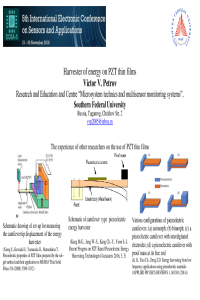
In the last decade, much attention has been paid to the development of devices for collecting and converting energy scattered in the environment - harvesters of energy. The most promising for this purpose are piezoelectric transducers. They make it possible to convert the mechanical energy of motion and scattered electromagnetic energy into an electrical signal. One of the main materials for such piezoelectric energy harvester is lead titanate zirconate (PbZrxTi1-xO3), which has high piezoelectric properties.
We developed and investigated the design and collected a laboratory energy harvester sample based on PZT thin films with a thickness of 1 - 1.5 μm. The films were formed by high-frequency reactive plasma sputtering in an oxygen atmosphere. The resulting sample was sensitive to mechanical acceleration and vibration. Sensor tests calibrated load on the electrochemical test stand showed that the sensor exhibits a power-law sensitivity dependence on the acceleration frequency, the highest sensitivity in the frequency range from 2 to 5 Hz with a sensitivity of up to 75 pC/g, which corresponds to a sensitivity of 1.2 -1.5 V/g.
The same sensor design was sensitive to scattered electromagnetic energy with a sensitivity of 6.8∙10-4 V/(V/cm). At what, the maximum sensitivity reached at non-low frequencies of an electromagnetic field of 20-50 Hz. It is known that the intensity of the scattered energy in the atmosphere can reach hundreds of V / m. The developed laboratory sample had an area of about 1 cm2. In the case of an area increase of 100 times, it is possible to obtain an output signal up to 1 V.
Thus, on the basis of small-size designs based on PZT films, it is possible to obtain autonomous energy sources.
The reported study was funded by RFBR according to the research project № 18-29-11019.
Keywords
segentoelectric films
energy converters
physical sensors
Manuscript
Petrov VV harverster of energy Manuscript 2018 11 19.pdf
Poster
Petrov VV harverster of energy Prezentation FINISH 2018 10 30.pdf
Non Model Approach Based Damage Detection in RC Frame with Masonry Infill