Event submissions
EventsMOL2NET'18, Conference on Molecular, Biomed., Comput. & Network Science and Engineering, 4th ed.
Published

This submission belongs to the session 02. USEDAT-04: USA-Europe Data Analysis Training Program Workshop, Cambridge, UK-Bilbao, Spain-Miami, USA, 2018 of the event MOL2NET'18, Conference on Molecular, Biomed., Comput. & Network Science and Engineering, 4th ed.
Published date
23 Nov, 2018
Citation
Renata Priscila Costa Barros, Marcus Tullius Scotti, Ligand-Based and Structure-Based virtual screening for the discovery of natural inhibitor the Hepatitis C Virus, in Proceedings of MOL2NET'18, Conference on Molecular, Biomed., Comput. & Network Science and Engineering, 4th ed., 15 January 2018–20 January 2019, MDPI: Basel, Switzerland, doi: 10.3390/mol2net-04-05873
Share
Email
Facebook
Twitter
LinkedIn
Ligand-Based and Structure-Based virtual screening for the discovery of natural inhibitor the Hepatitis C Virus
'%3e%3cpath%20d='M12.6647%2010.9104C12.4176%2010.325%2012.0589%209.7933%2011.6088%209.34485C11.16%208.89511%2010.6283%208.53653%2010.0432%208.28891C10.038%208.28629%2010.0327%208.28498%2010.0275%208.28236C10.8437%207.69282%2011.3743%206.73252%2011.3743%205.64907C11.3743%203.85423%209.92005%202.40002%208.12522%202.40002C6.33038%202.40002%204.87618%203.85423%204.87618%205.64907C4.87618%206.73252%205.40677%207.69282%206.22296%208.28367C6.21772%208.28629%206.21248%208.2876%206.20724%208.29022C5.62031%208.53783%205.09365%208.89287%204.64167%209.34616C4.19192%209.79496%203.83334%2010.3266%203.58573%2010.9117C3.34247%2011.4846%203.21128%2012.0987%203.19925%2012.721C3.1989%2012.735%203.20135%2012.7489%203.20646%2012.7619C3.21157%2012.7749%203.21924%2012.7868%203.22901%2012.7968C3.23877%2012.8068%203.25045%2012.8148%203.26334%2012.8202C3.27623%2012.8256%203.29007%2012.8284%203.30406%2012.8284H4.09012C4.14776%2012.8284%204.19362%2012.7825%204.19493%2012.7262C4.22113%2011.7148%204.62726%2010.7676%205.34519%2010.0497C6.08802%209.30686%207.07452%208.89811%208.12522%208.89811C9.17592%208.89811%2010.1624%209.30686%2010.9052%2010.0497C11.6232%2010.7676%2012.0293%2011.7148%2012.0555%2012.7262C12.0568%2012.7839%2012.1027%2012.8284%2012.1603%2012.8284H12.9464C12.9604%2012.8284%2012.9742%2012.8256%2012.9871%2012.8202C13%2012.8148%2013.0117%2012.8068%2013.0214%2012.7968C13.0312%2012.7868%2013.0389%2012.7749%2013.044%2012.7619C13.0491%2012.7489%2013.0515%2012.735%2013.0512%2012.721C13.0381%2012.0947%2012.9084%2011.4856%2012.6647%2010.9104ZM8.12522%207.90243C7.52388%207.90243%206.95792%207.66793%206.53214%207.24215C6.10636%206.81636%205.87185%206.2504%205.87185%205.64907C5.87185%205.04773%206.10636%204.48177%206.53214%204.05599C6.95792%203.63021%207.52388%203.3957%208.12522%203.3957C8.72655%203.3957%209.29252%203.63021%209.7183%204.05599C10.1441%204.48177%2010.3786%205.04773%2010.3786%205.64907C10.3786%206.2504%2010.1441%206.81636%209.7183%207.24215C9.29252%207.66793%208.72655%207.90243%208.12522%207.90243Z'%20fill='%235D1EE1'/%3e%3c/g%3e%3c/svg%3e)
Renata Priscila Costa Barros 1

Marcus Tullius Scotti 1
1. Federal University of Paraiba
Abstract
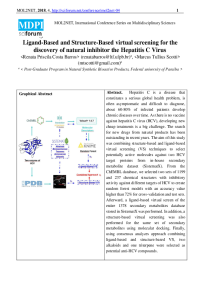
Hepatitis C is a disease that constitutes a serious global health problem, is often asymptomatic and difficult to diagnose, about 60-80% of infected patients develop chronic diseases over time. As there is no vaccine against hepatitis C virus (HCV), developing new cheap treatments is a big challenge. The search for new drugs from natural products has been outstanding in recent years. The aim of this study was combining structure-based and ligand-based virtual screening (VS) techniques to select potentially active molecules against two HCV target proteins from in-house secondary metabolite dataset (SistematX). From the ChEMBL database, we selected two sets of 1199 and 237chemical structures with inhibitory activity against different targets of HCV to create random forest models with an accuracy value higher than 72% for cross-validation and test sets. Afterward, a ligand-based virtual screen of the entire 1848 secondary metabolites database stored in SistematX was performed. In addition, a structure-based virtual screening was also performed for the same set of secondary metabolites using molecular docking. Finally, using consensus analyzes approach combining ligand-based and structure-based VS, two alkaloids and one triterpene were selected as potential anti-HCV compounds.
Keywords
Hepatitis C virus
alkaloids
terpenes
ligand-based virtual screening
structure-based virtual screening
Poster
Mol2Net Renata Priscila Costa Barros.pdf
Predicting Proteasome Inhibition using Atomic Weighted Vector and Machine Learning
PROPOSITION IN SILICO OF BENZOIC ANALOGS AGAINST Staphylococcus aureus