Event submissions
EventsMOL2NET'18, Conference on Molecular, Biomed., Comput. & Network Science and Engineering, 4th ed.
Published

This submission belongs to the session 05. MODEC-03: Workshop on Natural Products and Agro-Industrial Procesess in Amazon, UEA, Puyo, Ecuador, 2018 of the event MOL2NET'18, Conference on Molecular, Biomed., Comput. & Network Science and Engineering, 4th ed.
Published date
29 Nov, 2018
Citation
Galo Cerda Mejía, Víctor Rodrigo Cerda Mejía, Amaury Peréz Martínez, Javier Dominguez Brito, Erenio Gonzales Suarez, Thermal efficiency analysis of a discontinuous distiller for Ocotea quixos from Amazon Region of Ecuador, in Proceedings of MOL2NET'18, Conference on Molecular, Biomed., Comput. & Network Science and Engineering, 4th ed., 15 January 2018–20 January 2019, MDPI: Basel, Switzerland, doi: 10.3390/mol2net-04-05879
Share
Email
Facebook
Twitter
LinkedIn
Thermal efficiency analysis of a discontinuous distiller for Ocotea quixos from Amazon Region of Ecuador

Galo Cerda Mejía 1

Víctor Rodrigo Cerda Mejía 1
'%3e%3cpath%20d='M12.6647%2010.9104C12.4176%2010.325%2012.0589%209.7933%2011.6088%209.34485C11.16%208.89511%2010.6283%208.53653%2010.0432%208.28891C10.038%208.28629%2010.0327%208.28498%2010.0275%208.28236C10.8437%207.69282%2011.3743%206.73252%2011.3743%205.64907C11.3743%203.85423%209.92005%202.40002%208.12522%202.40002C6.33038%202.40002%204.87618%203.85423%204.87618%205.64907C4.87618%206.73252%205.40677%207.69282%206.22296%208.28367C6.21772%208.28629%206.21248%208.2876%206.20724%208.29022C5.62031%208.53783%205.09365%208.89287%204.64167%209.34616C4.19192%209.79496%203.83334%2010.3266%203.58573%2010.9117C3.34247%2011.4846%203.21128%2012.0987%203.19925%2012.721C3.1989%2012.735%203.20135%2012.7489%203.20646%2012.7619C3.21157%2012.7749%203.21924%2012.7868%203.22901%2012.7968C3.23877%2012.8068%203.25045%2012.8148%203.26334%2012.8202C3.27623%2012.8256%203.29007%2012.8284%203.30406%2012.8284H4.09012C4.14776%2012.8284%204.19362%2012.7825%204.19493%2012.7262C4.22113%2011.7148%204.62726%2010.7676%205.34519%2010.0497C6.08802%209.30686%207.07452%208.89811%208.12522%208.89811C9.17592%208.89811%2010.1624%209.30686%2010.9052%2010.0497C11.6232%2010.7676%2012.0293%2011.7148%2012.0555%2012.7262C12.0568%2012.7839%2012.1027%2012.8284%2012.1603%2012.8284H12.9464C12.9604%2012.8284%2012.9742%2012.8256%2012.9871%2012.8202C13%2012.8148%2013.0117%2012.8068%2013.0214%2012.7968C13.0312%2012.7868%2013.0389%2012.7749%2013.044%2012.7619C13.0491%2012.7489%2013.0515%2012.735%2013.0512%2012.721C13.0381%2012.0947%2012.9084%2011.4856%2012.6647%2010.9104ZM8.12522%207.90243C7.52388%207.90243%206.95792%207.66793%206.53214%207.24215C6.10636%206.81636%205.87185%206.2504%205.87185%205.64907C5.87185%205.04773%206.10636%204.48177%206.53214%204.05599C6.95792%203.63021%207.52388%203.3957%208.12522%203.3957C8.72655%203.3957%209.29252%203.63021%209.7183%204.05599C10.1441%204.48177%2010.3786%205.04773%2010.3786%205.64907C10.3786%206.2504%2010.1441%206.81636%209.7183%207.24215C9.29252%207.66793%208.72655%207.90243%208.12522%207.90243Z'%20fill='%235D1EE1'/%3e%3c/g%3e%3c/svg%3e)
Amaury Peréz Martínez 1
Javier Dominguez Brito 1
Erenio Gonzales Suarez 2
1. Universidad Estatal Amazónica
2. Universidad Central "Marta Abreu" de la Villas
Abstract
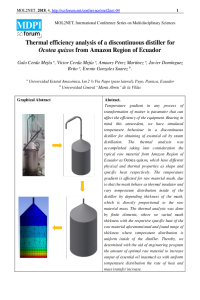
Temperature gradient in any process of transformation of matter is parameter that can affect the efficiency of the equipment. Bearing in mind this antecedent, we have simulated temperature behaviour in a discontinuous distiller for obtaining of essential oil by steam distillation. The thermal analysis was accomplished taking into consideration the typical raw material from Amazon Region of Ecuador as Ocotea Quixos, which have different physical and thermal properties as shape and specific heat respectively. The temperature gradient is affected for raw material mash, due to that the mash behave as thermal insulator and vary temperature distribution inside of the distiller by depending thickness of the mash, which is directly proportional to the raw material mass. The thermal analysis was done by finite elements, where we varied mash thickness with the respective specific heat of the raw material aforementioned and found range of thickness where temperature distribution is uniform inside of the distiller. Thereby, we determined with the aid of engineering program the amount of optimal raw material to increase output of essential oil inasmuch as with uniform temperature distribution the rate of heat and mass transfer increase.
Keywords
Thermal gradient
steam distillation
finite elements.
Poster
ID, Sciforum-022505.pdf
Content of phenolic compounds in powders of six Amazonian vegetables and its effect as a phytobiotic additive for pigs
The Pig Manure Anaerobic Digestion. A tubular biodigester characterization in the Ecuadorian Amazon