Event submissions
EventsMOL2NET'18, Conference on Molecular, Biomed., Comput. & Network Science and Engineering, 4th ed.
Published

This submission belongs to the session 09. NICEXSM-04: North-Ibero-American Congress on Exp. and Simul. Methods., Valencia, Spain-Talca, Chile-Miami, USA, 2018-2019 of the event MOL2NET'18, Conference on Molecular, Biomed., Comput. & Network Science and Engineering, 4th ed.
Published date
13 Dec, 2018
Citation
Adela León, Francisco Torrens, Gloria Castellano, Quantitative Structure-Antileukemic Activity Models of stilbenoids: A Theoretical Study, in Proceedings of MOL2NET'18, Conference on Molecular, Biomed., Comput. & Network Science and Engineering, 4th ed., 15 January 2018–20 January 2019, MDPI: Basel, Switzerland, doi: 10.3390/mol2net-04-05903
Share
Email
Facebook
Twitter
LinkedIn
Quantitative Structure-Antileukemic Activity Models of stilbenoids: A Theoretical Study
'%3e%3cpath%20d='M12.6647%2010.9104C12.4176%2010.325%2012.0589%209.7933%2011.6088%209.34485C11.16%208.89511%2010.6283%208.53653%2010.0432%208.28891C10.038%208.28629%2010.0327%208.28498%2010.0275%208.28236C10.8437%207.69282%2011.3743%206.73252%2011.3743%205.64907C11.3743%203.85423%209.92005%202.40002%208.12522%202.40002C6.33038%202.40002%204.87618%203.85423%204.87618%205.64907C4.87618%206.73252%205.40677%207.69282%206.22296%208.28367C6.21772%208.28629%206.21248%208.2876%206.20724%208.29022C5.62031%208.53783%205.09365%208.89287%204.64167%209.34616C4.19192%209.79496%203.83334%2010.3266%203.58573%2010.9117C3.34247%2011.4846%203.21128%2012.0987%203.19925%2012.721C3.1989%2012.735%203.20135%2012.7489%203.20646%2012.7619C3.21157%2012.7749%203.21924%2012.7868%203.22901%2012.7968C3.23877%2012.8068%203.25045%2012.8148%203.26334%2012.8202C3.27623%2012.8256%203.29007%2012.8284%203.30406%2012.8284H4.09012C4.14776%2012.8284%204.19362%2012.7825%204.19493%2012.7262C4.22113%2011.7148%204.62726%2010.7676%205.34519%2010.0497C6.08802%209.30686%207.07452%208.89811%208.12522%208.89811C9.17592%208.89811%2010.1624%209.30686%2010.9052%2010.0497C11.6232%2010.7676%2012.0293%2011.7148%2012.0555%2012.7262C12.0568%2012.7839%2012.1027%2012.8284%2012.1603%2012.8284H12.9464C12.9604%2012.8284%2012.9742%2012.8256%2012.9871%2012.8202C13%2012.8148%2013.0117%2012.8068%2013.0214%2012.7968C13.0312%2012.7868%2013.0389%2012.7749%2013.044%2012.7619C13.0491%2012.7489%2013.0515%2012.735%2013.0512%2012.721C13.0381%2012.0947%2012.9084%2011.4856%2012.6647%2010.9104ZM8.12522%207.90243C7.52388%207.90243%206.95792%207.66793%206.53214%207.24215C6.10636%206.81636%205.87185%206.2504%205.87185%205.64907C5.87185%205.04773%206.10636%204.48177%206.53214%204.05599C6.95792%203.63021%207.52388%203.3957%208.12522%203.3957C8.72655%203.3957%209.29252%203.63021%209.7183%204.05599C10.1441%204.48177%2010.3786%205.04773%2010.3786%205.64907C10.3786%206.2504%2010.1441%206.81636%209.7183%207.24215C9.29252%207.66793%208.72655%207.90243%208.12522%207.90243Z'%20fill='%235D1EE1'/%3e%3c/g%3e%3c/svg%3e)
Adela León 1

Francisco Torrens 2

Gloria Castellano 3
1. Escuela de Doctorado, Universidad Católica de Valencia San Vicente Mártir, 46008, Valencia, Spain.
2. Institut Universitari de Ciència Molecular, Universitat de València, Edifici d'Instituts de Paterna, P.O. Box 22085, E-46071, València, Spain.
3. Centro de Investigación Traslacional San Alberto Magno (CITSAM). Universidad Católica de Valencia San Vicente Mártir, 46001, Valencia, Spain. ORCID: 0000-0001-7284-880X
Abstract
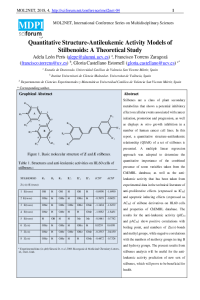
Stilbenes are a class of plant secondary metabolites that show a potential inhibitory effect on cellular events associated with cancer initiation, promotion, and progression, as well as display in vitro growth inhibition in a number of human cancer cell lines. In this report, a quantitative structure-antileukemic relationship (QSAR) of a set of stilbenes is presented. A multiple linear regression approach was adopted to determine the quantitative importance of the combined presence of some variables taken from the ChEMBL database, as well as the antileukemic activity that has been taken from experimental data in the technical literature of anti-proliferative effects (expressed as IC50) and apoptosis-inducing effects (expressed as AC50) of stilbene derivatives on HL60 cells and properties of ChEMBL database. The results for the antileukemic activity (pIC50 and pAC50) show positive correlations with boiling point, and numbers of cis-bonds and methyl groups, as well as negative correlations with the numbers of methoxy groups in ring B and hydroxy groups. Results from stilbenes analysis will be useful for antileukemic activity prediction of new sets of new stilbenoids, which will prove beneficial for health.
Keywords
Stilbenes
antileukemic activity
QSAR
Manuscript
mol2net-03-MOL2NET-2017-template final.pdf
Poster
mol2net-03-MOL2NET-2017-template final.pdf
The Diagnosis and Treatment of Niekmann Pick Disease (NPD)
A new procedure for the Antioxidant capacity dpph assessment in small samples.