Event submissions
EventsMOL2NET'18, Conference on Molecular, Biomed., Comput. & Network Science and Engineering, 4th ed.
Published

This submission belongs to the session 02. USEDAT-04: USA-Europe Data Analysis Training Program Workshop, Cambridge, UK-Bilbao, Spain-Miami, USA, 2018 of the event MOL2NET'18, Conference on Molecular, Biomed., Comput. & Network Science and Engineering, 4th ed.
Published date
16 Dec, 2018
Citation
Alex FM Monteiro, Marcus Tullius Scotti, Luciana Scotti, MOLECULAR MODELING OF NUCLEOTIDE DERIVATIVES OF 2.5-DIHYDROFURAN-2,5-DIOL FOR EVALUATION OF POTENTIAL ANTITUBERCULAR ACTIVITY, in Proceedings of MOL2NET'18, Conference on Molecular, Biomed., Comput. & Network Science and Engineering, 4th ed., 15 January 2018–20 January 2019, MDPI: Basel, Switzerland, doi: 10.3390/mol2net-04-05917
Share
Email
Facebook
Twitter
LinkedIn
MOLECULAR MODELING OF NUCLEOTIDE DERIVATIVES OF 2.5-DIHYDROFURAN-2,5-DIOL FOR EVALUATION OF POTENTIAL ANTITUBERCULAR ACTIVITY

Alex FM Monteiro 1,2
'%3e%3cpath%20d='M12.6647%2010.9104C12.4176%2010.325%2012.0589%209.7933%2011.6088%209.34485C11.16%208.89511%2010.6283%208.53653%2010.0432%208.28891C10.038%208.28629%2010.0327%208.28498%2010.0275%208.28236C10.8437%207.69282%2011.3743%206.73252%2011.3743%205.64907C11.3743%203.85423%209.92005%202.40002%208.12522%202.40002C6.33038%202.40002%204.87618%203.85423%204.87618%205.64907C4.87618%206.73252%205.40677%207.69282%206.22296%208.28367C6.21772%208.28629%206.21248%208.2876%206.20724%208.29022C5.62031%208.53783%205.09365%208.89287%204.64167%209.34616C4.19192%209.79496%203.83334%2010.3266%203.58573%2010.9117C3.34247%2011.4846%203.21128%2012.0987%203.19925%2012.721C3.1989%2012.735%203.20135%2012.7489%203.20646%2012.7619C3.21157%2012.7749%203.21924%2012.7868%203.22901%2012.7968C3.23877%2012.8068%203.25045%2012.8148%203.26334%2012.8202C3.27623%2012.8256%203.29007%2012.8284%203.30406%2012.8284H4.09012C4.14776%2012.8284%204.19362%2012.7825%204.19493%2012.7262C4.22113%2011.7148%204.62726%2010.7676%205.34519%2010.0497C6.08802%209.30686%207.07452%208.89811%208.12522%208.89811C9.17592%208.89811%2010.1624%209.30686%2010.9052%2010.0497C11.6232%2010.7676%2012.0293%2011.7148%2012.0555%2012.7262C12.0568%2012.7839%2012.1027%2012.8284%2012.1603%2012.8284H12.9464C12.9604%2012.8284%2012.9742%2012.8256%2012.9871%2012.8202C13%2012.8148%2013.0117%2012.8068%2013.0214%2012.7968C13.0312%2012.7868%2013.0389%2012.7749%2013.044%2012.7619C13.0491%2012.7489%2013.0515%2012.735%2013.0512%2012.721C13.0381%2012.0947%2012.9084%2011.4856%2012.6647%2010.9104ZM8.12522%207.90243C7.52388%207.90243%206.95792%207.66793%206.53214%207.24215C6.10636%206.81636%205.87185%206.2504%205.87185%205.64907C5.87185%205.04773%206.10636%204.48177%206.53214%204.05599C6.95792%203.63021%207.52388%203.3957%208.12522%203.3957C8.72655%203.3957%209.29252%203.63021%209.7183%204.05599C10.1441%204.48177%2010.3786%205.04773%2010.3786%205.64907C10.3786%206.2504%2010.1441%206.81636%209.7183%207.24215C9.29252%207.66793%208.72655%207.90243%208.12522%207.90243Z'%20fill='%235D1EE1'/%3e%3c/g%3e%3c/svg%3e)
Marcus Tullius Scotti 3
Luciana Scotti 3,4
1. Postgraduate Program in Bioactive Natural and Synthetic Products, Federal University of Paraíba, Castelo Branco - João Pessoa - Brazil.
2. Postgraduate Program in Chemistry - Federal Rural University of Pernambuco - UFRPE - Recife - PE.
3. Federal University of Paraíba, Health Sci. Center, 50670-910, João Pessoa, PB, Brazil
4. Teaching and Research Management - University Hospital, Federal University of Paraíba, João Pessoa, PB, Brazil
Abstract
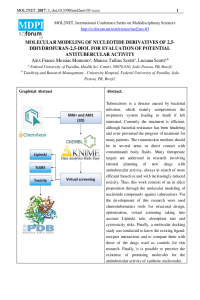
The bacteria Mycobacterium tuberculosis is responsible for the pathology known as tuberculosis, which is one of the top 10 causes of death in the world, according to the World Health Organization (WHO) in 2017 about 10 million people contracted the disease, of which 1.6 million died last year. The bacterial infection in its primary form compromises the lungs, however, it is possible to reach the brain, bones, heart, kidneys and other organ of the human body. The form of transmission is mainly through the air, where infected people cough, sneeze or spit spreading the bacteria, leaving it available to contaminate new individuals. Tuberculosis is treatable with the aid of antibiotics and avoided from childhood with the aid of the vaccine BCG (Bacillus Calmette-Guérin), however, studies show that 82% of tuberculosis cases the bacterium develops resistance to first-line drugs such as rifampicin, due to this problem, research in the field of pharmaceutical sciences is necessary to make new bioactive available to treat the disease. Some authors have developed studies on the use of nucleoside / nucleotide analogues as antitubercular bioactive and have shown good results that have made this class of synthetic compounds promising drug candidates in the fight against M. tuberculosis. Knowing the potential activity against tuberculosis of nucleotides, the objective of this study is the molecular modeling with the use of several computational tools for the theoretical proposition of some derivatives of 2,5-dihidroxyfuran-2,5-diol with adenine against tuberculosis-causing bacteria. For the initial part of this research, a model of activity prediction was developed in the KNIME Analytics Platform 3.7 using molecules exported from the database of chemical structure ChEMBL (https://www.ebi.ac.uk/chembl), thus, nucleotides that were active against the model were subjected to a virtual screening, taking into consideration the risks of cytotoxicity (mutagenicity, carcinogenicity, skin irritability and effect on the reproductive system), oral absorption rate (%ABS) and Lipinski's rule, of the compounds approved in the screening performed were calculated the energies of the ligand-receptor interactions for the proteins (PDB ID 5VRN and PDB ID 5YHV), as well as the drugs used as controls: pyrazinamide, ethambutol, rifabutin, amikacin, levofloxacin, ethionamide and protionamide. As conclusion of this research, it was possible to perceive the existence of compounds approved by the virtual screening that presented good ligand-receptor interactions in the molecular docking for the two proteins selected, being the most promising ones of the studied series.
Keywords
Molecular docking
tuberculosis
in silico
nucleotide
virtual screening.
Poster
RESUMO EXPANDIDO.pdf
A new simplex machine learning approach for analysis of structural chemical diversification processes. Comparison with other molecular modeling methods.
Mini-review on the applications and perspectives of a new simplex machine learning approach in chemistry and biology