Event submissions
EventsMOL2NET'18, Conference on Molecular, Biomed., Comput. & Network Science and Engineering, 4th ed.
Published

This submission belongs to the session 06. CHEMBIOMOL-04: Chem. Biol. & Med. Chem. Workshop, Paraiba, Porto, Rostock, Germany-Galveston, Texas, USA, 2018 of the event MOL2NET'18, Conference on Molecular, Biomed., Comput. & Network Science and Engineering, 4th ed.
Published date
17 Dec, 2018
Citation
Pedro Rafael Magalhães, Diogo Vila-Viçosa, Tomás Silva, Miguel Machuqueiro, pH effects on PG/PC and PS/PC lipid binary mixtures, in Proceedings of MOL2NET'18, Conference on Molecular, Biomed., Comput. & Network Science and Engineering, 4th ed., 15 January 2018–20 January 2019, MDPI: Basel, Switzerland, doi: 10.3390/mol2net-04-05922
Share
Email
Facebook
Twitter
LinkedIn
pH effects on PG/PC and PS/PC lipid binary mixtures
'%3e%3cpath%20d='M12.6647%2010.9104C12.4176%2010.325%2012.0589%209.7933%2011.6088%209.34485C11.16%208.89511%2010.6283%208.53653%2010.0432%208.28891C10.038%208.28629%2010.0327%208.28498%2010.0275%208.28236C10.8437%207.69282%2011.3743%206.73252%2011.3743%205.64907C11.3743%203.85423%209.92005%202.40002%208.12522%202.40002C6.33038%202.40002%204.87618%203.85423%204.87618%205.64907C4.87618%206.73252%205.40677%207.69282%206.22296%208.28367C6.21772%208.28629%206.21248%208.2876%206.20724%208.29022C5.62031%208.53783%205.09365%208.89287%204.64167%209.34616C4.19192%209.79496%203.83334%2010.3266%203.58573%2010.9117C3.34247%2011.4846%203.21128%2012.0987%203.19925%2012.721C3.1989%2012.735%203.20135%2012.7489%203.20646%2012.7619C3.21157%2012.7749%203.21924%2012.7868%203.22901%2012.7968C3.23877%2012.8068%203.25045%2012.8148%203.26334%2012.8202C3.27623%2012.8256%203.29007%2012.8284%203.30406%2012.8284H4.09012C4.14776%2012.8284%204.19362%2012.7825%204.19493%2012.7262C4.22113%2011.7148%204.62726%2010.7676%205.34519%2010.0497C6.08802%209.30686%207.07452%208.89811%208.12522%208.89811C9.17592%208.89811%2010.1624%209.30686%2010.9052%2010.0497C11.6232%2010.7676%2012.0293%2011.7148%2012.0555%2012.7262C12.0568%2012.7839%2012.1027%2012.8284%2012.1603%2012.8284H12.9464C12.9604%2012.8284%2012.9742%2012.8256%2012.9871%2012.8202C13%2012.8148%2013.0117%2012.8068%2013.0214%2012.7968C13.0312%2012.7868%2013.0389%2012.7749%2013.044%2012.7619C13.0491%2012.7489%2013.0515%2012.735%2013.0512%2012.721C13.0381%2012.0947%2012.9084%2011.4856%2012.6647%2010.9104ZM8.12522%207.90243C7.52388%207.90243%206.95792%207.66793%206.53214%207.24215C6.10636%206.81636%205.87185%206.2504%205.87185%205.64907C5.87185%205.04773%206.10636%204.48177%206.53214%204.05599C6.95792%203.63021%207.52388%203.3957%208.12522%203.3957C8.72655%203.3957%209.29252%203.63021%209.7183%204.05599C10.1441%204.48177%2010.3786%205.04773%2010.3786%205.64907C10.3786%206.2504%2010.1441%206.81636%209.7183%207.24215C9.29252%207.66793%208.72655%207.90243%208.12522%207.90243Z'%20fill='%235D1EE1'/%3e%3c/g%3e%3c/svg%3e)
Pedro Rafael Magalhães 1
Diogo Vila-Viçosa 1
Tomás Silva 1

Miguel Machuqueiro 1
1. FCUL
Abstract
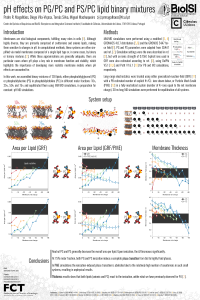
Membranes are vital components of biological systems, fulfilling a myriad of roles in the cell [1]. Despite their highly diverse composition, they are primarily comprised of zwitterionic and anionic lipids which, in some cases, makes them sensitive to changes in pH. In computational methods, the inherent complexity of these systems is often simplified via the use of model membranes normally composed of a single lipid type or, in some cases, of binary or ternary mixtures. While these approximations are generally adequate, there are particular instances where the pH, and consequently, the titration of lipid headgroups, plays a key role in membrane stability and function, meaning that the development of more realistic membrane models is extremely important.
Previously, we reported in simulations of a 25% PA/PC (phosphatidic acid/phosphatidylcholine) mixture a pH-dependent phase transition from gel to fluid [2]. In this work, we assembled binary mixtures of either phosphatidylglycerol (PG) or phosphatidylserine (PS) in phosphatidylcholine (PC) with different molar fractions (10%, 25%, 50% or 75% of PG or PS) and studied the effect of pH using the latest implementation of our constant-pH MD method with lipid titration (CpHMD-L) [2].
Acknowledgments
We acknowledge financial support from FCT through grant SFRH/BPD/110491/2015 and projects PTDC/QEQCOM/5904/2014, UID/MULTI/00612/2013 and UID/MULTI/04046/2013.
References
[1] Edidin, M., NRMCB, 4 (2003) 414.
[2] Santos, H.A.F., Vila-Viçosa, D., Teixeira, V.H., Baptista, A.M., Machuqueiro, M. JCTC, 11 (2015) 5973
Keywords
Constant-pH
molecular dynamics
anionic lipids
Manuscript
ejibce2018_poster_prmagalhaes.pdf
Poster
ejibce2018_poster_prmagalhaes.pdf
Incidence of the use of didactic material for students with hearing disability at the basic intercultural education center of deaf
Antibacterial activities of triterpenes from leaves of Cissus incisa