Event submissions
EventsMOL2NET'18, Conference on Molecular, Biomed., Comput. & Network Science and Engineering, 4th ed.
Published

This submission belongs to the session 06. CHEMBIOMOL-04: Chem. Biol. & Med. Chem. Workshop, Paraiba, Porto, Rostock, Germany-Galveston, Texas, USA, 2018 of the event MOL2NET'18, Conference on Molecular, Biomed., Comput. & Network Science and Engineering, 4th ed.
Published date
17 Dec, 2018
Citation
André Pina, Sérgio F. Sousa, Nuno M. F. S. A. Cerqueira, Application of QM/MM Methods in the Study of PNPOx, in Proceedings of MOL2NET'18, Conference on Molecular, Biomed., Comput. & Network Science and Engineering, 4th ed., 15 January 2018–20 January 2019, MDPI: Basel, Switzerland, doi: 10.3390/mol2net-04-06005
Share
Email
Facebook
Twitter
LinkedIn
Application of QM/MM Methods in the Study of PNPOx

André Pina 1

Sérgio F. Sousa 1
'%3e%3cpath%20d='M12.6647%2010.9104C12.4176%2010.325%2012.0589%209.7933%2011.6088%209.34485C11.16%208.89511%2010.6283%208.53653%2010.0432%208.28891C10.038%208.28629%2010.0327%208.28498%2010.0275%208.28236C10.8437%207.69282%2011.3743%206.73252%2011.3743%205.64907C11.3743%203.85423%209.92005%202.40002%208.12522%202.40002C6.33038%202.40002%204.87618%203.85423%204.87618%205.64907C4.87618%206.73252%205.40677%207.69282%206.22296%208.28367C6.21772%208.28629%206.21248%208.2876%206.20724%208.29022C5.62031%208.53783%205.09365%208.89287%204.64167%209.34616C4.19192%209.79496%203.83334%2010.3266%203.58573%2010.9117C3.34247%2011.4846%203.21128%2012.0987%203.19925%2012.721C3.1989%2012.735%203.20135%2012.7489%203.20646%2012.7619C3.21157%2012.7749%203.21924%2012.7868%203.22901%2012.7968C3.23877%2012.8068%203.25045%2012.8148%203.26334%2012.8202C3.27623%2012.8256%203.29007%2012.8284%203.30406%2012.8284H4.09012C4.14776%2012.8284%204.19362%2012.7825%204.19493%2012.7262C4.22113%2011.7148%204.62726%2010.7676%205.34519%2010.0497C6.08802%209.30686%207.07452%208.89811%208.12522%208.89811C9.17592%208.89811%2010.1624%209.30686%2010.9052%2010.0497C11.6232%2010.7676%2012.0293%2011.7148%2012.0555%2012.7262C12.0568%2012.7839%2012.1027%2012.8284%2012.1603%2012.8284H12.9464C12.9604%2012.8284%2012.9742%2012.8256%2012.9871%2012.8202C13%2012.8148%2013.0117%2012.8068%2013.0214%2012.7968C13.0312%2012.7868%2013.0389%2012.7749%2013.044%2012.7619C13.0491%2012.7489%2013.0515%2012.735%2013.0512%2012.721C13.0381%2012.0947%2012.9084%2011.4856%2012.6647%2010.9104ZM8.12522%207.90243C7.52388%207.90243%206.95792%207.66793%206.53214%207.24215C6.10636%206.81636%205.87185%206.2504%205.87185%205.64907C5.87185%205.04773%206.10636%204.48177%206.53214%204.05599C6.95792%203.63021%207.52388%203.3957%208.12522%203.3957C8.72655%203.3957%209.29252%203.63021%209.7183%204.05599C10.1441%204.48177%2010.3786%205.04773%2010.3786%205.64907C10.3786%206.2504%2010.1441%206.81636%209.7183%207.24215C9.29252%207.66793%208.72655%207.90243%208.12522%207.90243Z'%20fill='%235D1EE1'/%3e%3c/g%3e%3c/svg%3e)
Nuno M. F. S. A. Cerqueira 1
1. UCIBIO/REQUIMTE, BioSIM Departamento de Biomedicina, Faculdade de Medicina, Universidade do Porto, Alameda Professor Hernâni Monteiro, 4200-319 Porto, Portugal
Abstract
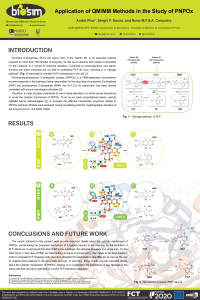
Pyridoxal 5'-phosphate (PLP), the active form of the vitamin B6, is an essential cofactor required by more than 160 families of enzymes. Its role as an electron sink makes it imperative for the catalysis of a myriad of chemical reactions. Contrarily to microorganisms and plants, humans and other mammals are not able to synthesize PLP de novo, resorting to a "salvage pathway" that helps to maintain PLP homeostasis [1]. The correct functioning of this salvage pathway is crucial for the cell, as demonstrated by the correlation between low levels of PLP and the occurrence of severe neurological disorders [2]. It was found that the major culprit is pyridoxine/pyridoxamine 5'-phosphate oxidase (PNPOx), an FMN-dependent homodimeric enzyme responsible for the recycling of pyridoxine 5'-phosphate (PNP) and pyridoxamine 5'-phosphate (PMP) into PLP [3]. Therefore, in order to better understand its role in these disorders, it is of the utmost importance to unveil the catalytic mechanism of PNPOx. To do so we used computational means, namely QM/MM hybrid methodologies [4], to evaluate different mechanistic proposals related to PNPOx reactivity. Models were prepared and evaluated enabling important aspects related to the catalytic modelling of this enzyme to be validated. The results obtained in the present work provide important details about the catalytic mechanism of PNPOx, helping us to understand the importance of some key residues in the active site that can have implications in some PLP-deficiency disorders. More studies are required to fully understand the catalytic mechanism of this important enzyme.
Acknowledgments: We acknowledge FCT for financial support to the PhD grant SFRH/BD/136594/2018, the Starting grants IF/01310/2013 and IF/00052/2014, and to the Project PTDC/QUI-QFI/31689/2017.
References
[1] Di Salvo, M L, et al. Vitamin B6 Salvage Enzymes: Mechanism, Structure and Regulation. BBA-Proteins Proteomics 2011, 1814(11), 1597–1608
[2] Mills, P B, et al. Neonatal Epileptic Encephalopathy Caused by Mutations in the PNPO Gene Encoding Pyridox(Am)Ine 5′-Phosphate Oxidase. Hum Mol Genet 2005, 14(8), 1077–1086
[3] Di Salvo, M L, et al. Structure and Mechanism of Escherichia Coli Pyridoxine 5′-Phosphate Oxidase. BBA-Proteins Proteomics 2003, 1647(1–2), 76–82
[4] Chung, L. W, et al. The ONIOM Method and Its Applications. Chem Rev 2015, 115(12), 5678–5796
Keywords
PNPOx
QM/MM
PLP
PNP
PMP
Manuscript
Andre_Pina_Abstract_MOL2NET.pdf
Poster
Poster_EJIBCE_2018_AndrePina.pdf
Is the 5,10-methylenetetrahydrofolate cofactor synthesized through a non-enzymatic or enzymatic mechanism?
From All Atom to Coarse Grain: Molecular Dynamic Simulation of Imprinting Process on a Silica Xerogel