Event submissions
EventsMOL2NET'18, Conference on Molecular, Biomed., Comput. & Network Science and Engineering, 4th ed.
Published

This submission belongs to the session 06. CHEMBIOMOL-04: Chem. Biol. & Med. Chem. Workshop, Paraiba, Porto, Rostock, Germany-Galveston, Texas, USA, 2018 of the event MOL2NET'18, Conference on Molecular, Biomed., Comput. & Network Science and Engineering, 4th ed.
Published date
17 Dec, 2018
Citation
João Luís, Ana I. Mata, Nuno G. Alves, Carlos J. V. Simões, João Pereira-Vaz, Daniela C. Vaz, Vítor Duque, Rui M. M. Brito, Influence of codon 35 amino acid insertion in HIV-1 protease: insights from molecular dynamics, in Proceedings of MOL2NET'18, Conference on Molecular, Biomed., Comput. & Network Science and Engineering, 4th ed., 15 January 2018–20 January 2019, MDPI: Basel, Switzerland, doi: 10.3390/mol2net-04-06007
Share
Email
Facebook
Twitter
LinkedIn
Influence of codon 35 amino acid insertion in HIV-1 protease: insights from molecular dynamics
'%3e%3cpath%20d='M12.6647%2010.9104C12.4176%2010.325%2012.0589%209.7933%2011.6088%209.34485C11.16%208.89511%2010.6283%208.53653%2010.0432%208.28891C10.038%208.28629%2010.0327%208.28498%2010.0275%208.28236C10.8437%207.69282%2011.3743%206.73252%2011.3743%205.64907C11.3743%203.85423%209.92005%202.40002%208.12522%202.40002C6.33038%202.40002%204.87618%203.85423%204.87618%205.64907C4.87618%206.73252%205.40677%207.69282%206.22296%208.28367C6.21772%208.28629%206.21248%208.2876%206.20724%208.29022C5.62031%208.53783%205.09365%208.89287%204.64167%209.34616C4.19192%209.79496%203.83334%2010.3266%203.58573%2010.9117C3.34247%2011.4846%203.21128%2012.0987%203.19925%2012.721C3.1989%2012.735%203.20135%2012.7489%203.20646%2012.7619C3.21157%2012.7749%203.21924%2012.7868%203.22901%2012.7968C3.23877%2012.8068%203.25045%2012.8148%203.26334%2012.8202C3.27623%2012.8256%203.29007%2012.8284%203.30406%2012.8284H4.09012C4.14776%2012.8284%204.19362%2012.7825%204.19493%2012.7262C4.22113%2011.7148%204.62726%2010.7676%205.34519%2010.0497C6.08802%209.30686%207.07452%208.89811%208.12522%208.89811C9.17592%208.89811%2010.1624%209.30686%2010.9052%2010.0497C11.6232%2010.7676%2012.0293%2011.7148%2012.0555%2012.7262C12.0568%2012.7839%2012.1027%2012.8284%2012.1603%2012.8284H12.9464C12.9604%2012.8284%2012.9742%2012.8256%2012.9871%2012.8202C13%2012.8148%2013.0117%2012.8068%2013.0214%2012.7968C13.0312%2012.7868%2013.0389%2012.7749%2013.044%2012.7619C13.0491%2012.7489%2013.0515%2012.735%2013.0512%2012.721C13.0381%2012.0947%2012.9084%2011.4856%2012.6647%2010.9104ZM8.12522%207.90243C7.52388%207.90243%206.95792%207.66793%206.53214%207.24215C6.10636%206.81636%205.87185%206.2504%205.87185%205.64907C5.87185%205.04773%206.10636%204.48177%206.53214%204.05599C6.95792%203.63021%207.52388%203.3957%208.12522%203.3957C8.72655%203.3957%209.29252%203.63021%209.7183%204.05599C10.1441%204.48177%2010.3786%205.04773%2010.3786%205.64907C10.3786%206.2504%2010.1441%206.81636%209.7183%207.24215C9.29252%207.66793%208.72655%207.90243%208.12522%207.90243Z'%20fill='%235D1EE1'/%3e%3c/g%3e%3c/svg%3e)
João Luís 1
Ana I. Mata 1
Nuno G. Alves 1
Carlos J. V. Simões 1,2
João Pereira-Vaz 3
Daniela C. Vaz 4

Vítor Duque 5
Rui M. M. Brito 1,2
1. CQC, Chemistry Department, Faculty of Science and Technology, University of Coimbra, Coimbra, Portugal
2. BSIM Therapeutics, Instituto Pedro Nunes, Coimbra, Portugal
3. Laboratory of Molecular Biology, Clinical Pathology Unit, CHUC, Coimbra, Portugal
4. Health Research Unit, School of Health Sciences, Leiria, Portugal
5. Infectious Diseases Unit, CHUC, Coimbra, Portugal
Abstract
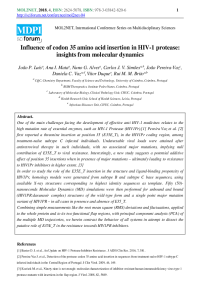
One of the main challenges facing the development of effective anti HIV-1 medicines relates to the high mutation rate of essential enzymes, such as HIV-1 Protease (HIV1Pr).[1] Pereira Vaz et al. [2] first reported a threonine insertion at position 35 (E35E_T), in the HIV1Pr coding region, among treatment-naïve subtype C infected individuals. Undetectable viral loads were attained after antiretroviral therapy in such individuals, with no associated major mutations, implying null contribution of E35E_T to viral resistance. Interestingly, a new study suggests a potential additive effect of position 35 insertions when in presence of major mutations – ultimately leading to resistance to HIV1Pr inhibitors in higher extent. [3]
In order to study the role of the E35E_T insertion in the structure and ligand-binding propensity of HIV1Pr, homology models were generated from subtype B and subtype C base sequences, using available X-ray structures corresponding to highest identity sequences as template. Fifty (50)-nanoseconds Molecular Dynamics (MD) simulations were then performed for unbound and bound (HIV1PR:darunavir complex) structures of the wild-type form and a single‑point major mutation variant of HIV1PR – in all cases in presence and absence of E35_T.
Combining simple measurements like the root mean square (RMS) deviations and fluctuations, applied to the whole protein and to its two functional flap regions, with principal component analysis (PCA) of the multiple MD trajectories, we herein contrast the behaviour of all systems in attempt to dissect the putative role of E35E_T in the resistance towards HIV1PR inhibitors.
Keywords
Insertion E35E_T
HIV-1 protease
Moelcular Dynamics
Manuscript
Abstract_JoãoLuís_EJIBCE.pdf
Poster
Abstract_JoãoLuís_EJIBCE.pdf
From All Atom to Coarse Grain: Molecular Dynamic Simulation of Imprinting Process on a Silica Xerogel
COMPUTATIONAL STUDY OF HYBRID PLA-PEG NANOPARTICLES AS ANTIPLATELET DRUG CARRIERS