Event submissions
EventsMOL2NET'18, Conference on Molecular, Biomed., Comput. & Network Science and Engineering, 4th ed.
Published

This submission belongs to the session 06. CHEMBIOMOL-04: Chem. Biol. & Med. Chem. Workshop, Paraiba, Porto, Rostock, Germany-Galveston, Texas, USA, 2018 of the event MOL2NET'18, Conference on Molecular, Biomed., Comput. & Network Science and Engineering, 4th ed.
Published date
18 Dec, 2018
Citation
Cristina Elisabete Araújo de Sousa, António M. P. Ribeiro, António Gil Fortes, Nuno M. F. S. A. Cerqueira, Maria José Alves, Experimental and Computational Studies Addressed to 1,3-Dipolar Cycloadditions of D-Erythrose 1,3-Dioxane 1,5-Lactone with Regio- andStereo-selectivity, in Proceedings of MOL2NET'18, Conference on Molecular, Biomed., Comput. & Network Science and Engineering, 4th ed., 15 January 2018–20 January 2019, MDPI: Basel, Switzerland, doi: 10.3390/mol2net-04-06075
Share
Email
Facebook
Twitter
LinkedIn
Experimental and Computational Studies Addressed to 1,3-Dipolar Cycloadditions of D-Erythrose 1,3-Dioxane 1,5-Lactone with Regio- and
Stereo-selectivity
Stereo-selectivity

Cristina Elisabete Araújo de Sousa 1
'%3e%3cpath%20d='M12.6647%2010.9104C12.4176%2010.325%2012.0589%209.7933%2011.6088%209.34485C11.16%208.89511%2010.6283%208.53653%2010.0432%208.28891C10.038%208.28629%2010.0327%208.28498%2010.0275%208.28236C10.8437%207.69282%2011.3743%206.73252%2011.3743%205.64907C11.3743%203.85423%209.92005%202.40002%208.12522%202.40002C6.33038%202.40002%204.87618%203.85423%204.87618%205.64907C4.87618%206.73252%205.40677%207.69282%206.22296%208.28367C6.21772%208.28629%206.21248%208.2876%206.20724%208.29022C5.62031%208.53783%205.09365%208.89287%204.64167%209.34616C4.19192%209.79496%203.83334%2010.3266%203.58573%2010.9117C3.34247%2011.4846%203.21128%2012.0987%203.19925%2012.721C3.1989%2012.735%203.20135%2012.7489%203.20646%2012.7619C3.21157%2012.7749%203.21924%2012.7868%203.22901%2012.7968C3.23877%2012.8068%203.25045%2012.8148%203.26334%2012.8202C3.27623%2012.8256%203.29007%2012.8284%203.30406%2012.8284H4.09012C4.14776%2012.8284%204.19362%2012.7825%204.19493%2012.7262C4.22113%2011.7148%204.62726%2010.7676%205.34519%2010.0497C6.08802%209.30686%207.07452%208.89811%208.12522%208.89811C9.17592%208.89811%2010.1624%209.30686%2010.9052%2010.0497C11.6232%2010.7676%2012.0293%2011.7148%2012.0555%2012.7262C12.0568%2012.7839%2012.1027%2012.8284%2012.1603%2012.8284H12.9464C12.9604%2012.8284%2012.9742%2012.8256%2012.9871%2012.8202C13%2012.8148%2013.0117%2012.8068%2013.0214%2012.7968C13.0312%2012.7868%2013.0389%2012.7749%2013.044%2012.7619C13.0491%2012.7489%2013.0515%2012.735%2013.0512%2012.721C13.0381%2012.0947%2012.9084%2011.4856%2012.6647%2010.9104ZM8.12522%207.90243C7.52388%207.90243%206.95792%207.66793%206.53214%207.24215C6.10636%206.81636%205.87185%206.2504%205.87185%205.64907C5.87185%205.04773%206.10636%204.48177%206.53214%204.05599C6.95792%203.63021%207.52388%203.3957%208.12522%203.3957C8.72655%203.3957%209.29252%203.63021%209.7183%204.05599C10.1441%204.48177%2010.3786%205.04773%2010.3786%205.64907C10.3786%206.2504%2010.1441%206.81636%209.7183%207.24215C9.29252%207.66793%208.72655%207.90243%208.12522%207.90243Z'%20fill='%235D1EE1'/%3e%3c/g%3e%3c/svg%3e)
António M. P. Ribeiro 2
António Gil Fortes 2
Nuno M. F. S. A. Cerqueira 3

Maria José Alves 2
1. Universidade Do Minho/BioSIM
2. Universidade Do Minho
3. BioSIM
Abstract
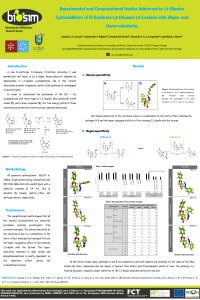
A new D-erythrose 1,3-dioxane 1,5-lactone derivative was synthetized and found to be a highly stereo-selective template as dipolarophile in 1,3-dipolar cycloadditions. Different regio-selectivities were obtained depending on the nature of the 1,3-dipole: complete, with alkyl azides and diazomethylbenzene, inexistent, with nitrile oxides. To understand the mechanisms of cycloadditions with the three types of 1,3-dipoles, computational studies were performed, giving full agreement with the experimental data.
The computational results showed that all the studied cycloadditions are concerted processes, involving exoenergonic, and small free activation energies. The stereoselectivity of the reactions is due to a combination of the steric effect endorsed by hydrogen H-8 and the hyper conjugative effect of the incoming 1,3-dipole with the lactone. The regioselectivity observed in alkyl azides and phenyldiazomethane is mostly dependent on the distortion effect during the cycloaddition process. This distortion effect is however higher in the alkyl azide compounds than in phenyldiazomethane. This distortion effect is absent from nitrile oxides. This study provides a specific example where apparent similar chemistry was found to proceed via different mechanisms, leading to different output results.
Keywords
Regio- and Stereo-selectivity
1,3-Dipolar Cycloadditions
Mechanistic Computational Studies
Manuscript
Mol2netCristinaSousa.pdf
Poster
PosterCristinaSousa.pdf
Chemometric Characterization of Chemlali Extra-Virgin Olive Oil Adulteration Mixed with Soybean Oil, Corn Oil and Sunflower Oil
pH-dependent permeability of outer membrane protein G: an in silico study