Event submissions
EventsMOL2NET'18, Conference on Molecular, Biomed., Comput. & Network Science and Engineering, 4th ed.
Published

This submission belongs to the session 06. CHEMBIOMOL-04: Chem. Biol. & Med. Chem. Workshop, Paraiba, Porto, Rostock, Germany-Galveston, Texas, USA, 2018 of the event MOL2NET'18, Conference on Molecular, Biomed., Comput. & Network Science and Engineering, 4th ed.
Published date
19 Dec, 2018
Citation
Inês D. S. Pires, Miguel Machuqueiro, pH-dependent permeability of outer membrane protein G: an in silico study, in Proceedings of MOL2NET'18, Conference on Molecular, Biomed., Comput. & Network Science and Engineering, 4th ed., 15 January 2018–20 January 2019, MDPI: Basel, Switzerland, doi: 10.3390/mol2net-04-06077
Share
Email
Facebook
Twitter
LinkedIn
pH-dependent permeability of outer membrane protein G: an in silico study
'%3e%3cpath%20d='M12.6647%2010.9104C12.4176%2010.325%2012.0589%209.7933%2011.6088%209.34485C11.16%208.89511%2010.6283%208.53653%2010.0432%208.28891C10.038%208.28629%2010.0327%208.28498%2010.0275%208.28236C10.8437%207.69282%2011.3743%206.73252%2011.3743%205.64907C11.3743%203.85423%209.92005%202.40002%208.12522%202.40002C6.33038%202.40002%204.87618%203.85423%204.87618%205.64907C4.87618%206.73252%205.40677%207.69282%206.22296%208.28367C6.21772%208.28629%206.21248%208.2876%206.20724%208.29022C5.62031%208.53783%205.09365%208.89287%204.64167%209.34616C4.19192%209.79496%203.83334%2010.3266%203.58573%2010.9117C3.34247%2011.4846%203.21128%2012.0987%203.19925%2012.721C3.1989%2012.735%203.20135%2012.7489%203.20646%2012.7619C3.21157%2012.7749%203.21924%2012.7868%203.22901%2012.7968C3.23877%2012.8068%203.25045%2012.8148%203.26334%2012.8202C3.27623%2012.8256%203.29007%2012.8284%203.30406%2012.8284H4.09012C4.14776%2012.8284%204.19362%2012.7825%204.19493%2012.7262C4.22113%2011.7148%204.62726%2010.7676%205.34519%2010.0497C6.08802%209.30686%207.07452%208.89811%208.12522%208.89811C9.17592%208.89811%2010.1624%209.30686%2010.9052%2010.0497C11.6232%2010.7676%2012.0293%2011.7148%2012.0555%2012.7262C12.0568%2012.7839%2012.1027%2012.8284%2012.1603%2012.8284H12.9464C12.9604%2012.8284%2012.9742%2012.8256%2012.9871%2012.8202C13%2012.8148%2013.0117%2012.8068%2013.0214%2012.7968C13.0312%2012.7868%2013.0389%2012.7749%2013.044%2012.7619C13.0491%2012.7489%2013.0515%2012.735%2013.0512%2012.721C13.0381%2012.0947%2012.9084%2011.4856%2012.6647%2010.9104ZM8.12522%207.90243C7.52388%207.90243%206.95792%207.66793%206.53214%207.24215C6.10636%206.81636%205.87185%206.2504%205.87185%205.64907C5.87185%205.04773%206.10636%204.48177%206.53214%204.05599C6.95792%203.63021%207.52388%203.3957%208.12522%203.3957C8.72655%203.3957%209.29252%203.63021%209.7183%204.05599C10.1441%204.48177%2010.3786%205.04773%2010.3786%205.64907C10.3786%206.2504%2010.1441%206.81636%209.7183%207.24215C9.29252%207.66793%208.72655%207.90243%208.12522%207.90243Z'%20fill='%235D1EE1'/%3e%3c/g%3e%3c/svg%3e)
Inês D. S. Pires 1
Miguel Machuqueiro 1
1. Centro de Química e Bioquímica and BioISI: Biosystems and Integrative Sciences Institute, Faculdade de Ciências, Universidade de Lisboa, 1749-016 Lisboa, Portugal
Abstract
Outer membrane protein G (OmpG) is a monomeric protein of E. coli outer membrane that mediates a pH-dependent non-specific oligosaccharide transport [1]. Two X-ray structures have been determined at different pH values: a closed conformation at low pH that inhibits metabolite transport; and an open one at neutral pH that allows it [1,2]. The key structural difference behind the mechanism lies in the position of the external loops, that determine the open or closed conformation of the channel. Given the important function of this protein, a detailed description of the conformation changes that result from varying the pH has enormous biological relevance, possibly contributing in making it a better antibiotic target and more flexible biosensor [3]. Here, we will perform constant pH molecular dynamics (CpHMD) simulations of a membrane-embedded OmpG in order to characterize the conformational/protonation space of both end states (open and closed). pH-induced conformational transitions and metabolite transmembrane diffusion through the pore are examples of other objectives in the current project.
[1] Yildiz, Ö., Vinothkumar, K.R., Goswami, P., Kühlbrandt, W. EMBO J., 2006, 25, 3702
[2] Zhuang, T., Chisholm, C., Chen, M., Tamm, L.K. J.Am.Chem.Soc., 2013, 135, 15101
[3] Chen, M., Khalid, S., Sansom, M. S., Bayley, H. Proc. Natl. Acad. Sci. U.S.A., 2008, 105, 6272.
Keywords
OmpG
Computational Biochemistry
CpHMD
Manuscript
pH-dependent permeability of outer membrane protein G_ an in silico study - poster.pdf
Poster
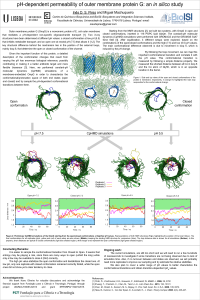
pH-dependent permeability of outer membrane protein G_ an in silico study - poster.pdf
Experimental and Computational Studies Addressed to 1,3-Dipolar Cycloadditions of D-Erythrose 1,3-Dioxane 1,5-Lactone with Regio- and Stereo-selectivity
Evaluation of Different Scoring Functions for Docking and Virtual Screening against GPCR Drug Targets