Event submissions
EventsMOL2NET'18, Conference on Molecular, Biomed., Comput. & Network Science and Engineering, 4th ed.
Published

This submission belongs to the session 06. CHEMBIOMOL-04: Chem. Biol. & Med. Chem. Workshop, Paraiba, Porto, Rostock, Germany-Galveston, Texas, USA, 2018 of the event MOL2NET'18, Conference on Molecular, Biomed., Comput. & Network Science and Engineering, 4th ed.
Published date
19 Dec, 2018
Citation
Tatiana F. Vieira, Rita Magalhães, Nuno M. F. S. A. Cerqueira, Sérgio F. Sousa, Evaluation of Different Scoring Functions for Docking and Virtual Screening against GPCR Drug Targets, in Proceedings of MOL2NET'18, Conference on Molecular, Biomed., Comput. & Network Science and Engineering, 4th ed., 15 January 2018–20 January 2019, MDPI: Basel, Switzerland, doi: 10.3390/mol2net-04-06078
Share
Email
Facebook
Twitter
LinkedIn
Evaluation of Different Scoring Functions for Docking and Virtual Screening against GPCR Drug Targets

Tatiana F. Vieira 1,2
'%3e%3cpath%20d='M12.6647%2010.9104C12.4176%2010.325%2012.0589%209.7933%2011.6088%209.34485C11.16%208.89511%2010.6283%208.53653%2010.0432%208.28891C10.038%208.28629%2010.0327%208.28498%2010.0275%208.28236C10.8437%207.69282%2011.3743%206.73252%2011.3743%205.64907C11.3743%203.85423%209.92005%202.40002%208.12522%202.40002C6.33038%202.40002%204.87618%203.85423%204.87618%205.64907C4.87618%206.73252%205.40677%207.69282%206.22296%208.28367C6.21772%208.28629%206.21248%208.2876%206.20724%208.29022C5.62031%208.53783%205.09365%208.89287%204.64167%209.34616C4.19192%209.79496%203.83334%2010.3266%203.58573%2010.9117C3.34247%2011.4846%203.21128%2012.0987%203.19925%2012.721C3.1989%2012.735%203.20135%2012.7489%203.20646%2012.7619C3.21157%2012.7749%203.21924%2012.7868%203.22901%2012.7968C3.23877%2012.8068%203.25045%2012.8148%203.26334%2012.8202C3.27623%2012.8256%203.29007%2012.8284%203.30406%2012.8284H4.09012C4.14776%2012.8284%204.19362%2012.7825%204.19493%2012.7262C4.22113%2011.7148%204.62726%2010.7676%205.34519%2010.0497C6.08802%209.30686%207.07452%208.89811%208.12522%208.89811C9.17592%208.89811%2010.1624%209.30686%2010.9052%2010.0497C11.6232%2010.7676%2012.0293%2011.7148%2012.0555%2012.7262C12.0568%2012.7839%2012.1027%2012.8284%2012.1603%2012.8284H12.9464C12.9604%2012.8284%2012.9742%2012.8256%2012.9871%2012.8202C13%2012.8148%2013.0117%2012.8068%2013.0214%2012.7968C13.0312%2012.7868%2013.0389%2012.7749%2013.044%2012.7619C13.0491%2012.7489%2013.0515%2012.735%2013.0512%2012.721C13.0381%2012.0947%2012.9084%2011.4856%2012.6647%2010.9104ZM8.12522%207.90243C7.52388%207.90243%206.95792%207.66793%206.53214%207.24215C6.10636%206.81636%205.87185%206.2504%205.87185%205.64907C5.87185%205.04773%206.10636%204.48177%206.53214%204.05599C6.95792%203.63021%207.52388%203.3957%208.12522%203.3957C8.72655%203.3957%209.29252%203.63021%209.7183%204.05599C10.1441%204.48177%2010.3786%205.04773%2010.3786%205.64907C10.3786%206.2504%2010.1441%206.81636%209.7183%207.24215C9.29252%207.66793%208.72655%207.90243%208.12522%207.90243Z'%20fill='%235D1EE1'/%3e%3c/g%3e%3c/svg%3e)
Rita Magalhães 3
Nuno M. F. S. A. Cerqueira 3

Sérgio F. Sousa 3
1. Associate Laboratory i4HB - Institute for Health and Bioeconomy, Faculdade de Medicina, Universidade do Porto, 4200-319 Porto, Portugal
2. UCIBIO – Applied Molecular Biosciences Unit, BioSIM - Departamento de Biomedicina, Faculdade de Medicina, Universidade do Porto, 4200-319 Porto, Portugal
3. UCIBIO/REQUIMTE, BioSIM
Abstract
G-protein-coupled receptors (GPCRs) constitute a large family of structurally similar proteins that respond to diverse physiological and environmental stimulants and that includes many therapeutic targets. In fact, 40% of all modern medicinal drugs are thought to target G-protein-coupled receptors (GPCRs), making this large family of proteins a particular appealing target for drug discovery efforts [1, 2].
Protein-ligand docking is a computational method that tries to predict and rank the structure resulting from the association between a ligand and a target protein [3]. Virtual screening (VS) can use docking to evaluate databases with millions of compounds to identify promising new molecules that could bind to a specific target of pharmacological interest, including GPCRs [4]. This strategy if often used to limit the amount of molecules that has to be tested experimentally and to reduce the cost in the identification of new lead molecules for drug development.
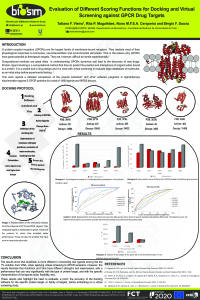
This work reports a detailed comparison of the popular Autodock and Vina software programs in ligand/decoys discrimination against 5 GPCR proteins, (Adenosine 2a receptor, Beta-1 adrenergic receptor, Beta-2 adrenergic receptor, C-X-C chemokine receptor type 4 and Dopamine D3 receptor), for a total of 1480 ligands and 99763 decoys. The results show that AutoDock is more efficient in recovering real ligands among the top 1% solution than VINA, when applying virtual screening to GPCR receptors.
- Lagerstrom, M.C. and H.B. Schioth, Structural diversity of G protein-coupled receptors and significance for drug discovery. Nature Reviews Drug Discovery, 2008. 7(4): p. 339-357.
- Overington, J.P., B. Al-Lazikani, and A.L. Hopkins, Opinion - How many drug targets are there? Nature Reviews Drug Discovery, 2006. 5(12): p. 993-996.
- Sousa, S.F., P.A. Fernandes, and M.J. Ramos, Protein-ligand docking: Current status and future challenges. Proteins-Structure Function and Bioinformatics, 2006. 65(1): p. 15-26.
- Shoichet, B.K. and B.K. Kobilka, Structure-based drug screening for G-protein-coupled receptors. Trends in Pharmacological Sciences, 2012. 33(5): p. 268-272.
Keywords
GPCRs
docking
drug discovery
virtual screening
Manuscript
mol2net submition.pdf
Poster
poster_ejibce2018_v3.pdf
pH-dependent permeability of outer membrane protein G: an in silico study
Creation of a Structural Database for Inhibition of Biofilm Formation