Event submissions
EventsMOL2NET'18, Conference on Molecular, Biomed., Comput. & Network Science and Engineering, 4th ed.
Published

This submission belongs to the session 06. CHEMBIOMOL-04: Chem. Biol. & Med. Chem. Workshop, Paraiba, Porto, Rostock, Germany-Galveston, Texas, USA, 2018 of the event MOL2NET'18, Conference on Molecular, Biomed., Comput. & Network Science and Engineering, 4th ed.
Published date
19 Dec, 2018
Citation
Rita P. Magalhães, Tatiana F. Vieira, Henrique S. Fernandes, Nuno M.F.S.A. Cerqueira, André Melo, Manuel Simões, Sérgio F. Sousa, Creation of a Structural Database for Inhibition of Biofilm Formation, in Proceedings of MOL2NET'18, Conference on Molecular, Biomed., Comput. & Network Science and Engineering, 4th ed., 15 January 2018–20 January 2019, MDPI: Basel, Switzerland, doi: 10.3390/mol2net-04-06079
Share
Email
Facebook
Twitter
LinkedIn
Creation of a Structural Database for Inhibition of Biofilm Formation
'%3e%3cpath%20d='M12.6647%2010.9104C12.4176%2010.325%2012.0589%209.7933%2011.6088%209.34485C11.16%208.89511%2010.6283%208.53653%2010.0432%208.28891C10.038%208.28629%2010.0327%208.28498%2010.0275%208.28236C10.8437%207.69282%2011.3743%206.73252%2011.3743%205.64907C11.3743%203.85423%209.92005%202.40002%208.12522%202.40002C6.33038%202.40002%204.87618%203.85423%204.87618%205.64907C4.87618%206.73252%205.40677%207.69282%206.22296%208.28367C6.21772%208.28629%206.21248%208.2876%206.20724%208.29022C5.62031%208.53783%205.09365%208.89287%204.64167%209.34616C4.19192%209.79496%203.83334%2010.3266%203.58573%2010.9117C3.34247%2011.4846%203.21128%2012.0987%203.19925%2012.721C3.1989%2012.735%203.20135%2012.7489%203.20646%2012.7619C3.21157%2012.7749%203.21924%2012.7868%203.22901%2012.7968C3.23877%2012.8068%203.25045%2012.8148%203.26334%2012.8202C3.27623%2012.8256%203.29007%2012.8284%203.30406%2012.8284H4.09012C4.14776%2012.8284%204.19362%2012.7825%204.19493%2012.7262C4.22113%2011.7148%204.62726%2010.7676%205.34519%2010.0497C6.08802%209.30686%207.07452%208.89811%208.12522%208.89811C9.17592%208.89811%2010.1624%209.30686%2010.9052%2010.0497C11.6232%2010.7676%2012.0293%2011.7148%2012.0555%2012.7262C12.0568%2012.7839%2012.1027%2012.8284%2012.1603%2012.8284H12.9464C12.9604%2012.8284%2012.9742%2012.8256%2012.9871%2012.8202C13%2012.8148%2013.0117%2012.8068%2013.0214%2012.7968C13.0312%2012.7868%2013.0389%2012.7749%2013.044%2012.7619C13.0491%2012.7489%2013.0515%2012.735%2013.0512%2012.721C13.0381%2012.0947%2012.9084%2011.4856%2012.6647%2010.9104ZM8.12522%207.90243C7.52388%207.90243%206.95792%207.66793%206.53214%207.24215C6.10636%206.81636%205.87185%206.2504%205.87185%205.64907C5.87185%205.04773%206.10636%204.48177%206.53214%204.05599C6.95792%203.63021%207.52388%203.3957%208.12522%203.3957C8.72655%203.3957%209.29252%203.63021%209.7183%204.05599C10.1441%204.48177%2010.3786%205.04773%2010.3786%205.64907C10.3786%206.2504%2010.1441%206.81636%209.7183%207.24215C9.29252%207.66793%208.72655%207.90243%208.12522%207.90243Z'%20fill='%235D1EE1'/%3e%3c/g%3e%3c/svg%3e)
Rita P. Magalhães 1,2

Tatiana F. Vieira 3
Henrique S. Fernandes 3
Nuno M.F.S.A. Cerqueira 1
André Melo 2
Manuel Simões 4

Sérgio F. Sousa 3
1. UCIBIO/REQUIMTE, BioSIM, Departamento de Biomedicina, Faculdade de Medicina, Universidade do Porto,
2. LAQV/REQUIMTE, Departamento de Química e Bioquímica, Faculdade de Ciências, Universidade do Porto
3. UCIBIO/REQUIMTE, BioSIM, Departamento de Biomedicina, Faculdade de Medicina, Universidade do Porto
4. LEPABE, Departamento de Engenharia Química, Faculdade de Engenharia, Universidade do Porto
Abstract
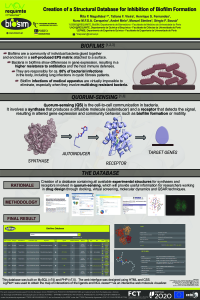
Biofilms can be prevalent in natural, industrial and hospital settings and are associated to ca. 80% of all human infections 1. The increased antimicrobial resistance and mutation rate of bacteria in biofilms contributes to the development of antibiotic resistance, greatly limiting the therapeutic options to a variety of infections, posing a critical problem to the biomedical sector. Preventing biofilm formation could dramatically reduce the effects of infectious diseases 2.
Quorum-sensing (QS) is the cell-to-cell communication in bacteria and contributes to the formation of organized structural communities of bacteria in biofilms 3. Several different microbial-derived signaling molecule types and receptors have been recently identified, offering a very appealing opportunity for rational design of new drugs.
This work reports the creation of a database containing all the available experimental X-ray structures for all the synthases and receptors known to be involved in quorum sensing and includes also structural and biological information on all the known compounds with demonstrated inhibitory activity against each of these protein targets.
This database will provide useful atomic-level information for researchers working on this field with direct application in drug design and development efforts through docking, virtual screening, molecular dynamics and QSAR techniques.
- Worthington, R. J.; Richards, J. J.; Melander, C., Small molecule control of bacterial biofilms. Organic & biomolecular chemistry 2012, 10 (37), 7457-74.
- Subhadra, B.; Kim, D. H.; Woo, K.; Surendran, S.; Choi, C. H., Control of Biofilm Formation in Healthcare: Recent Advances Exploiting Quorum-Sensing Interference Strategies and Multidrug Efflux Pump Inhibitors. Materials (Basel, Switzerland) 2018, 11 (9).
- Banerjee, G.; Ray, A. K., Quorum-sensing network-associated gene regulation in Gram-positive bacteria. Acta microbiologica et immunologica Hungarica 2017, 64 (4), 439-453.
Keywords
biofilms
quorum sensing
database
multi-drug resistant bacteria
MDR
docking
QSAR
virtual screening
molecular dynamics
QM/MM
Manuscript
Creation of a Structural Database for Inhibition of Biofilm Formation - Rita Magalhães.pdf
Poster
poster_ejibce2018_Rita_Magalhaes.pdf
Evaluation of Different Scoring Functions for Docking and Virtual Screening against GPCR Drug Targets
Antihyperalgesic activity of quillaic acid obtained from Quillaja saponaria Mol.