Event submissions
EventsMOL2NET'18, Conference on Molecular, Biomed., Comput. & Network Science and Engineering, 4th ed.
Published

This submission belongs to the session 06. CHEMBIOMOL-04: Chem. Biol. & Med. Chem. Workshop, Paraiba, Porto, Rostock, Germany-Galveston, Texas, USA, 2018 of the event MOL2NET'18, Conference on Molecular, Biomed., Comput. & Network Science and Engineering, 4th ed.
Published date
19 Dec, 2018
Citation
Maité Rodríguez-Díaz, Carla Delporte, Sylvia Arrau, Bruce K. Cassels, Hugo F. Miranda, Gabriela Valenzuela, Andrés Barriga, Antihyperalgesic activity of quillaic acid obtained from Quillaja saponaria Mol., in Proceedings of MOL2NET'18, Conference on Molecular, Biomed., Comput. & Network Science and Engineering, 4th ed., 15 January 2018–20 January 2019, MDPI: Basel, Switzerland, doi: 10.3390/mol2net-04-06080
Share
Email
Facebook
Twitter
LinkedIn
Antihyperalgesic activity of quillaic acid obtained from Quillaja saponaria Mol.

Maité Rodríguez-Díaz 1
'%3e%3cpath%20d='M12.6647%2010.9104C12.4176%2010.325%2012.0589%209.7933%2011.6088%209.34485C11.16%208.89511%2010.6283%208.53653%2010.0432%208.28891C10.038%208.28629%2010.0327%208.28498%2010.0275%208.28236C10.8437%207.69282%2011.3743%206.73252%2011.3743%205.64907C11.3743%203.85423%209.92005%202.40002%208.12522%202.40002C6.33038%202.40002%204.87618%203.85423%204.87618%205.64907C4.87618%206.73252%205.40677%207.69282%206.22296%208.28367C6.21772%208.28629%206.21248%208.2876%206.20724%208.29022C5.62031%208.53783%205.09365%208.89287%204.64167%209.34616C4.19192%209.79496%203.83334%2010.3266%203.58573%2010.9117C3.34247%2011.4846%203.21128%2012.0987%203.19925%2012.721C3.1989%2012.735%203.20135%2012.7489%203.20646%2012.7619C3.21157%2012.7749%203.21924%2012.7868%203.22901%2012.7968C3.23877%2012.8068%203.25045%2012.8148%203.26334%2012.8202C3.27623%2012.8256%203.29007%2012.8284%203.30406%2012.8284H4.09012C4.14776%2012.8284%204.19362%2012.7825%204.19493%2012.7262C4.22113%2011.7148%204.62726%2010.7676%205.34519%2010.0497C6.08802%209.30686%207.07452%208.89811%208.12522%208.89811C9.17592%208.89811%2010.1624%209.30686%2010.9052%2010.0497C11.6232%2010.7676%2012.0293%2011.7148%2012.0555%2012.7262C12.0568%2012.7839%2012.1027%2012.8284%2012.1603%2012.8284H12.9464C12.9604%2012.8284%2012.9742%2012.8256%2012.9871%2012.8202C13%2012.8148%2013.0117%2012.8068%2013.0214%2012.7968C13.0312%2012.7868%2013.0389%2012.7749%2013.044%2012.7619C13.0491%2012.7489%2013.0515%2012.735%2013.0512%2012.721C13.0381%2012.0947%2012.9084%2011.4856%2012.6647%2010.9104ZM8.12522%207.90243C7.52388%207.90243%206.95792%207.66793%206.53214%207.24215C6.10636%206.81636%205.87185%206.2504%205.87185%205.64907C5.87185%205.04773%206.10636%204.48177%206.53214%204.05599C6.95792%203.63021%207.52388%203.3957%208.12522%203.3957C8.72655%203.3957%209.29252%203.63021%209.7183%204.05599C10.1441%204.48177%2010.3786%205.04773%2010.3786%205.64907C10.3786%206.2504%2010.1441%206.81636%209.7183%207.24215C9.29252%207.66793%208.72655%207.90243%208.12522%207.90243Z'%20fill='%235D1EE1'/%3e%3c/g%3e%3c/svg%3e)
Carla Delporte 2
Sylvia Arrau 2
Bruce K. Cassels 2
Hugo F. Miranda 2
Gabriela Valenzuela 2
Andrés Barriga 2
1. Universidad Andres Bello
2. Universidad de Chile
Abstract
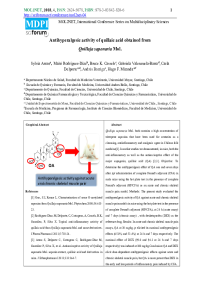
- Background: Quillaja saponaria Mol. bark contains a high concentration of triterpene saponins that have been used for centuries as a cleansing, antiinflammatory and analgesic agent in Chilean folk medicine. In earlier studies we demonstrated, in mice, both the anti-inflammatory as well as the antinociceptive effect of the major sapogenin, quillaic acid (QA).
- Objective: To determine the antihyperalgesic effect of QA one and seven days after itpl administration of complete Freund's adjuvant (CFA) in male mice using the hot plate test in the presence of complete Freund's adjuvant (HP/CFA) as an acute and chronic skeletal muscle pain model.
- Methods: The present study evaluated the antihyperalgesic activity of QA against acute and chronic skeletal muscle pain models in mice using the hot plate test in the presence of complete Freund's adjuvant (HP/CFA), at 24 h (acute assay) and 7 days (chronic assay) , with dexketoprofen (DEX) as the reference drug.
- Results: In acute and chronic skeletal muscle pain assays, QA at 30 mg/kg ip elicited its maximal antihyperalgesic effects (65.0% and 53.4%) at 24 h and 7 days respectively. The maximal effect of DEX (99.0 and 94.1 at 24 h and 7 days respectively) was induced at 100 mg/kg.
- Conclusion: QA and DEX elicit dose-dependent antihyperalgesic effects against acute and chronic skeletal muscle pain, but QA is more potent than DEX in the early and late periods of inflammatory pain induced by CFA.
Keywords
Quillaja saponaria
quillaic acid
skeletal muscle pain
antihyperalgesic activity
complete Freund's adjuvant
Poster
MOL2NET, International Conference_Maite Rodríguez-Díaz.pdf
Creation of a Structural Database for Inhibition of Biofilm Formation
MVVM design pattern for asynchronous events in information system