Event submissions
EventsMOL2NET'18, Conference on Molecular, Biomed., Comput. & Network Science and Engineering, 4th ed.
Published

This submission belongs to the session 06. CHEMBIOMOL-04: Chem. Biol. & Med. Chem. Workshop, Paraiba, Porto, Rostock, Germany-Galveston, Texas, USA, 2018 of the event MOL2NET'18, Conference on Molecular, Biomed., Comput. & Network Science and Engineering, 4th ed.
Published date
20 Dec, 2018
Citation
Juliana F. Rocha, David S. Freitas, Jennifer Noro, Carla S. Silva Teixeira, Cristina E. A. Sousa, Sérgio F. Sousa, Maria J. Alves, Nuno M. F. S. A. Cerqueira, Combined experimental and computational studies devoted to the synthesis of 1,4-lactones, in Proceedings of MOL2NET'18, Conference on Molecular, Biomed., Comput. & Network Science and Engineering, 4th ed., 15 January 2018–20 January 2019, MDPI: Basel, Switzerland, doi: 10.3390/mol2net-04-06089
Share
Email
Facebook
Twitter
LinkedIn
Combined experimental and computational studies devoted to the synthesis of 1,4-lactones
'%3e%3cpath%20d='M12.6647%2010.9104C12.4176%2010.325%2012.0589%209.7933%2011.6088%209.34485C11.16%208.89511%2010.6283%208.53653%2010.0432%208.28891C10.038%208.28629%2010.0327%208.28498%2010.0275%208.28236C10.8437%207.69282%2011.3743%206.73252%2011.3743%205.64907C11.3743%203.85423%209.92005%202.40002%208.12522%202.40002C6.33038%202.40002%204.87618%203.85423%204.87618%205.64907C4.87618%206.73252%205.40677%207.69282%206.22296%208.28367C6.21772%208.28629%206.21248%208.2876%206.20724%208.29022C5.62031%208.53783%205.09365%208.89287%204.64167%209.34616C4.19192%209.79496%203.83334%2010.3266%203.58573%2010.9117C3.34247%2011.4846%203.21128%2012.0987%203.19925%2012.721C3.1989%2012.735%203.20135%2012.7489%203.20646%2012.7619C3.21157%2012.7749%203.21924%2012.7868%203.22901%2012.7968C3.23877%2012.8068%203.25045%2012.8148%203.26334%2012.8202C3.27623%2012.8256%203.29007%2012.8284%203.30406%2012.8284H4.09012C4.14776%2012.8284%204.19362%2012.7825%204.19493%2012.7262C4.22113%2011.7148%204.62726%2010.7676%205.34519%2010.0497C6.08802%209.30686%207.07452%208.89811%208.12522%208.89811C9.17592%208.89811%2010.1624%209.30686%2010.9052%2010.0497C11.6232%2010.7676%2012.0293%2011.7148%2012.0555%2012.7262C12.0568%2012.7839%2012.1027%2012.8284%2012.1603%2012.8284H12.9464C12.9604%2012.8284%2012.9742%2012.8256%2012.9871%2012.8202C13%2012.8148%2013.0117%2012.8068%2013.0214%2012.7968C13.0312%2012.7868%2013.0389%2012.7749%2013.044%2012.7619C13.0491%2012.7489%2013.0515%2012.735%2013.0512%2012.721C13.0381%2012.0947%2012.9084%2011.4856%2012.6647%2010.9104ZM8.12522%207.90243C7.52388%207.90243%206.95792%207.66793%206.53214%207.24215C6.10636%206.81636%205.87185%206.2504%205.87185%205.64907C5.87185%205.04773%206.10636%204.48177%206.53214%204.05599C6.95792%203.63021%207.52388%203.3957%208.12522%203.3957C8.72655%203.3957%209.29252%203.63021%209.7183%204.05599C10.1441%204.48177%2010.3786%205.04773%2010.3786%205.64907C10.3786%206.2504%2010.1441%206.81636%209.7183%207.24215C9.29252%207.66793%208.72655%207.90243%208.12522%207.90243Z'%20fill='%235D1EE1'/%3e%3c/g%3e%3c/svg%3e)
Juliana F. Rocha 1
David S. Freitas 2

Jennifer Noro 2
Carla S. Silva Teixeira 1

Cristina E. A. Sousa 2

Sérgio F. Sousa 1

Maria J. Alves 2
Nuno M. F. S. A. Cerqueira 1
1. UCIBIO/REQUIMTE, BioSIM Departamento de Biomedicina, Faculdade de Medicina, Universidade do Porto, Alameda Professor Hernani Monteiro, 4200-319 Porto, Portugal
2. Departamento de Química, Universidade do Minho, Campus de Gualtar, 4710-057 Braga, Portugal
Abstract
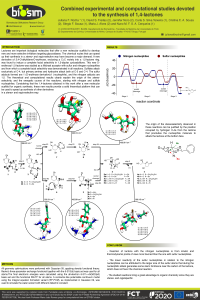
Lactones are important biological molecules that offer a new molecular scaffold to develop new and more selective inhibitors targeting glycosidases [1]. The chemical routes that can speed up their synthesis in a stereo- and regio-selective way have become a major demand. A new derivative of 2,4-O-alkylidene-D-erythrose, enclosing a C=C moiety into a 1,5-lactone ring, was found to induce a complete facial selectivity in 1,3-dipolar cycloadditions [2]. This new D-erythrosyl 1,5-lactone was studied as a Michael acceptor with sulfur and nitrogen nucleophiles and from which a complete facial selectivity was demonstrated in all reactions [3]. Sulfides attack exclusively at C-4, but primary amines and hydrazine attack both at C-2 and C-4. The sulfur adducts formed are 1 (D-erythrose derivative):1 (nucleophile), and the nitrogen adducts are 1:2. The theoretical and computational results clearly explain the origin of the stereo-selectivity, and the energetic course of the reactions, starting with nitrogen and sulfide nucleophiles. Considering that the 1,4-lactones obtained in this work offer a new molecular scaffold for organic synthesis, these new results provide a solid theoretical platform that can be used to speed up synthesis of other derivatives in a stereo- and regio-selective way.
References
[1]Rocha, J. F.; Cerqueira, N. M. F. S. A. Glucosidases and galactosidases as drug targets. Curr. Top. Biochem. Res. 2017, 18, 117− 126.
[2]Sousa, C. E.; Ribeiro, A. M.; Gil Fortes, A.; Cerqueira, N. M.; Alves, M. J. Total Facial Discrimination of 1,3-Dipolar Cycloadditions in a d-Erythrose 1,3-Dioxane Template: Computational Studies of a Concerted Mechanism. J. Org. Chem. 2017, 82 (2), 982−991.
[3]Rocha, J. F.; Freitas, D. S.; Noro, J.; Teixeira, C. S. S.; Sousa, C. E.; Alves, M. J.; Cerqueira, N. M. F. S. A. Total Stereoselective Michael Addition of N- and S- Nucleophiles to a d-Erythrosyl 1,5-Lactone Derivative. Experimental and Theoretical Studies Devoted to the Synthesis of 2,6-Dideoxy-4-functionalized-d-ribono-hexono-1,4-lactone. J. Org. Chem. 2018, 83 (15), 8011-8019 DOI: 10.1021/acs.joc.8b00769.
Keywords
D-erythrose derivative
stereo- and regio-selective
organic chemistry
1,4-lactones
Manuscript
mol2net_model_JFR.pdf
Poster
poster_ejibce2018_JFRmol2net.pdf
Unraveling the catalytic mechanism of Tryptophan synthase, a drug target against Mycobacterium tuberculosis
A proposed new measure to verify the general version of Chargaff 2nd rule.