Event submissions
EventsMOL2NET'18, Conference on Molecular, Biomed., Comput. & Network Science and Engineering, 4th ed.
Published

This submission belongs to the session 09. NICEXSM-04: North-Ibero-American Congress on Exp. and Simul. Methods., Valencia, Spain-Talca, Chile-Miami, USA, 2018-2019 of the event MOL2NET'18, Conference on Molecular, Biomed., Comput. & Network Science and Engineering, 4th ed.
Published date
05 Jan, 2019
Citation
Bairon Hernández, Gonzalo Riadi, Can Fusion Transcripts between a transposable element and an exon generate piRNAs in mouse (Mus musculus)?, in Proceedings of MOL2NET'18, Conference on Molecular, Biomed., Comput. & Network Science and Engineering, 4th ed., 15 January 2018–20 January 2019, MDPI: Basel, Switzerland, doi: 10.3390/mol2net-04-06118
Share
Email
Facebook
Twitter
LinkedIn
Can Fusion Transcripts between a transposable element and an exon generate piRNAs in mouse (Mus musculus)?
'%3e%3cpath%20d='M12.6647%2010.9104C12.4176%2010.325%2012.0589%209.7933%2011.6088%209.34485C11.16%208.89511%2010.6283%208.53653%2010.0432%208.28891C10.038%208.28629%2010.0327%208.28498%2010.0275%208.28236C10.8437%207.69282%2011.3743%206.73252%2011.3743%205.64907C11.3743%203.85423%209.92005%202.40002%208.12522%202.40002C6.33038%202.40002%204.87618%203.85423%204.87618%205.64907C4.87618%206.73252%205.40677%207.69282%206.22296%208.28367C6.21772%208.28629%206.21248%208.2876%206.20724%208.29022C5.62031%208.53783%205.09365%208.89287%204.64167%209.34616C4.19192%209.79496%203.83334%2010.3266%203.58573%2010.9117C3.34247%2011.4846%203.21128%2012.0987%203.19925%2012.721C3.1989%2012.735%203.20135%2012.7489%203.20646%2012.7619C3.21157%2012.7749%203.21924%2012.7868%203.22901%2012.7968C3.23877%2012.8068%203.25045%2012.8148%203.26334%2012.8202C3.27623%2012.8256%203.29007%2012.8284%203.30406%2012.8284H4.09012C4.14776%2012.8284%204.19362%2012.7825%204.19493%2012.7262C4.22113%2011.7148%204.62726%2010.7676%205.34519%2010.0497C6.08802%209.30686%207.07452%208.89811%208.12522%208.89811C9.17592%208.89811%2010.1624%209.30686%2010.9052%2010.0497C11.6232%2010.7676%2012.0293%2011.7148%2012.0555%2012.7262C12.0568%2012.7839%2012.1027%2012.8284%2012.1603%2012.8284H12.9464C12.9604%2012.8284%2012.9742%2012.8256%2012.9871%2012.8202C13%2012.8148%2013.0117%2012.8068%2013.0214%2012.7968C13.0312%2012.7868%2013.0389%2012.7749%2013.044%2012.7619C13.0491%2012.7489%2013.0515%2012.735%2013.0512%2012.721C13.0381%2012.0947%2012.9084%2011.4856%2012.6647%2010.9104ZM8.12522%207.90243C7.52388%207.90243%206.95792%207.66793%206.53214%207.24215C6.10636%206.81636%205.87185%206.2504%205.87185%205.64907C5.87185%205.04773%206.10636%204.48177%206.53214%204.05599C6.95792%203.63021%207.52388%203.3957%208.12522%203.3957C8.72655%203.3957%209.29252%203.63021%209.7183%204.05599C10.1441%204.48177%2010.3786%205.04773%2010.3786%205.64907C10.3786%206.2504%2010.1441%206.81636%209.7183%207.24215C9.29252%207.66793%208.72655%207.90243%208.12522%207.90243Z'%20fill='%235D1EE1'/%3e%3c/g%3e%3c/svg%3e)
Bairon Hernández 1
Gonzalo Riadi 1
1. Center for Bioinformatics and Molecular Simulations (CBSM), Universidad de Talca
Abstract
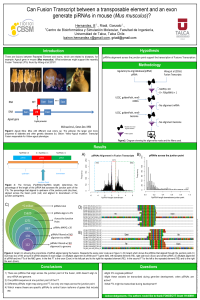
A Fusion Transcript (FT) is a RNA molecule product of cis/trans-splicing of two differently annotated elements, either genes or Transposable Elements (TE). It may be coding or non-coding. There are many examples of gene-gene FTs in cancer. Lately, FTs have been also reported in control conditions in different organisms. Moreover, other authors argue that a FT might be a product of artifacts, either experimental or computational. In a recent work, we have developed a pipeline to predict FTs between an exon and a TE. In it, we have found 813 exon-TE FTs from 438 different genes. This prediction was made starting with RNA-seq data from Nucleus Accumbens in mouse (M. musculus) treated with cocaine vs. control. From that group, 20 candidates were taken and all were validated experimentally through PCR. However, the depth of sequencing is low. We can further gather supporting evidence of their expression by filtering the candidates, which could be regulated by small RNAs, the same way piRNAs regulate TEs. We aligned around 5 million mouse piRNAs against the 813 mouse exon-TE Fts, identifying 112 piRNAs that map only across the juction point of exon-TE FTs, in 56 genes. These piRNAs do not map on the reference genome or on the transcriptome sequences. These results suggest that either: 1) piRNAs might regulate the expression of exon-TE FTs, or 2) the exon-TE Fts may be the origin of piRNAs. In either case, they suggest that exon-TE FTs may express in germline. Grant Fondecyt #11140869.
Keywords
mus muculus
Poster
Hernandez_Bairon_iCBSM.pdf
First draft genome sequencing of the Salicola genus
Elucidating the role of the intracellular pH sensing mechanism of TASK-2 K2P channel