Event submissions
EventsMOL2NET'18, Conference on Molecular, Biomed., Comput. & Network Science and Engineering, 4th ed.
Published

This submission belongs to the session 09. NICEXSM-04: North-Ibero-American Congress on Exp. and Simul. Methods., Valencia, Spain-Talca, Chile-Miami, USA, 2018-2019 of the event MOL2NET'18, Conference on Molecular, Biomed., Comput. & Network Science and Engineering, 4th ed.
Published date
06 Jan, 2019
Citation
Daniela Araya, Braulio Valdebenito, Johany Peñailillo, Juan Larrain, Gonzalo Riadi, Xenopus snc-RNA genes are predominantly located within TEs and are differentially expressed in regenerative and non-regenerative stages after spinal cord injury., in Proceedings of MOL2NET'18, Conference on Molecular, Biomed., Comput. & Network Science and Engineering, 4th ed., 15 January 2018–20 January 2019, MDPI: Basel, Switzerland, doi: 10.3390/mol2net-04-06122
Share
Email
Facebook
Twitter
LinkedIn
Xenopus snc-RNA genes are predominantly located within TEs and are differentially expressed in regenerative and non-regenerative stages after spinal cord injury.
'%3e%3cpath%20d='M12.6647%2010.9104C12.4176%2010.325%2012.0589%209.7933%2011.6088%209.34485C11.16%208.89511%2010.6283%208.53653%2010.0432%208.28891C10.038%208.28629%2010.0327%208.28498%2010.0275%208.28236C10.8437%207.69282%2011.3743%206.73252%2011.3743%205.64907C11.3743%203.85423%209.92005%202.40002%208.12522%202.40002C6.33038%202.40002%204.87618%203.85423%204.87618%205.64907C4.87618%206.73252%205.40677%207.69282%206.22296%208.28367C6.21772%208.28629%206.21248%208.2876%206.20724%208.29022C5.62031%208.53783%205.09365%208.89287%204.64167%209.34616C4.19192%209.79496%203.83334%2010.3266%203.58573%2010.9117C3.34247%2011.4846%203.21128%2012.0987%203.19925%2012.721C3.1989%2012.735%203.20135%2012.7489%203.20646%2012.7619C3.21157%2012.7749%203.21924%2012.7868%203.22901%2012.7968C3.23877%2012.8068%203.25045%2012.8148%203.26334%2012.8202C3.27623%2012.8256%203.29007%2012.8284%203.30406%2012.8284H4.09012C4.14776%2012.8284%204.19362%2012.7825%204.19493%2012.7262C4.22113%2011.7148%204.62726%2010.7676%205.34519%2010.0497C6.08802%209.30686%207.07452%208.89811%208.12522%208.89811C9.17592%208.89811%2010.1624%209.30686%2010.9052%2010.0497C11.6232%2010.7676%2012.0293%2011.7148%2012.0555%2012.7262C12.0568%2012.7839%2012.1027%2012.8284%2012.1603%2012.8284H12.9464C12.9604%2012.8284%2012.9742%2012.8256%2012.9871%2012.8202C13%2012.8148%2013.0117%2012.8068%2013.0214%2012.7968C13.0312%2012.7868%2013.0389%2012.7749%2013.044%2012.7619C13.0491%2012.7489%2013.0515%2012.735%2013.0512%2012.721C13.0381%2012.0947%2012.9084%2011.4856%2012.6647%2010.9104ZM8.12522%207.90243C7.52388%207.90243%206.95792%207.66793%206.53214%207.24215C6.10636%206.81636%205.87185%206.2504%205.87185%205.64907C5.87185%205.04773%206.10636%204.48177%206.53214%204.05599C6.95792%203.63021%207.52388%203.3957%208.12522%203.3957C8.72655%203.3957%209.29252%203.63021%209.7183%204.05599C10.1441%204.48177%2010.3786%205.04773%2010.3786%205.64907C10.3786%206.2504%2010.1441%206.81636%209.7183%207.24215C9.29252%207.66793%208.72655%207.90243%208.12522%207.90243Z'%20fill='%235D1EE1'/%3e%3c/g%3e%3c/svg%3e)
Daniela Araya 1
Braulio Valdebenito 1
Johany Peñailillo 2
Juan Larrain 2
Gonzalo Riadi 1
1. CBSM, Universidad de Talca
2. Departamento de Biología Celular y Molecular, Pontificia Universidad Católica De Chile
Abstract
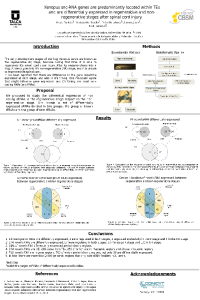
The early development stages of the frog Xenopus laevis are known as the regenerative (R) stage, because during that time, it is able to regenerate. After its metamorphosis into a frog, X. laevis goes into its non-regenerative (NR) stage. It has been reported that there are differences in the gene repertoire expressed at each stage after spinal cord injury, and also in its timing. One molecular agent that might influence gene expression and its timing are small non-coding RNAs (snc-RNAs). To gain insights into the role of snc-RNAs, in this work we aimed to investigate their differential expression between the R and the NR stages and their origins in genome regions. We have performed small RNA sequencing and differential expression analysis between the R and the NR stages. The majority of sequenced snc-RNAs have high quality, and their lengths suggest that the majority belong to the small interfering or, to the micro RNA class. In average, 98% of the ~50 million sequences completely aligned to X. laevis genome, and ~45% of them represent novel snc-RNAs. The snc-RNAs were further classified in 2.238 families, using as criteria their genomic location: ~49% of novel snc-RNA are in TEs regions. ~53% of families have their origins in genes (~33% in intronic regions) and ~47% in intergenic regions. 374 novel snc-RNAs are differentially expressed. 289 come from TEs, 250 of which are in intergenic regions and 39 are in intronic regions. These results, taken together with the differentially expressed genes, will help understanding the spinal cord regeneration process in frogs.
Keywords
snc-RNAs
miRNA
Spinal cord regeneration
Transposable elements
Poster
poster_90x120_CBSM.pdf
ANÁLISIS ÉTICO Y JURÍDICO SOBRE EL USO DE LA TÉCNICA CRISPR-CAS9 EN LA TERAPIA GÉNICA APLICADA EN HUMANOS
Hyperheuristics for indirect elicitation of outranking model’s parameters in Project Portfolio Optimization