Event submissions
EventsMOL2NET'18, Conference on Molecular, Biomed., Comput. & Network Science and Engineering, 4th ed.
Published

This submission belongs to the session 03. CHEMBIOINFO-04: Chem-Bioinformatics Congress Cambridge, UK-Chapel Hill and Duluth, USA, 2018 of the event MOL2NET'18, Conference on Molecular, Biomed., Comput. & Network Science and Engineering, 4th ed.
Published date
13 Jan, 2019
Citation
Arelys López-Sacerio, Yudith Cañizarez- Carmenate, Juan Alberto Castillo-Garit, Identification of new analgesic candidates through virtual in silico screening and in vivo experimental test., in Proceedings of MOL2NET'18, Conference on Molecular, Biomed., Comput. & Network Science and Engineering, 4th ed., 15 January 2018–20 January 2019, MDPI: Basel, Switzerland, doi: 10.3390/mol2net-04-06132
Share
Email
Facebook
Twitter
LinkedIn
Identification of new analgesic candidates through virtual in silico screening and in vivo experimental test.
'%3e%3cpath%20d='M12.6647%2010.9104C12.4176%2010.325%2012.0589%209.7933%2011.6088%209.34485C11.16%208.89511%2010.6283%208.53653%2010.0432%208.28891C10.038%208.28629%2010.0327%208.28498%2010.0275%208.28236C10.8437%207.69282%2011.3743%206.73252%2011.3743%205.64907C11.3743%203.85423%209.92005%202.40002%208.12522%202.40002C6.33038%202.40002%204.87618%203.85423%204.87618%205.64907C4.87618%206.73252%205.40677%207.69282%206.22296%208.28367C6.21772%208.28629%206.21248%208.2876%206.20724%208.29022C5.62031%208.53783%205.09365%208.89287%204.64167%209.34616C4.19192%209.79496%203.83334%2010.3266%203.58573%2010.9117C3.34247%2011.4846%203.21128%2012.0987%203.19925%2012.721C3.1989%2012.735%203.20135%2012.7489%203.20646%2012.7619C3.21157%2012.7749%203.21924%2012.7868%203.22901%2012.7968C3.23877%2012.8068%203.25045%2012.8148%203.26334%2012.8202C3.27623%2012.8256%203.29007%2012.8284%203.30406%2012.8284H4.09012C4.14776%2012.8284%204.19362%2012.7825%204.19493%2012.7262C4.22113%2011.7148%204.62726%2010.7676%205.34519%2010.0497C6.08802%209.30686%207.07452%208.89811%208.12522%208.89811C9.17592%208.89811%2010.1624%209.30686%2010.9052%2010.0497C11.6232%2010.7676%2012.0293%2011.7148%2012.0555%2012.7262C12.0568%2012.7839%2012.1027%2012.8284%2012.1603%2012.8284H12.9464C12.9604%2012.8284%2012.9742%2012.8256%2012.9871%2012.8202C13%2012.8148%2013.0117%2012.8068%2013.0214%2012.7968C13.0312%2012.7868%2013.0389%2012.7749%2013.044%2012.7619C13.0491%2012.7489%2013.0515%2012.735%2013.0512%2012.721C13.0381%2012.0947%2012.9084%2011.4856%2012.6647%2010.9104ZM8.12522%207.90243C7.52388%207.90243%206.95792%207.66793%206.53214%207.24215C6.10636%206.81636%205.87185%206.2504%205.87185%205.64907C5.87185%205.04773%206.10636%204.48177%206.53214%204.05599C6.95792%203.63021%207.52388%203.3957%208.12522%203.3957C8.72655%203.3957%209.29252%203.63021%209.7183%204.05599C10.1441%204.48177%2010.3786%205.04773%2010.3786%205.64907C10.3786%206.2504%2010.1441%206.81636%209.7183%207.24215C9.29252%207.66793%208.72655%207.90243%208.12522%207.90243Z'%20fill='%235D1EE1'/%3e%3c/g%3e%3c/svg%3e)
Arelys López-Sacerio 1
Yudith Cañizarez- Carmenate 1
Juan Alberto Castillo-Garit 2
1. Central University of Las Villas
2. Medical University of Villa Clara
Abstract
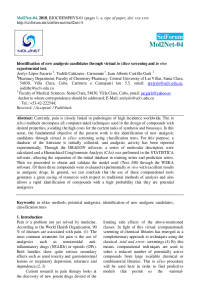
Currently, pain is closely linked to pathologies of high incidence worldwide. The in silico methods encompass all computer-aided techniques used in the design of compounds with desired properties, avoiding the high costs for the current tasks of synthesis and bioassays. In this sense, the fundamental objective of the present work is the identification of new analgesic candidates through virtual in silico screening using classification trees. For this purpose, a database of the literature is initially collected and analgesic activity has been reported experimentally. Through the DRAGON software, a series of molecular descriptors were calculated and a Hierarchical Conglomerate Analysis (CAs) was performed in the STATISTICA software, allowing the separation of the initial database in training series and prediction series. Then we proceeded to obtain and validate the model used (Tree J48) through the WEKA software. Finally, eight isolated compounds of Boldoa purpurascens and 12 products of the hydrolysis of these were screened for a total of 20 compounds. Of these three compounds were evaluated experimentally in vivo with excellent results as analgesic drugs. In general, we can conclude that the use of these computational tools generates a great saving of resources with respect to traditional methods of analysis and also allows a rapid identification of compounds with a high probability that they are potential analgesics.
Keywords
in silico methods
potential analgesics
identification of new analgesic candidates
classification trees
Manuscript
MOLINetArelys Lopez -Sacerio.pdf
Poster
MOLINetArelys Lopez -Sacerio.pdf
The regulation of emerging technologies: is it possible to stem the tide?
Structure-antimicrobial activity relationship of a series of functionalized arylbenzothiazoles