Event submissions
EventsMOL2NET'18, Conference on Molecular, Biomed., Comput. & Network Science and Engineering, 4th ed.
Published

This submission belongs to the session 03. CHEMBIOINFO-04: Chem-Bioinformatics Congress Cambridge, UK-Chapel Hill and Duluth, USA, 2018 of the event MOL2NET'18, Conference on Molecular, Biomed., Comput. & Network Science and Engineering, 4th ed.
Published date
16 Jan, 2019
Citation
Valentin Toro Castillo, Everardo Briseño Silva, Rafael Jimenez Mejía, ISOLATION AND CHARACTERIZATION OF BACTERIAL CONSORTIA WITH CAPACITY TO DEGRADE HYDROCARBONS, in Proceedings of MOL2NET'18, Conference on Molecular, Biomed., Comput. & Network Science and Engineering, 4th ed., 15 January 2018–20 January 2019, MDPI: Basel, Switzerland, doi: 10.3390/mol2net-04-06140
Share
Email
Facebook
Twitter
LinkedIn
ISOLATION AND CHARACTERIZATION OF BACTERIAL CONSORTIA WITH CAPACITY TO DEGRADE HYDROCARBONS
'%3e%3cpath%20d='M12.6647%2010.9104C12.4176%2010.325%2012.0589%209.7933%2011.6088%209.34485C11.16%208.89511%2010.6283%208.53653%2010.0432%208.28891C10.038%208.28629%2010.0327%208.28498%2010.0275%208.28236C10.8437%207.69282%2011.3743%206.73252%2011.3743%205.64907C11.3743%203.85423%209.92005%202.40002%208.12522%202.40002C6.33038%202.40002%204.87618%203.85423%204.87618%205.64907C4.87618%206.73252%205.40677%207.69282%206.22296%208.28367C6.21772%208.28629%206.21248%208.2876%206.20724%208.29022C5.62031%208.53783%205.09365%208.89287%204.64167%209.34616C4.19192%209.79496%203.83334%2010.3266%203.58573%2010.9117C3.34247%2011.4846%203.21128%2012.0987%203.19925%2012.721C3.1989%2012.735%203.20135%2012.7489%203.20646%2012.7619C3.21157%2012.7749%203.21924%2012.7868%203.22901%2012.7968C3.23877%2012.8068%203.25045%2012.8148%203.26334%2012.8202C3.27623%2012.8256%203.29007%2012.8284%203.30406%2012.8284H4.09012C4.14776%2012.8284%204.19362%2012.7825%204.19493%2012.7262C4.22113%2011.7148%204.62726%2010.7676%205.34519%2010.0497C6.08802%209.30686%207.07452%208.89811%208.12522%208.89811C9.17592%208.89811%2010.1624%209.30686%2010.9052%2010.0497C11.6232%2010.7676%2012.0293%2011.7148%2012.0555%2012.7262C12.0568%2012.7839%2012.1027%2012.8284%2012.1603%2012.8284H12.9464C12.9604%2012.8284%2012.9742%2012.8256%2012.9871%2012.8202C13%2012.8148%2013.0117%2012.8068%2013.0214%2012.7968C13.0312%2012.7868%2013.0389%2012.7749%2013.044%2012.7619C13.0491%2012.7489%2013.0515%2012.735%2013.0512%2012.721C13.0381%2012.0947%2012.9084%2011.4856%2012.6647%2010.9104ZM8.12522%207.90243C7.52388%207.90243%206.95792%207.66793%206.53214%207.24215C6.10636%206.81636%205.87185%206.2504%205.87185%205.64907C5.87185%205.04773%206.10636%204.48177%206.53214%204.05599C6.95792%203.63021%207.52388%203.3957%208.12522%203.3957C8.72655%203.3957%209.29252%203.63021%209.7183%204.05599C10.1441%204.48177%2010.3786%205.04773%2010.3786%205.64907C10.3786%206.2504%2010.1441%206.81636%209.7183%207.24215C9.29252%207.66793%208.72655%207.90243%208.12522%207.90243Z'%20fill='%235D1EE1'/%3e%3c/g%3e%3c/svg%3e)
Valentin Toro Castillo 1
Everardo Briseño Silva 1
Rafael Jimenez Mejía 1
1. Universidad de le Ciénega del Estado de Michoacán de Ocampo
Abstract
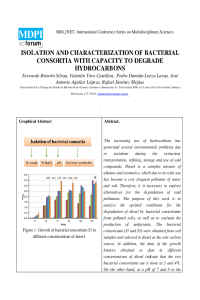
The increasing use of hydrocarbons has generated several environmental problems due to accidents during the extraction, transportation, refining, storage and use of said compounds. Diesel is a complex mixture of alkanes and aromatics, which due to its wide use has become a very frequent pollutant of water and soil. Therefore, it is necessary to explore alternatives for the degradation of said pollutants. The purpose of this work is to analyze the optimal conditions for the degradation of diesel by bacterial consortiums from polluted soils, as well as to evaluate the production of surfactants. The bacterial consortiums (J3 and S3) were obtained from soil samples and selected in diesel as the sole carbon source, in addition, the data of the growth kinetics obtained to date in different concentrations of diesel indicate that the two bacterial consortiums use it more at 3 and 4%. On the other hand, at a pH of 7 and 8 in the presence of 3% of diesel, better bacterial growth was observed. Also, the S3 consortium showed good growth at NaCl levels of 4%. For the case of the production of surfactants only the J3 consortium, production was produced with an E24 emulsion index of 38%, which was also recorded by the hemolytic activity of the bacterial supernatant and by the collapse of the oil drop. On the other hand, the consortia are able to grow in pentadecane and citronellol, while they do not grow in naphthalene and pyrene as the sole source of carbon. Although they are partial results, they reflect the potential of these consortiums for the degradation of linear hydrocarbons, so studies are being conducted to quantify diesel degradation, identify the members of each consortium and characterize the surfactants produced.
Keywords
Diesel
Bacterial consortium
degradation.
Poster
ISOLATION AND CHARACTERIZATION OF BACTERIAL CONSORTIA WITH CAPACITY TO DEGRADE HYDROCARBONS (2).pdf
Assessing the effect of calcium and magnesium ions in the structural stability of the protein kinase A through molecular dynamics simulations
Machine learning techniques and the identification of new potentially active compounds against Leishmania infantum.