Event submissions
EventsMOL2NET'18, Conference on Molecular, Biomed., Comput. & Network Science and Engineering, 4th ed.
Published

This submission belongs to the session 06. CHEMBIOMOL-04: Chem. Biol. & Med. Chem. Workshop, Paraiba, Porto, Rostock, Germany-Galveston, Texas, USA, 2018 of the event MOL2NET'18, Conference on Molecular, Biomed., Comput. & Network Science and Engineering, 4th ed.
Published date
17 Jan, 2019
Citation
Naivi Flores Balmaseda, Susana Rojas Socarrás, Juan Alberto Castillo Garit, Machine learning techniques and the identification of new potentially active compounds against Leishmania infantum., in Proceedings of MOL2NET'18, Conference on Molecular, Biomed., Comput. & Network Science and Engineering, 4th ed., 15 January 2018–20 January 2019, MDPI: Basel, Switzerland, doi: 10.3390/mol2net-04-06141
Share
Email
Facebook
Twitter
LinkedIn
Machine learning techniques and the identification of new potentially active compounds against Leishmania infantum.
'%3e%3cpath%20d='M12.6647%2010.9104C12.4176%2010.325%2012.0589%209.7933%2011.6088%209.34485C11.16%208.89511%2010.6283%208.53653%2010.0432%208.28891C10.038%208.28629%2010.0327%208.28498%2010.0275%208.28236C10.8437%207.69282%2011.3743%206.73252%2011.3743%205.64907C11.3743%203.85423%209.92005%202.40002%208.12522%202.40002C6.33038%202.40002%204.87618%203.85423%204.87618%205.64907C4.87618%206.73252%205.40677%207.69282%206.22296%208.28367C6.21772%208.28629%206.21248%208.2876%206.20724%208.29022C5.62031%208.53783%205.09365%208.89287%204.64167%209.34616C4.19192%209.79496%203.83334%2010.3266%203.58573%2010.9117C3.34247%2011.4846%203.21128%2012.0987%203.19925%2012.721C3.1989%2012.735%203.20135%2012.7489%203.20646%2012.7619C3.21157%2012.7749%203.21924%2012.7868%203.22901%2012.7968C3.23877%2012.8068%203.25045%2012.8148%203.26334%2012.8202C3.27623%2012.8256%203.29007%2012.8284%203.30406%2012.8284H4.09012C4.14776%2012.8284%204.19362%2012.7825%204.19493%2012.7262C4.22113%2011.7148%204.62726%2010.7676%205.34519%2010.0497C6.08802%209.30686%207.07452%208.89811%208.12522%208.89811C9.17592%208.89811%2010.1624%209.30686%2010.9052%2010.0497C11.6232%2010.7676%2012.0293%2011.7148%2012.0555%2012.7262C12.0568%2012.7839%2012.1027%2012.8284%2012.1603%2012.8284H12.9464C12.9604%2012.8284%2012.9742%2012.8256%2012.9871%2012.8202C13%2012.8148%2013.0117%2012.8068%2013.0214%2012.7968C13.0312%2012.7868%2013.0389%2012.7749%2013.044%2012.7619C13.0491%2012.7489%2013.0515%2012.735%2013.0512%2012.721C13.0381%2012.0947%2012.9084%2011.4856%2012.6647%2010.9104ZM8.12522%207.90243C7.52388%207.90243%206.95792%207.66793%206.53214%207.24215C6.10636%206.81636%205.87185%206.2504%205.87185%205.64907C5.87185%205.04773%206.10636%204.48177%206.53214%204.05599C6.95792%203.63021%207.52388%203.3957%208.12522%203.3957C8.72655%203.3957%209.29252%203.63021%209.7183%204.05599C10.1441%204.48177%2010.3786%205.04773%2010.3786%205.64907C10.3786%206.2504%2010.1441%206.81636%209.7183%207.24215C9.29252%207.66793%208.72655%207.90243%208.12522%207.90243Z'%20fill='%235D1EE1'/%3e%3c/g%3e%3c/svg%3e)
Naivi Flores Balmaseda 1
Susana Rojas Socarrás 2
Juan Alberto Castillo Garit 3
1. Unit of Computer-Aided Molecular "Biosilico" Discovery and Bioinformatic Research (CAMD-BIR Unit), Department of Pharmacy, Faculty of Chemical-Pharmacy. Central University of Las Villas, Santa Clara, 54830, Villa Clara, Cuba
2. Department of Pharmacy, Faculty of Chemical-Pharmacy. Central University of Las Villas, Santa Clara, 54830, Villa Clara, Cuba.
3. Unit of Computer-Aided Molecular “Biosilico” Discovery and Bioinformatic Research (CAMD-BIR Unit). Central University of Las Villas
Unit of Experimental Toxicology, University of Medical Sciences "Dr. Serafín Ruiz de Zarate Ruiz "Villa, Clara. Cuba
Abstract
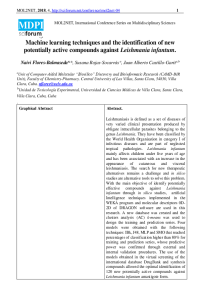
Leishmaniasis is defined as a set of diseases of very varied clinical presentation produced by obligate intracellular parasites belonging to the genus Leishmania. They have been classified by the World Health Organization in category I of infectious diseases and are part of neglected tropical pathologies. Leishmania infantum mainly affects children under five years of age and has been associated with an increase in the appearance of cutaneous and visceral leishmaniasis. The search for new therapeutic alternatives remains a challenge and in silico studies are alternative tools to solve this problem. With the main objective of identify potentially effective compounds against Leishmania infantum through in silico studies, artificial Intelligence techniques implemented in the WEKA program and molecular descriptors 0D-2D of DRAGON software are used in this research. A new database was created and the clusters analysis (AC) k-means was used to design the training and prediction series. Four models were obtained with the following techniques: IBk, J48, MLP and SMO that reached percentages of classification higher than 80% for training and prediction series, whose predictive power was confirmed through external and internal validation procedures. The use of the models obtained in the virtual screening of the international database DrugBank and synthesis compounds allowed the optimal identification of 120 new potentially active compounds against Leishmania infantum amastigote form.
Keywords
Leishmaniasis
machine learning techniques
protozoo
WEKA software
Leishmania infantum
amastigote.
Poster
mol2net sciforum-022856.pdf
ISOLATION AND CHARACTERIZATION OF BACTERIAL CONSORTIA WITH CAPACITY TO DEGRADE HYDROCARBONS
Analysis of chemical composition of Cissus incisa leaves by GC/MS