Event submissions
EventsMOL2NET'19, Conference on Molecular, Biomed., Comput. & Network Science and Engineering, 5th ed.
Published

This submission belongs to the session 07. CHEMBIOMOL-05: Chem. Biol. & Med. Chem. Workshop, Bilbao-Lisboa, Portugal-Rostock, Germany, Galveston, Texas, USA, 2019 of the event MOL2NET'19, Conference on Molecular, Biomed., Comput. & Network Science and Engineering, 5th ed.
Published date
03 Oct, 2019
Citation
Sana Zouaoui, Nabil Semmar, Preliminary updating on structural and chemotaxonomical aspects of pharmacologically evaluated flavonoids, in Proceedings of MOL2NET'19, Conference on Molecular, Biomed., Comput. & Network Science and Engineering, 5th ed., 20 March–20 December 2019, MDPI: Basel, Switzerland, doi: 10.3390/mol2net-05-06263
Share
Email
Facebook
Twitter
LinkedIn
Preliminary updating on structural and chemotaxonomical aspects of pharmacologically evaluated flavonoids
'%3e%3cpath%20d='M12.6647%2010.9104C12.4176%2010.325%2012.0589%209.7933%2011.6088%209.34485C11.16%208.89511%2010.6283%208.53653%2010.0432%208.28891C10.038%208.28629%2010.0327%208.28498%2010.0275%208.28236C10.8437%207.69282%2011.3743%206.73252%2011.3743%205.64907C11.3743%203.85423%209.92005%202.40002%208.12522%202.40002C6.33038%202.40002%204.87618%203.85423%204.87618%205.64907C4.87618%206.73252%205.40677%207.69282%206.22296%208.28367C6.21772%208.28629%206.21248%208.2876%206.20724%208.29022C5.62031%208.53783%205.09365%208.89287%204.64167%209.34616C4.19192%209.79496%203.83334%2010.3266%203.58573%2010.9117C3.34247%2011.4846%203.21128%2012.0987%203.19925%2012.721C3.1989%2012.735%203.20135%2012.7489%203.20646%2012.7619C3.21157%2012.7749%203.21924%2012.7868%203.22901%2012.7968C3.23877%2012.8068%203.25045%2012.8148%203.26334%2012.8202C3.27623%2012.8256%203.29007%2012.8284%203.30406%2012.8284H4.09012C4.14776%2012.8284%204.19362%2012.7825%204.19493%2012.7262C4.22113%2011.7148%204.62726%2010.7676%205.34519%2010.0497C6.08802%209.30686%207.07452%208.89811%208.12522%208.89811C9.17592%208.89811%2010.1624%209.30686%2010.9052%2010.0497C11.6232%2010.7676%2012.0293%2011.7148%2012.0555%2012.7262C12.0568%2012.7839%2012.1027%2012.8284%2012.1603%2012.8284H12.9464C12.9604%2012.8284%2012.9742%2012.8256%2012.9871%2012.8202C13%2012.8148%2013.0117%2012.8068%2013.0214%2012.7968C13.0312%2012.7868%2013.0389%2012.7749%2013.044%2012.7619C13.0491%2012.7489%2013.0515%2012.735%2013.0512%2012.721C13.0381%2012.0947%2012.9084%2011.4856%2012.6647%2010.9104ZM8.12522%207.90243C7.52388%207.90243%206.95792%207.66793%206.53214%207.24215C6.10636%206.81636%205.87185%206.2504%205.87185%205.64907C5.87185%205.04773%206.10636%204.48177%206.53214%204.05599C6.95792%203.63021%207.52388%203.3957%208.12522%203.3957C8.72655%203.3957%209.29252%203.63021%209.7183%204.05599C10.1441%204.48177%2010.3786%205.04773%2010.3786%205.64907C10.3786%206.2504%2010.1441%206.81636%209.7183%207.24215C9.29252%207.66793%208.72655%207.90243%208.12522%207.90243Z'%20fill='%235D1EE1'/%3e%3c/g%3e%3c/svg%3e)
Sana Zouaoui 1
Nabil Semmar 2
1. University of Tunis El Manar. Tunisia. Pasteur Institute of Tunis. Laboratory of BioInformatics, bioMathematics and bioStatistics (BIMS).
2. University of Tunis El Manar. Pasteur Institute of Tunis. Laboratory of BioInformatics, bioMathematics and bioStatistics (BIMS), 1002, Tunis, Tunisia
Abstract
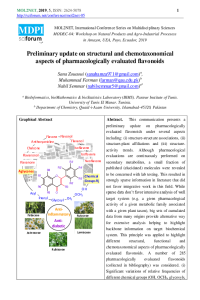
This communication presents a preliminary update on pharmacologically evaluated flavonoids under several aspects including: structure-structure associations, structure-activity trends and structure-plant affiliations. Although pharmacological evaluations are continuously performed on secondary metabolites, a small fraction of published (elucidated) molecules were revealed to be concerned with lab testing. This resulted in strongly sparse information in literature that did not favor integrative work in this field. While sparse data don’t favor intensive analysis of well target system (e.g. a given pharmacological activity of a given metabolic family associated with a given plant taxon), big sets of cumulated data from many origins provide alternative way for extensive analysis helping to highlight backbone information on a target biochemical system. This principle was applied to highlight different structural, functional and chemotaxonomical aspects of pharmacologically evaluated flavonoids from 285 molecules belonging to different flavonoid families and originated from different plant taxa. (i) Significant variations of relative frequencies of different chemical groups (OH, OCH3, glycosyls, prenyl) in different flavonoid aglycone (structure-structure associations). (ii) Clear structural differentiation ways of different plant families characterized by relatively high frequencies of some aglycones and chemical groups. (iii) Positive and negative effects of some chemical groups (occurring in some carbons of aglycones) on some pharmacological activities. Anti-inflammatory (If) and antidiabetic (Db) activities were considered because of more available data. The work calls for further investigations in pharmacological evaluations of flavonoids. It is openly ready for further updates by considering more biologically evaluated flavonoids as they are published.
Keywords
Classification
aglycones
chemical groups
structure-activity trends
structure-plant associations
phytoconstituent profiles
Manuscript
Zouaoui el al Communication.pdf
Poster
Zouaoui el al Communication.pdf
Comprehensive study of a Thithonia diversifolia material using mathematical modeling
PANELFIT’s Official Newsletter, H2020, Europe Commission Project, Number 01 , May, 2019.