Event submissions
Published

This submission belongs to the session B. Posters of the event 5th International Electronic Conference on Medicinal Chemistry
Published date
30 Oct, 2019
Citation
Habibu Tijjani, Abubakar Mohammed, Adegbenro Peter Adegunloye, Phytochemicals and in vitro antioxidant studies of Daucus carota L. seed extracts, in Proceedings of 5th International Electronic Conference on Medicinal Chemistry, 1 November–30 November 2019, MDPI: Basel, Switzerland, doi: 10.3390/ECMC2019-06278
Share
Email
Facebook
Twitter
LinkedIn
Phytochemicals and in vitro antioxidant studies of Daucus carota L. seed extracts

Habibu Tijjani 1,2
'%3e%3cpath%20d='M12.6647%2010.9104C12.4176%2010.325%2012.0589%209.7933%2011.6088%209.34485C11.16%208.89511%2010.6283%208.53653%2010.0432%208.28891C10.038%208.28629%2010.0327%208.28498%2010.0275%208.28236C10.8437%207.69282%2011.3743%206.73252%2011.3743%205.64907C11.3743%203.85423%209.92005%202.40002%208.12522%202.40002C6.33038%202.40002%204.87618%203.85423%204.87618%205.64907C4.87618%206.73252%205.40677%207.69282%206.22296%208.28367C6.21772%208.28629%206.21248%208.2876%206.20724%208.29022C5.62031%208.53783%205.09365%208.89287%204.64167%209.34616C4.19192%209.79496%203.83334%2010.3266%203.58573%2010.9117C3.34247%2011.4846%203.21128%2012.0987%203.19925%2012.721C3.1989%2012.735%203.20135%2012.7489%203.20646%2012.7619C3.21157%2012.7749%203.21924%2012.7868%203.22901%2012.7968C3.23877%2012.8068%203.25045%2012.8148%203.26334%2012.8202C3.27623%2012.8256%203.29007%2012.8284%203.30406%2012.8284H4.09012C4.14776%2012.8284%204.19362%2012.7825%204.19493%2012.7262C4.22113%2011.7148%204.62726%2010.7676%205.34519%2010.0497C6.08802%209.30686%207.07452%208.89811%208.12522%208.89811C9.17592%208.89811%2010.1624%209.30686%2010.9052%2010.0497C11.6232%2010.7676%2012.0293%2011.7148%2012.0555%2012.7262C12.0568%2012.7839%2012.1027%2012.8284%2012.1603%2012.8284H12.9464C12.9604%2012.8284%2012.9742%2012.8256%2012.9871%2012.8202C13%2012.8148%2013.0117%2012.8068%2013.0214%2012.7968C13.0312%2012.7868%2013.0389%2012.7749%2013.044%2012.7619C13.0491%2012.7489%2013.0515%2012.735%2013.0512%2012.721C13.0381%2012.0947%2012.9084%2011.4856%2012.6647%2010.9104ZM8.12522%207.90243C7.52388%207.90243%206.95792%207.66793%206.53214%207.24215C6.10636%206.81636%205.87185%206.2504%205.87185%205.64907C5.87185%205.04773%206.10636%204.48177%206.53214%204.05599C6.95792%203.63021%207.52388%203.3957%208.12522%203.3957C8.72655%203.3957%209.29252%203.63021%209.7183%204.05599C10.1441%204.48177%2010.3786%205.04773%2010.3786%205.64907C10.3786%206.2504%2010.1441%206.81636%209.7183%207.24215C9.29252%207.66793%208.72655%207.90243%208.12522%207.90243Z'%20fill='%235D1EE1'/%3e%3c/g%3e%3c/svg%3e)
Abubakar Mohammed 3
Adegbenro Peter Adegunloye 4
1. Department of Biochemistry, Natural Product Research Laboratory, Bauchi State University, Gadau, Bauchi State, Nigeria
2. Department of Science Laboratory Technology, Bauchi State University, Gadau, Bauchi State, Nigeria.
3. Department of Biochemistry, Bauchi State University, Gadau, Nigeria
4. Department of Biochemistry, University of Ilorin, Ilorin, Nigeria
Abstract
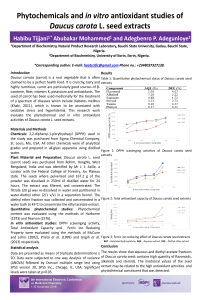
Daucus carota seeds are important in the treatment of a broad spectrum of ailments. This study evaluated the phytochemicals status and in vitro antioxidant effects of aqueous and diethyl ether extracts of D. carota seed. 50 g of D. carota seeds were pulverized and dissolved in 200 ml distilled water for 24 hours, the crude aqueous extract obtained (AQE, 11.05g, 22.1% yield) was partition in water/diethyl ether (2:1) to yield the diethyl ether fraction (DEE, 0.45g, 0.90% yield). The extracts were evaluated for quantitative phytochemicals, 2,2-diphenyl-1-picrylhydrazyl (DPPH), total antioxidant capacity and ferric ion reducing effect at 0.4 to 2.0 mg/ml. AQE and DEE contain alkaloids (7.28%, 5.22%), flavonoids (5.56%, 4.03%), saponins (4.68%, 1.52%), steroids (3.23%, 2.71%), tannins (0.40%, 0.27%) and phenol (0.37%, 0.22%) respectively. The DPPH scavenging effect of the extracts was superior to the reference compound butylated hydroxytolune (BHT) with IC50 of 2.84 mg/ml compared to AQE with 2.00 mg/ml and DEE with 1.39 mg/ml respectively. AQE extract when compared with BHT had similar total antioxidant capacity while BHT was significantly (p<0.05) higher than DEE. However, both AQE and DEE express better ferric ion reducing effect compared to BHT at the concentrations range. The results shows that aqueous and diethyl ether extracts of D. carota seed possess good in vitro radical scavenging activities with presence of higher phytochemical content in the aqueous extract.
Keywords
Antioxidants
Daucus carota
Phytochemicals
Solvent extracts
Seed
Manuscript
Tijjani et al., IECMC.pdf
Poster
Tijjani et al., IECMC.pdf
Screening for PKS-I gene cluster from endophytic actinomycetes residing in Ocmium tenuiflorum (Tulsi) and Azadirachta indica (Neem)
Medicated surgical braces