Event submissions
Published

This submission belongs to the session B. Posters of the event 5th International Electronic Conference on Medicinal Chemistry
Published date
30 Oct, 2019
Citation
Azizah Malebari, Mary Meegan, Novel synthesis of 3-fluoro- and 3,3-difluoro-substituted β-lactams: evaluation as potential antiproliferative and tubulin destabilizing agents, in Proceedings of 5th International Electronic Conference on Medicinal Chemistry, 1 November–30 November 2019, MDPI: Basel, Switzerland, doi: 10.3390/ECMC2019-06303
Share
Email
Facebook
Twitter
LinkedIn
Novel synthesis of 3-fluoro- and 3,3-difluoro-substituted β-lactams: evaluation as potential antiproliferative and tubulin destabilizing agents
'%3e%3cpath%20d='M12.6647%2010.9104C12.4176%2010.325%2012.0589%209.7933%2011.6088%209.34485C11.16%208.89511%2010.6283%208.53653%2010.0432%208.28891C10.038%208.28629%2010.0327%208.28498%2010.0275%208.28236C10.8437%207.69282%2011.3743%206.73252%2011.3743%205.64907C11.3743%203.85423%209.92005%202.40002%208.12522%202.40002C6.33038%202.40002%204.87618%203.85423%204.87618%205.64907C4.87618%206.73252%205.40677%207.69282%206.22296%208.28367C6.21772%208.28629%206.21248%208.2876%206.20724%208.29022C5.62031%208.53783%205.09365%208.89287%204.64167%209.34616C4.19192%209.79496%203.83334%2010.3266%203.58573%2010.9117C3.34247%2011.4846%203.21128%2012.0987%203.19925%2012.721C3.1989%2012.735%203.20135%2012.7489%203.20646%2012.7619C3.21157%2012.7749%203.21924%2012.7868%203.22901%2012.7968C3.23877%2012.8068%203.25045%2012.8148%203.26334%2012.8202C3.27623%2012.8256%203.29007%2012.8284%203.30406%2012.8284H4.09012C4.14776%2012.8284%204.19362%2012.7825%204.19493%2012.7262C4.22113%2011.7148%204.62726%2010.7676%205.34519%2010.0497C6.08802%209.30686%207.07452%208.89811%208.12522%208.89811C9.17592%208.89811%2010.1624%209.30686%2010.9052%2010.0497C11.6232%2010.7676%2012.0293%2011.7148%2012.0555%2012.7262C12.0568%2012.7839%2012.1027%2012.8284%2012.1603%2012.8284H12.9464C12.9604%2012.8284%2012.9742%2012.8256%2012.9871%2012.8202C13%2012.8148%2013.0117%2012.8068%2013.0214%2012.7968C13.0312%2012.7868%2013.0389%2012.7749%2013.044%2012.7619C13.0491%2012.7489%2013.0515%2012.735%2013.0512%2012.721C13.0381%2012.0947%2012.9084%2011.4856%2012.6647%2010.9104ZM8.12522%207.90243C7.52388%207.90243%206.95792%207.66793%206.53214%207.24215C6.10636%206.81636%205.87185%206.2504%205.87185%205.64907C5.87185%205.04773%206.10636%204.48177%206.53214%204.05599C6.95792%203.63021%207.52388%203.3957%208.12522%203.3957C8.72655%203.3957%209.29252%203.63021%209.7183%204.05599C10.1441%204.48177%2010.3786%205.04773%2010.3786%205.64907C10.3786%206.2504%2010.1441%206.81636%209.7183%207.24215C9.29252%207.66793%208.72655%207.90243%208.12522%207.90243Z'%20fill='%235D1EE1'/%3e%3c/g%3e%3c/svg%3e)
Azizah Malebari 1

Mary Meegan 2
1. Department of Pharmaceutical Chemistry, College of Pharmacy, King Abdulaziz University, Jeddah, KSA
School of Pharmacy and Pharmaceutical Sciences, Trinity Biomedical Sciences Institute, 152-160 Pearse Street, Trinity College Dublin, Dublin 2, Ireland
2. School of Pharmacy and Pharmaceutical Sciences, Trinity Biomedical Sciences Institute, 152-160 Pearse Street, Trinity College Dublin, Dublin 2, Ireland
Abstract
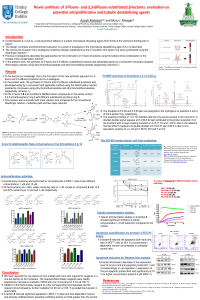
Combretastatin A-4 (CA-4), a natural stilbene is a potent microtubule-disrupting agent, which binds at the colchicine-binding site of tubulin. The design, synthesis and biochemical evaluation of a series of analogues of the microtubule-destabilising agent CA-4 is described. The monocyclic β-lactam CA-4 analogues containing halogen substituents at the C-3 position of β-lactam ring were synthesized using the Staudinger reaction. Previous investigations described two approaches for the construction of 3-fluoro-β-lactams using the ketene-imine condensation or the enolate-imine condensation method. In the present work, a ready synthesis of 3-fluoro- and 3,3-difluoro-substituted β-lactams was developed by a convenient microwave-assisted Reformatsky reaction using ethyl bromofluoroacetate and ethyl bromodifluoroacetate respectively. To the best to our knowledge, this is the first report of this new synthetic approach for 3-fluoro- and 3,3-difluoro-β-lactams as CA-4 analogues. The reaction was successful with short reaction time compared to the conventional Staudinger reaction, moderate yields and few steps. It is demonstrated to be a convenient and facile method for the preparation of a variety of 3-fluoro- and 3,3-difluoro-β-lactams. The 3-fluoro-β-lactams (1-8) and 3,3-difluoro-β-lactams (9-16) in this series contain the 3,4,5-trimethoxyphenyl ring A, (required for potent activity of CA-4), together with various ring B substituents. The structure of β-lactams 6 and 14 was confirmed by X-ray crystallography. Preliminary cell viability studies demonstrated the antiproliferative effects of these novel compounds, with IC50 value of 0.153 µM for 6 in MCF-7 human breast cancer cell line.
Keywords
Combretastatin A-4 (CA-4)
β-lactam
microwave assisted Reformatsky reaction
MCF-7
Manuscript
Poster for 5th International Electronic Conference on Medicinal Chemistry.pdf
Poster
sciforum-027761.pdf
Novel radiolabeled silicon rhodamine dyes for bimodal scintigraphic and optical imaging
Influence of partially hydrogenated pyridines (derivatives of cyanothioacetamide) on blood indicators of rats with acute tetrachloromethane hepatitis