Event submissions
Published

This submission belongs to the session B. Posters of the event 5th International Electronic Conference on Medicinal Chemistry
Published date
30 Oct, 2019
Citation
Jeanette Guadalupe Cárdenas Valdovinos, Pedro Damián Loeza Lara, Hortencia Gabriela Mena Violante, María Valentina Angoa Pérez, Antimicrobial activity of extract of strawberry of different quality against antibiotic-resistant Staphylococcus aureus , in Proceedings of 5th International Electronic Conference on Medicinal Chemistry, 1 November–30 November 2019, MDPI: Basel, Switzerland, doi: 10.3390/ECMC2019-06309
Share
Email
Facebook
Twitter
LinkedIn
Antimicrobial activity of extract of strawberry of different quality against antibiotic-resistant Staphylococcus aureus

Jeanette Guadalupe Cárdenas Valdovinos 1
'%3e%3cpath%20d='M12.6647%2010.9104C12.4176%2010.325%2012.0589%209.7933%2011.6088%209.34485C11.16%208.89511%2010.6283%208.53653%2010.0432%208.28891C10.038%208.28629%2010.0327%208.28498%2010.0275%208.28236C10.8437%207.69282%2011.3743%206.73252%2011.3743%205.64907C11.3743%203.85423%209.92005%202.40002%208.12522%202.40002C6.33038%202.40002%204.87618%203.85423%204.87618%205.64907C4.87618%206.73252%205.40677%207.69282%206.22296%208.28367C6.21772%208.28629%206.21248%208.2876%206.20724%208.29022C5.62031%208.53783%205.09365%208.89287%204.64167%209.34616C4.19192%209.79496%203.83334%2010.3266%203.58573%2010.9117C3.34247%2011.4846%203.21128%2012.0987%203.19925%2012.721C3.1989%2012.735%203.20135%2012.7489%203.20646%2012.7619C3.21157%2012.7749%203.21924%2012.7868%203.22901%2012.7968C3.23877%2012.8068%203.25045%2012.8148%203.26334%2012.8202C3.27623%2012.8256%203.29007%2012.8284%203.30406%2012.8284H4.09012C4.14776%2012.8284%204.19362%2012.7825%204.19493%2012.7262C4.22113%2011.7148%204.62726%2010.7676%205.34519%2010.0497C6.08802%209.30686%207.07452%208.89811%208.12522%208.89811C9.17592%208.89811%2010.1624%209.30686%2010.9052%2010.0497C11.6232%2010.7676%2012.0293%2011.7148%2012.0555%2012.7262C12.0568%2012.7839%2012.1027%2012.8284%2012.1603%2012.8284H12.9464C12.9604%2012.8284%2012.9742%2012.8256%2012.9871%2012.8202C13%2012.8148%2013.0117%2012.8068%2013.0214%2012.7968C13.0312%2012.7868%2013.0389%2012.7749%2013.044%2012.7619C13.0491%2012.7489%2013.0515%2012.735%2013.0512%2012.721C13.0381%2012.0947%2012.9084%2011.4856%2012.6647%2010.9104ZM8.12522%207.90243C7.52388%207.90243%206.95792%207.66793%206.53214%207.24215C6.10636%206.81636%205.87185%206.2504%205.87185%205.64907C5.87185%205.04773%206.10636%204.48177%206.53214%204.05599C6.95792%203.63021%207.52388%203.3957%208.12522%203.3957C8.72655%203.3957%209.29252%203.63021%209.7183%204.05599C10.1441%204.48177%2010.3786%205.04773%2010.3786%205.64907C10.3786%206.2504%2010.1441%206.81636%209.7183%207.24215C9.29252%207.66793%208.72655%207.90243%208.12522%207.90243Z'%20fill='%235D1EE1'/%3e%3c/g%3e%3c/svg%3e)
Pedro Damián Loeza Lara 2
Hortencia Gabriela Mena Violante 1
María Valentina Angoa Pérez 1
1. Instituto Politécnico Nacional
2. Universidad de La Ciénega del Estado de Michoacán de Ocampo, Michoacán, MX
Abstract
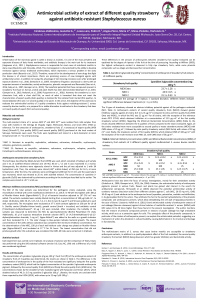
Inflammation of the mammary gland in cattle is known as mastitis, and Staphylococcus aureus is the most common causative agent, it has the ability to develop resistance to most of the antibiotics used to combat this disease, which, added to its indiscriminate use, It results in a very difficult infection to control that causes significant economic losses. That is why research for the development of new drugs that fight this condition is of great relevance. The secondary metabolites present in fruits and plants are an important source of naturally occurring antimicrobials. Strawberry is a berry with an important amount of metabolites, mainly anthocyanins, phenolic compounds and flavonoids; The beneficial potential that these compounds have on human, animal and plant health has been demonstrated. However, it is a non-climacteric fruit, with a short shelf life, so much of what is harvested that does not meet the characteristics of export quality (Extra quality), goes to the national fresh market (first quality), to industrialization (first and / or second quality) or to waste. In this sense, the objective of this work was to evaluate the antimicrobial activity of strawberry fruits of these three qualities, as an alternative proposal to add value to the strawberry that does not reach export quality (first and second quality). The Minimum Inhibitory and Bactericidal Concentration (CMI and CMB) of strawberry anthocyanin extracts (extra, first and second), was determined against S. aureus causative of antibiotic multidrug bovine mastitis (AMC 9, AMC 23 and ATCC 27543). The results indicated that all strawberry extracts presented antimicrobial potential. However, there were differences between the different qualities evaluated. Both the MICs and the CMBs presented by the extract of strawberry anthocyanins of second quality were significantly lower (MIC of 6.3 to 12.5 μg / ml; CMB 25 μg / ml) than those presented by extracts of Extra quality (MIC 25 μg / ml; CMB 50 μg / ml) and first quality (MIC from 12.5 to 25 μg / ml; CMB from 50 to 100 μg / ml) for all strains. These results indicate that the multiresistant strains of S. aureus that cause bovine mastitis are susceptible to strawberry anthocyanin extracts, in addition to a quality-dependent effect of the fruit evaluated, being the extract of waste fruits the one that has greater antimicrobial potential against all the strains, which can be a viable alternative for the use of discarded strawberry fruits, as well as for use as a treatment against bovine mastitis.
Keywords
Antimicrobial activity
anthocyanin
strawberry
microbial resistance
Manuscript
Poster JGCV.pdf
Poster
sciforum-027848.pdf
Production of high valued medicinal compounds using plant cell tissue and organ culture
In the search of new xanthine oxidase inhibitors: 3-Phenylcoumarins versus 2-phenylbenzofurans