Event submissions
Published

This submission belongs to the session B. Posters of the event 5th International Electronic Conference on Medicinal Chemistry
Published date
30 Oct, 2019
Citation
Noelia Fraga Matías, Isabel Maria Ureña Vacas, Elena González-Burgos, M. Pilar Gómez-Serranillos, Biological evaluation of Cetrarioid clade as cholinesterase inhibitors, in Proceedings of 5th International Electronic Conference on Medicinal Chemistry, 1 November–30 November 2019, MDPI: Basel, Switzerland, doi: 10.3390/ECMC2019-06316
Share
Email
Facebook
Twitter
LinkedIn
Biological evaluation of Cetrarioid clade as cholinesterase inhibitors
'%3e%3cpath%20d='M12.6647%2010.9104C12.4176%2010.325%2012.0589%209.7933%2011.6088%209.34485C11.16%208.89511%2010.6283%208.53653%2010.0432%208.28891C10.038%208.28629%2010.0327%208.28498%2010.0275%208.28236C10.8437%207.69282%2011.3743%206.73252%2011.3743%205.64907C11.3743%203.85423%209.92005%202.40002%208.12522%202.40002C6.33038%202.40002%204.87618%203.85423%204.87618%205.64907C4.87618%206.73252%205.40677%207.69282%206.22296%208.28367C6.21772%208.28629%206.21248%208.2876%206.20724%208.29022C5.62031%208.53783%205.09365%208.89287%204.64167%209.34616C4.19192%209.79496%203.83334%2010.3266%203.58573%2010.9117C3.34247%2011.4846%203.21128%2012.0987%203.19925%2012.721C3.1989%2012.735%203.20135%2012.7489%203.20646%2012.7619C3.21157%2012.7749%203.21924%2012.7868%203.22901%2012.7968C3.23877%2012.8068%203.25045%2012.8148%203.26334%2012.8202C3.27623%2012.8256%203.29007%2012.8284%203.30406%2012.8284H4.09012C4.14776%2012.8284%204.19362%2012.7825%204.19493%2012.7262C4.22113%2011.7148%204.62726%2010.7676%205.34519%2010.0497C6.08802%209.30686%207.07452%208.89811%208.12522%208.89811C9.17592%208.89811%2010.1624%209.30686%2010.9052%2010.0497C11.6232%2010.7676%2012.0293%2011.7148%2012.0555%2012.7262C12.0568%2012.7839%2012.1027%2012.8284%2012.1603%2012.8284H12.9464C12.9604%2012.8284%2012.9742%2012.8256%2012.9871%2012.8202C13%2012.8148%2013.0117%2012.8068%2013.0214%2012.7968C13.0312%2012.7868%2013.0389%2012.7749%2013.044%2012.7619C13.0491%2012.7489%2013.0515%2012.735%2013.0512%2012.721C13.0381%2012.0947%2012.9084%2011.4856%2012.6647%2010.9104ZM8.12522%207.90243C7.52388%207.90243%206.95792%207.66793%206.53214%207.24215C6.10636%206.81636%205.87185%206.2504%205.87185%205.64907C5.87185%205.04773%206.10636%204.48177%206.53214%204.05599C6.95792%203.63021%207.52388%203.3957%208.12522%203.3957C8.72655%203.3957%209.29252%203.63021%209.7183%204.05599C10.1441%204.48177%2010.3786%205.04773%2010.3786%205.64907C10.3786%206.2504%2010.1441%206.81636%209.7183%207.24215C9.29252%207.66793%208.72655%207.90243%208.12522%207.90243Z'%20fill='%235D1EE1'/%3e%3c/g%3e%3c/svg%3e)
Noelia Fraga Matías 1
Isabel Maria Ureña Vacas 1
Elena González-Burgos 1
M. Pilar Gómez-Serranillos 1
1. Department of Pharmacology, Pharmacognosy and Botanical, Faculty of Pharmacy, University Complutense of Madrid (Madrid, Spain)
Abstract
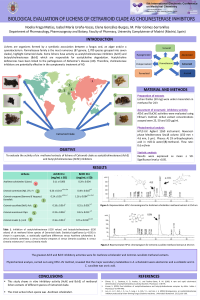
OBJECTIVE: Deficiencies in the neurotransmitter acetylcholine have been linked to the pathogenesis of Alzheimer's disease (AD). Therefore, cholinesterase inhibitors are potentially clinical effective for the symptomatic treatment of AD. Little is known about the neuroprotective activity of lichens as cholinesterase inhibitors. The aim of the present work is to evaluate for the first time the activity of five methanol extracts of lichens from Cetraroid clade: Cetraria commixta (Nyl.) Th.Fr, Cetraria crespoae (Barreno & Vazquez) Karnefelt, Cetraria cucullata (Bell.) Ach., Cetraria ericetorum. Opiz, Cetraria nivalis (L.) Ach and Asahinea scholanderi (Llano) as acetylcholinesterase (AchE) and butyrilcholinesterase (BchE) inhibitors.
METHODS: The AChE and BuChE activities were evaluated using the Ellman’s method at 25, 50 and 100 µg/ml methanol extract concentrations. Chemical analysis was performed using High Performance Liquid Chromatography (HPLC-UV).
RESULTS: Among all lichen extracts, Asahinea scholanderi was found the most potent AchE inhibitor (IC50 = 0.11 ± 0.006) followed by Cetraria nivalis (IC50 = 0.16 ± 0.013), Cetraria cucullata (IC50 = 0.18 ± 0.014). Regarding the action on BchE, Asahinea scholanderi was once again the most active lichen specie (IC50= 0.29 ± 0,004) followed by Cetraria cucullata (IC50= 0.31 ± 0,001) and Cetraria commixta (IC50= 0.49 ± 0,018). Since Asahinea scholanderi was the most active cholinesterase inhibitor, phytochemical analysis was performed. HPLC analysis of methanol extract revealed that the main compounds were α- and β-alectoronic, β-collatolic and usnic acid.
CONCLUSION: Our findings suggest that Asahinea scholanderi methanol extract display inhibitory activities against both AChE and BuChE, being a useful promising agent for AD treatment.
Keywords
Cetrarioid clade
cholinesterase inhibitors
lichens
Manuscript
Definitive CETRARIOID CLADE AS CHOLINESTERASE INHIBITORS.pdf
Poster
Definitive CETRARIOID CLADE AS CHOLINESTERASE INHIBITORS.pdf
Consumption of medicinal plants for central nervous system (CNS) disorders among university students in the Community of Madrid
Antioxidant capacity and cholinesterase inhibitory activity of Vulpicida pinastri lichen and its chemical composition