Event submissions
Published

This submission belongs to the session B. Posters of the event 5th International Electronic Conference on Medicinal Chemistry
Published date
30 Oct, 2019
Citation
Krzysztof Szafrański, Jarosław Sławiński, Anna Kawiak, Optimization of 4-chloro-5-[5-(2-arylvinyl)-1,3,4-oxadiazol-2-yl]benzenesulfonamide structure towards anticancer activity, in Proceedings of 5th International Electronic Conference on Medicinal Chemistry, 1 November–30 November 2019, MDPI: Basel, Switzerland, doi: 10.3390/ECMC2019-06318
Share
Email
Facebook
Twitter
LinkedIn
Optimization of 4-chloro-5-[5-(2-arylvinyl)-1,3,4-oxadiazol-2-yl]benzenesulfonamide structure towards anticancer activity
'%3e%3cpath%20d='M12.6647%2010.9104C12.4176%2010.325%2012.0589%209.7933%2011.6088%209.34485C11.16%208.89511%2010.6283%208.53653%2010.0432%208.28891C10.038%208.28629%2010.0327%208.28498%2010.0275%208.28236C10.8437%207.69282%2011.3743%206.73252%2011.3743%205.64907C11.3743%203.85423%209.92005%202.40002%208.12522%202.40002C6.33038%202.40002%204.87618%203.85423%204.87618%205.64907C4.87618%206.73252%205.40677%207.69282%206.22296%208.28367C6.21772%208.28629%206.21248%208.2876%206.20724%208.29022C5.62031%208.53783%205.09365%208.89287%204.64167%209.34616C4.19192%209.79496%203.83334%2010.3266%203.58573%2010.9117C3.34247%2011.4846%203.21128%2012.0987%203.19925%2012.721C3.1989%2012.735%203.20135%2012.7489%203.20646%2012.7619C3.21157%2012.7749%203.21924%2012.7868%203.22901%2012.7968C3.23877%2012.8068%203.25045%2012.8148%203.26334%2012.8202C3.27623%2012.8256%203.29007%2012.8284%203.30406%2012.8284H4.09012C4.14776%2012.8284%204.19362%2012.7825%204.19493%2012.7262C4.22113%2011.7148%204.62726%2010.7676%205.34519%2010.0497C6.08802%209.30686%207.07452%208.89811%208.12522%208.89811C9.17592%208.89811%2010.1624%209.30686%2010.9052%2010.0497C11.6232%2010.7676%2012.0293%2011.7148%2012.0555%2012.7262C12.0568%2012.7839%2012.1027%2012.8284%2012.1603%2012.8284H12.9464C12.9604%2012.8284%2012.9742%2012.8256%2012.9871%2012.8202C13%2012.8148%2013.0117%2012.8068%2013.0214%2012.7968C13.0312%2012.7868%2013.0389%2012.7749%2013.044%2012.7619C13.0491%2012.7489%2013.0515%2012.735%2013.0512%2012.721C13.0381%2012.0947%2012.9084%2011.4856%2012.6647%2010.9104ZM8.12522%207.90243C7.52388%207.90243%206.95792%207.66793%206.53214%207.24215C6.10636%206.81636%205.87185%206.2504%205.87185%205.64907C5.87185%205.04773%206.10636%204.48177%206.53214%204.05599C6.95792%203.63021%207.52388%203.3957%208.12522%203.3957C8.72655%203.3957%209.29252%203.63021%209.7183%204.05599C10.1441%204.48177%2010.3786%205.04773%2010.3786%205.64907C10.3786%206.2504%2010.1441%206.81636%209.7183%207.24215C9.29252%207.66793%208.72655%207.90243%208.12522%207.90243Z'%20fill='%235D1EE1'/%3e%3c/g%3e%3c/svg%3e)
Krzysztof Szafrański 1
Jarosław Sławiński 1
Anna Kawiak 2
1. Department of Organic Chemistry, Medical University of Gdańsk
2. Intercollegiate Faculty of Biotechnology, University of Gdańsk and Medical University of Gdańsk
Abstract
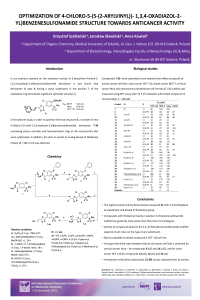
During our extensive research on anticancer activity of 2-mercaptobenznensulfonamide derivatives [1-5] we have found that a series of (E)-2-(benzylthio)-4-chloro-5-(5-styryl-1,3,4-oxadiazol-2-yl)benzenesulfonamide possesses a significant anti-tumor activity [5]. In presented studies, we decided to optimize hit-structure in order to determine the structure-activity relationships in this group of promising anticancer compounds. Therefore, we have tested the effect of the change of an aryl ring in the vinyl position (Ar), by synthesis of novel derivatives with diverse substituted aryl rings and 5- or 6-membered heterocyclic rings in that position. Secondly, we have checked the significance of the thiobenzyl substituent at the position 2 of the benzenesulfonamide scaffold by comparing compounds containing thiobenzyl substituent or chlorine atom.
Synthesized compounds 7-36 were tested using MTT assay towards their effect on growth of three human cancer cell lines: colon cancer HCT-116, breast cancer MCF-7 and cervical cancer HeLa as well as on noncancerous keratinocyte cell line HaCaT. Cell viability was measured after 72 h of incubation with tested compound in five concentrations 1 – 100 μM.
Analysis of the obtained results showed high cytostatic activity of derivatives based on the 2-(benzylthio)-4-chloro-benzenesulfonamide scaffold. On the other hand compounds based on 2,4-dichlorobenzenesulfonamide scaffold displayed considerable variety of activity strongly depending on type of aryl substituent in vinyl position. The most optimal configuration for compound 31 was the presence of 2‑nitrothiophene substituent and a lack of thiobenzyl moiety, which afforded with very high cytostatic activity in the IC50 range 0.5-4.5 μM (cisplatin 2.2-3.8 μM).
[1] A.Pogorzelska, B. Żołnowska, J. Sławiński, A. Kawiak, K. Szafrański, M. Belka, T. Bączek, Monatshefte Für Chemie - Chem. Mon. 149 (2018) 1885–1898.
[2] B. Żołnowska, J. Sławiński, K. Szafrański, A. Angeli, C.T. Supuran, A. Kawiak, M. Wieczór, J. Zielińska, T. Bączek, S. Bartoszewska, Eur. J. Med. Chem. 143 (2018) 1931–1941.
[3] A. Pogorzelska, J. Sławiński, B. Żołnowska, K. Szafrański, A. Kawiak, J. Chojnacki, S. Ulenberg, J. Zielińska, T. Bączek, Eur. J. Med. Chem. 138 (2017).
[4] B. Żołnowska, J. Sławiński, A. Pogorzelska, K. Szafrański, A. Kawiak, G. Stasiłojć, M. Belka, J. Zielińska, T. Bączek, Chem. Biol. Drug Des. 90 (2017).
[5] J. Sławiński, K. Szafrański, A. Pogorzelska, B. Żołnowska, A. Kawiak, K. Macur, M. Belka, T. Bączek, Eur. J. Med. Chem. 132 (2017) 236–248.
Keywords
benzenesulfonamide
anticancer activity
MTT
synthesis
Manuscript
Szafranski_5ecmc_poster.pdf
Poster
sciforum-027925.pdf
Antioxidant capacity and cholinesterase inhibitory activity of Vulpicida pinastri lichen and its chemical composition
Anticancer Hybrid Combinations with phenolic compounds