Event submissions
Published

This submission belongs to the session B. Posters of the event 5th International Electronic Conference on Medicinal Chemistry
Published date
30 Oct, 2019
Citation
Patrícia Calado, Catarina Dias, Ana Marta Matos, Maria Teresa Blásquez-Sanchez, Alice Martins, Philipp Dätwyler, Beat Ernst, M. Paula Macedo, Nicola Colabufo, Amélia Rauter, Coupling deoxy sugars to polyphenols: Neuroprotection and bioavailability, in Proceedings of 5th International Electronic Conference on Medicinal Chemistry, 1 November–30 November 2019, MDPI: Basel, Switzerland, doi: 10.3390/ECMC2019-06341
Share
Email
Facebook
Twitter
LinkedIn
Coupling deoxy sugars to polyphenols: Neuroprotection and bioavailability
'%3e%3cpath%20d='M12.6647%2010.9104C12.4176%2010.325%2012.0589%209.7933%2011.6088%209.34485C11.16%208.89511%2010.6283%208.53653%2010.0432%208.28891C10.038%208.28629%2010.0327%208.28498%2010.0275%208.28236C10.8437%207.69282%2011.3743%206.73252%2011.3743%205.64907C11.3743%203.85423%209.92005%202.40002%208.12522%202.40002C6.33038%202.40002%204.87618%203.85423%204.87618%205.64907C4.87618%206.73252%205.40677%207.69282%206.22296%208.28367C6.21772%208.28629%206.21248%208.2876%206.20724%208.29022C5.62031%208.53783%205.09365%208.89287%204.64167%209.34616C4.19192%209.79496%203.83334%2010.3266%203.58573%2010.9117C3.34247%2011.4846%203.21128%2012.0987%203.19925%2012.721C3.1989%2012.735%203.20135%2012.7489%203.20646%2012.7619C3.21157%2012.7749%203.21924%2012.7868%203.22901%2012.7968C3.23877%2012.8068%203.25045%2012.8148%203.26334%2012.8202C3.27623%2012.8256%203.29007%2012.8284%203.30406%2012.8284H4.09012C4.14776%2012.8284%204.19362%2012.7825%204.19493%2012.7262C4.22113%2011.7148%204.62726%2010.7676%205.34519%2010.0497C6.08802%209.30686%207.07452%208.89811%208.12522%208.89811C9.17592%208.89811%2010.1624%209.30686%2010.9052%2010.0497C11.6232%2010.7676%2012.0293%2011.7148%2012.0555%2012.7262C12.0568%2012.7839%2012.1027%2012.8284%2012.1603%2012.8284H12.9464C12.9604%2012.8284%2012.9742%2012.8256%2012.9871%2012.8202C13%2012.8148%2013.0117%2012.8068%2013.0214%2012.7968C13.0312%2012.7868%2013.0389%2012.7749%2013.044%2012.7619C13.0491%2012.7489%2013.0515%2012.735%2013.0512%2012.721C13.0381%2012.0947%2012.9084%2011.4856%2012.6647%2010.9104ZM8.12522%207.90243C7.52388%207.90243%206.95792%207.66793%206.53214%207.24215C6.10636%206.81636%205.87185%206.2504%205.87185%205.64907C5.87185%205.04773%206.10636%204.48177%206.53214%204.05599C6.95792%203.63021%207.52388%203.3957%208.12522%203.3957C8.72655%203.3957%209.29252%203.63021%209.7183%204.05599C10.1441%204.48177%2010.3786%205.04773%2010.3786%205.64907C10.3786%206.2504%2010.1441%206.81636%209.7183%207.24215C9.29252%207.66793%208.72655%207.90243%208.12522%207.90243Z'%20fill='%235D1EE1'/%3e%3c/g%3e%3c/svg%3e)
Patrícia Calado 1
Catarina Dias 1
Ana Marta Matos 1
Maria Teresa Blásquez-Sanchez 1

Alice Martins 1
Philipp Dätwyler 2
Beat Ernst 2
M. Paula Macedo 3
Nicola Colabufo 4

Amélia Rauter 1
1. Faculty of Sciences, University of Lisbon
2. Department of Pharmaceutical Sciences, Pharmacenter, University of Basel
3. Chronic Disease Research Center, NOVA Medical School, Lisbon
4. Biofordrug, Bari, Italy
Abstract
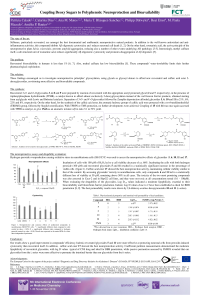
Resveratrol and methyl caffeate health-promoting role in chronic and degenerative diseases is well known, however, their efficiency is affected by their low bioavailability in humans due to poor water solubility. Since these compounds have a peculiar role in the inhibition of Aβ oligomeric cytotoxicity and thus reduction of neuronal cell death [1,2], we were encouraged to investigate a new approach to overcome these issues. We disclose herein the benefits discovered by coupling sugars to these polyphenols, aiming to improve compound polarity, facilitated by the presence of additional OH groups of the sugar moiety. A robust synthetic route was developed in order to couple 2-deoxyglycosides to these natural molecules- resveratrol and caffeic acid, using glycals as easily accessed glycosyl donors. The resveratrol 2-deoxyglycosides 1 and 2 are more effective at protecting neuronal cells from peroxide-induced cytotoxicity than resveratrol itself, and caffeic acid ester glycoside 3 was also highly active as neuroprotective agent. Compounds were not cytotoxic to neuroblastoma, intestinal or liver cells at all concentrations tested. Coefficient partition measurements (logD, pH=7.4) confirmed the moderate lipophilicity of these resveratrol glycosides, which log D values are typical of CNS drug and for BBB penetration. This work illustrates the benefits of coupling sugars to polyphenols, in particular deoxy sugars, to improve polyphenol bioactivity and physicochemical properties.
Keywords
2-deoxyglycosides
polyphenols
neuroprotection
bioavailability
Manuscript
Patrícia Calado Poster 5th ECMC.pdf
Poster
sciforum-028084.pdf
Lactose-based Fatty Acid Monoesters: Synthesis, antimicrobial activity and permeability enhancement studies
The in silico identification of potent natural bioactive anti-dengue agents by targeting the human hexokinase 2 enzyme