Event submissions
Published

This submission belongs to the session B. Posters of the event 5th International Electronic Conference on Medicinal Chemistry
Published date
31 Oct, 2019
Citation
Emina Mrkalić, Jovica Tomović, Jovana Milosavljević, Aleksandar Kočović, Ratomir Jelić, Miroslav Sovrlić, The effect of the caffeine on the binding of haloperidol to human serum albumin, in Proceedings of 5th International Electronic Conference on Medicinal Chemistry, 1 November–30 November 2019, MDPI: Basel, Switzerland, doi: 10.3390/ECMC2019-06348
Share
Email
Facebook
Twitter
LinkedIn
The effect of the caffeine on the binding of haloperidol to human serum albumin
'%3e%3cpath%20d='M12.6647%2010.9104C12.4176%2010.325%2012.0589%209.7933%2011.6088%209.34485C11.16%208.89511%2010.6283%208.53653%2010.0432%208.28891C10.038%208.28629%2010.0327%208.28498%2010.0275%208.28236C10.8437%207.69282%2011.3743%206.73252%2011.3743%205.64907C11.3743%203.85423%209.92005%202.40002%208.12522%202.40002C6.33038%202.40002%204.87618%203.85423%204.87618%205.64907C4.87618%206.73252%205.40677%207.69282%206.22296%208.28367C6.21772%208.28629%206.21248%208.2876%206.20724%208.29022C5.62031%208.53783%205.09365%208.89287%204.64167%209.34616C4.19192%209.79496%203.83334%2010.3266%203.58573%2010.9117C3.34247%2011.4846%203.21128%2012.0987%203.19925%2012.721C3.1989%2012.735%203.20135%2012.7489%203.20646%2012.7619C3.21157%2012.7749%203.21924%2012.7868%203.22901%2012.7968C3.23877%2012.8068%203.25045%2012.8148%203.26334%2012.8202C3.27623%2012.8256%203.29007%2012.8284%203.30406%2012.8284H4.09012C4.14776%2012.8284%204.19362%2012.7825%204.19493%2012.7262C4.22113%2011.7148%204.62726%2010.7676%205.34519%2010.0497C6.08802%209.30686%207.07452%208.89811%208.12522%208.89811C9.17592%208.89811%2010.1624%209.30686%2010.9052%2010.0497C11.6232%2010.7676%2012.0293%2011.7148%2012.0555%2012.7262C12.0568%2012.7839%2012.1027%2012.8284%2012.1603%2012.8284H12.9464C12.9604%2012.8284%2012.9742%2012.8256%2012.9871%2012.8202C13%2012.8148%2013.0117%2012.8068%2013.0214%2012.7968C13.0312%2012.7868%2013.0389%2012.7749%2013.044%2012.7619C13.0491%2012.7489%2013.0515%2012.735%2013.0512%2012.721C13.0381%2012.0947%2012.9084%2011.4856%2012.6647%2010.9104ZM8.12522%207.90243C7.52388%207.90243%206.95792%207.66793%206.53214%207.24215C6.10636%206.81636%205.87185%206.2504%205.87185%205.64907C5.87185%205.04773%206.10636%204.48177%206.53214%204.05599C6.95792%203.63021%207.52388%203.3957%208.12522%203.3957C8.72655%203.3957%209.29252%203.63021%209.7183%204.05599C10.1441%204.48177%2010.3786%205.04773%2010.3786%205.64907C10.3786%206.2504%2010.1441%206.81636%209.7183%207.24215C9.29252%207.66793%208.72655%207.90243%208.12522%207.90243Z'%20fill='%235D1EE1'/%3e%3c/g%3e%3c/svg%3e)
Emina Mrkalić 1
Jovica Tomović 2
Jovana Milosavljević 2
Aleksandar Kočović 2
Ratomir Jelić 2

Miroslav Sovrlić 2
1. Institute for Information Technologies Kragujevac, Department of Science, University of Kragujevac, Jovana Cvijića bb, 34000 Kragujevac, Serbia
2. Faculty of Medical Sciences, Department of Pharmacy, University of Kragujevac, Svetozara Markovića 69, 34000 Kragujevac, Serbia
Abstract
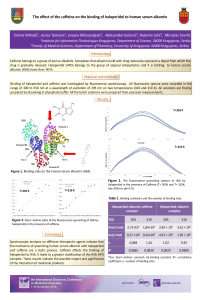
Caffeine belongs to a group of purine alkaloids. Complexes that albumin build with drug molecules represent a depot from which the drug is gradually released. Haloperidol (HPD) belongs to the group of atypical antipsyhotics and it is binding to human serum albumin (HSA) more than 90 %. The aim of this study was to determine the effect of caffeine on the binding of haloperidol to HSA. Reviewing the results will determine whether and how the caffeine affects the binding of haloperidol to HSA. Binding of haloperidol and caffeine was investigated by fluorescence spectroscopy. All fluorescent spectra were recorded in the range of 300 to 550 nm at a wavelength of excitation of 295 nm on two temperatures (303 and 310 K). Fluorescence spectroscopic data showed that the fluorescence quenching of HSA resulted from the formation of the HPD-HSA-Caffeine complex. Spectroscopic analyses on different therapeutic agents indicate that the mechanics of quenching human serum albumin with haloperidol and caffeine are a static process. Estimated constants (Ksv, Ka) and binding sites (n), between haloperidol, caffeine and human serum albumin, are Ksv 2.71 × 10³ l/mol, Ka = 9.27 × 10³ l/mol at a temperature of 303K, and Ksv 1.83 × 10³ l/mol, Ka = 9.33 × 10³ l/mol at a temperature of 310K. The number of operating points is 1. Caffeine affects the binding of haloperidol to HSA. It leads to a greater stabilization of the HSA-HPD complex. These results indicate the possible impact and significance of the interaction of medicinal products.
Keywords
haloperidol
caffeine
binding
human serum albumin
Manuscript
2.ecmc-5_ecmc-5_Poster_templatemrkalic.pdf
Poster
sciforum-027990.pdf
Food for celiacs with black quinoa (Chenopodium petiolare kunth)
GalNAc mimetics: from synthesis to potential inhibitors in Alzheimer’s Disease