Event submissions
Published

This submission belongs to the session B. Posters of the event 5th International Electronic Conference on Medicinal Chemistry
Published date
01 Nov, 2019
Citation
Eduarda Fernandes, Telma Soares, Andreia Almeida, M. Elisabete C.D. Real Oliveira, Bruno Sarmento, Marlene Lúcio, The membrane/aqueous partitioning as an essential tool for pharmacokinetic profiling to support drug design, in Proceedings of 5th International Electronic Conference on Medicinal Chemistry, 1 November–30 November 2019, MDPI: Basel, Switzerland, doi: 10.3390/ECMC2019-06357
Share
Email
Facebook
Twitter
LinkedIn
The membrane/aqueous partitioning as an essential tool for pharmacokinetic profiling to support drug design

Eduarda Fernandes 1
'%3e%3cpath%20d='M12.6647%2010.9104C12.4176%2010.325%2012.0589%209.7933%2011.6088%209.34485C11.16%208.89511%2010.6283%208.53653%2010.0432%208.28891C10.038%208.28629%2010.0327%208.28498%2010.0275%208.28236C10.8437%207.69282%2011.3743%206.73252%2011.3743%205.64907C11.3743%203.85423%209.92005%202.40002%208.12522%202.40002C6.33038%202.40002%204.87618%203.85423%204.87618%205.64907C4.87618%206.73252%205.40677%207.69282%206.22296%208.28367C6.21772%208.28629%206.21248%208.2876%206.20724%208.29022C5.62031%208.53783%205.09365%208.89287%204.64167%209.34616C4.19192%209.79496%203.83334%2010.3266%203.58573%2010.9117C3.34247%2011.4846%203.21128%2012.0987%203.19925%2012.721C3.1989%2012.735%203.20135%2012.7489%203.20646%2012.7619C3.21157%2012.7749%203.21924%2012.7868%203.22901%2012.7968C3.23877%2012.8068%203.25045%2012.8148%203.26334%2012.8202C3.27623%2012.8256%203.29007%2012.8284%203.30406%2012.8284H4.09012C4.14776%2012.8284%204.19362%2012.7825%204.19493%2012.7262C4.22113%2011.7148%204.62726%2010.7676%205.34519%2010.0497C6.08802%209.30686%207.07452%208.89811%208.12522%208.89811C9.17592%208.89811%2010.1624%209.30686%2010.9052%2010.0497C11.6232%2010.7676%2012.0293%2011.7148%2012.0555%2012.7262C12.0568%2012.7839%2012.1027%2012.8284%2012.1603%2012.8284H12.9464C12.9604%2012.8284%2012.9742%2012.8256%2012.9871%2012.8202C13%2012.8148%2013.0117%2012.8068%2013.0214%2012.7968C13.0312%2012.7868%2013.0389%2012.7749%2013.044%2012.7619C13.0491%2012.7489%2013.0515%2012.735%2013.0512%2012.721C13.0381%2012.0947%2012.9084%2011.4856%2012.6647%2010.9104ZM8.12522%207.90243C7.52388%207.90243%206.95792%207.66793%206.53214%207.24215C6.10636%206.81636%205.87185%206.2504%205.87185%205.64907C5.87185%205.04773%206.10636%204.48177%206.53214%204.05599C6.95792%203.63021%207.52388%203.3957%208.12522%203.3957C8.72655%203.3957%209.29252%203.63021%209.7183%204.05599C10.1441%204.48177%2010.3786%205.04773%2010.3786%205.64907C10.3786%206.2504%2010.1441%206.81636%209.7183%207.24215C9.29252%207.66793%208.72655%207.90243%208.12522%207.90243Z'%20fill='%235D1EE1'/%3e%3c/g%3e%3c/svg%3e)
Telma Soares 1,2

Andreia Almeida 3,4

M. Elisabete C.D. Real Oliveira 1

Bruno Sarmento 3,4,5

Marlene Lúcio 1,2
1. CF-UM-UP, Centro de Física das Universidades do Minho e Porto, Departamento de Física da Universidade do Minho, Campus de Gualtar, Braga, Portugal
2. CBMA, Centro de Biologia Molecular e Ambiental, Departamento de Biologia, Universidade do Minho, Campus de Gualtar, Braga, Portugal
3. i3S, Instituto de Investigação e Inovação em Saúde, Universidade do Porto, Porto, Portugal
4. INEB, Instituto de Engenharia Biomédica, Universidade do Porto, Porto, Portugal
5. CESPU, Instituto de Investigação e Formação Avançada em Ciências e Tecnologias da Saúde, Instituto Universitário de Ciências da Saúde, Gandra, Portugal
Abstract
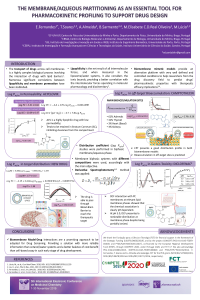
Advances in automated synthesis and combinatorial chemistry have led to the preparation of a vast number of potential candidates, often making the inefficacy to reach the pharmaceutical target as the rate-limiting step in drug design. To elicit its pharmacological and therapeutic effects, a compound has to be able to pass through several physiological barriers. Membrane permeability is fundamental and determines the pharmacokinetic profile of drugs (Absorption, Distribution, Metabolism and Excretion – ADME). In this regard, a thorough understanding of the structure and characteristics of physiological barriers and of the mechanisms of drug transport is necessary. Numerous significant correlations between lipophilicity and drug membrane permeation have been stablished. Additionally, anisotropic membrane-like systems, such as liposomes/water partitioning systems, are increasingly described as an alternative to octanol/water for the estimation of pharmacokinetic behaviour. In fact, lipophilicity measured in isotropic organic octanol/water system only expresses the balance of hydrophobic and polar interactions. However, lipophilicity is the net result of all intermolecular forces, and when measured in the liposome/water systems, it also considers the ionic bounds, providing a better correlation with the intermolecular forces operating in molecular pharmacology and biochemistry. Thus, different biomimetic models were prepared, and partitioning behaviour of several compounds were evaluated by derivative spectroscopy to obtain information about their affinity to several biological membranes/barriers and respective implications in in vivo pharmacokinetic behaviour.
Keywords
pharmacokinetic
ADME
biophysics
biomimetic membrane models
lipophilicity
membrane permeability
Manuscript
EDUARDA FERNANDES_ POSTER.pdf
Poster
sciforum-027836.pdf
The influence of quercetin on the interaction of haloperidol with human serum albumin
Synthesis of N-acetyl and N-formyl pyrazoline derivatives from vanillin and their antigenotoxic activity