Event submissions
Published

This submission belongs to the session B. Posters of the event 5th International Electronic Conference on Medicinal Chemistry
Published date
01 Nov, 2019
Citation
Ana Reis-Mendes, Margarida Duarte-Araújo, José Alberto Duarte, Salomé Gonçalves-Monteiro, Fernando Remião, Félix Carvalho, Emília Sousa, Maria Lourdes Bastos, Vera Marisa Costa, Anticancer drugs-induced toxicity in different age male CD-1 mice, in Proceedings of 5th International Electronic Conference on Medicinal Chemistry, 1 November–30 November 2019, MDPI: Basel, Switzerland, doi: 10.3390/ECMC2019-06365
Share
Email
Facebook
Twitter
LinkedIn
Anticancer drugs-induced toxicity in different age male CD-1 mice
'%3e%3cpath%20d='M12.6647%2010.9104C12.4176%2010.325%2012.0589%209.7933%2011.6088%209.34485C11.16%208.89511%2010.6283%208.53653%2010.0432%208.28891C10.038%208.28629%2010.0327%208.28498%2010.0275%208.28236C10.8437%207.69282%2011.3743%206.73252%2011.3743%205.64907C11.3743%203.85423%209.92005%202.40002%208.12522%202.40002C6.33038%202.40002%204.87618%203.85423%204.87618%205.64907C4.87618%206.73252%205.40677%207.69282%206.22296%208.28367C6.21772%208.28629%206.21248%208.2876%206.20724%208.29022C5.62031%208.53783%205.09365%208.89287%204.64167%209.34616C4.19192%209.79496%203.83334%2010.3266%203.58573%2010.9117C3.34247%2011.4846%203.21128%2012.0987%203.19925%2012.721C3.1989%2012.735%203.20135%2012.7489%203.20646%2012.7619C3.21157%2012.7749%203.21924%2012.7868%203.22901%2012.7968C3.23877%2012.8068%203.25045%2012.8148%203.26334%2012.8202C3.27623%2012.8256%203.29007%2012.8284%203.30406%2012.8284H4.09012C4.14776%2012.8284%204.19362%2012.7825%204.19493%2012.7262C4.22113%2011.7148%204.62726%2010.7676%205.34519%2010.0497C6.08802%209.30686%207.07452%208.89811%208.12522%208.89811C9.17592%208.89811%2010.1624%209.30686%2010.9052%2010.0497C11.6232%2010.7676%2012.0293%2011.7148%2012.0555%2012.7262C12.0568%2012.7839%2012.1027%2012.8284%2012.1603%2012.8284H12.9464C12.9604%2012.8284%2012.9742%2012.8256%2012.9871%2012.8202C13%2012.8148%2013.0117%2012.8068%2013.0214%2012.7968C13.0312%2012.7868%2013.0389%2012.7749%2013.044%2012.7619C13.0491%2012.7489%2013.0515%2012.735%2013.0512%2012.721C13.0381%2012.0947%2012.9084%2011.4856%2012.6647%2010.9104ZM8.12522%207.90243C7.52388%207.90243%206.95792%207.66793%206.53214%207.24215C6.10636%206.81636%205.87185%206.2504%205.87185%205.64907C5.87185%205.04773%206.10636%204.48177%206.53214%204.05599C6.95792%203.63021%207.52388%203.3957%208.12522%203.3957C8.72655%203.3957%209.29252%203.63021%209.7183%204.05599C10.1441%204.48177%2010.3786%205.04773%2010.3786%205.64907C10.3786%206.2504%2010.1441%206.81636%209.7183%207.24215C9.29252%207.66793%208.72655%207.90243%208.12522%207.90243Z'%20fill='%235D1EE1'/%3e%3c/g%3e%3c/svg%3e)
Ana Reis-Mendes 1
Margarida Duarte-Araújo 2,3
José Alberto Duarte 4
Salomé Gonçalves-Monteiro 5

Fernando Remião 1

Félix Carvalho 1

Emília Sousa 6,7
Maria Lourdes Bastos 1

Vera Marisa Costa 8
1. UCIBIO, REQUIMTE, Laboratory of Toxicology, Department of Biological Sciences, Faculty of Pharmacy, University of Porto, Porto, Portugal;
2. LAQV/REQUIMTE, University of Porto, Portugal;
3. Department of Immuno-Physiology and Pharmacology, Institute of Biomedical Sciences Abel Salazar, University of Porto, Portugal;
4. CIAFEL, Faculty of Sport, University of Porto, Porto, Portugal;
5. LAQV/REQUIMTE, Laboratory of Pharmacology, Department of Drug Sciences, Faculty of Pharmacy, University of Porto, Porto, Portugal;
6. Laboratory of Organic and Pharmaceutical Chemistry, Chemistry Department, Faculty of Pharmacy, University of Porto, Porto, Portugal;
7. CIIMAR – Interdisciplinary Centre of Marine and Environmental Research, Porto, Portugal;
8. UCIBIO, REQUIMTE, Laboratory of Toxicology, Department of Biological Sciences, Faculty of Pharmacy, University of Porto, Porto, Portugal.
Abstract
Anticancer drugs like doxorubicin (DOX) and mitoxantrone (MTX) are used to treat cancer. Nevertheless, they have worrying long-term toxicity. MTX and DOX cause cardiotoxicity and several risk factors could aggravate it. The aim of this work was to study the toxicity of clinically relevant MTX and DOX doses in infant (4 weeks), adult (3 months), and old (18-20 months) male CD-1 mice. All animals received biweekly intraperitoneal administrations, for 3 weeks. MTX-treated groups received a total cumulative dose of 6 mg/kg, DOX-treated infants and adults received a total cumulative dose of 18 mg/kg, while a second group of adults and old mice received a total cumulative DOX dose of 9 mg/kg. The animals’ weight, food and water consumptions and general welfare were recorded throughout the experiment. Mice were sacrificed 7 days (adults and old animals) or 17 days (infants) after the last injection. Blood, brain, heart, kidneys, spleen, and liver were collected. The heart, kidneys, and liver were analyzed through light microscopy and blood plasma was used for biochemical determinations. Regarding the results, significant body weight loss was observed in the adult population treated with MTX and DOX 18 mg/kg, and in DOX-treated infants’ animals, when compared to the respective controls. In addition, food and water consumptions decreased in the infant and adult populations treated with MTX and DOX 18mg/kg. Regarding organ weight/ brain weight ratios at sacrifice, the ratio of all the organs were significantly decreased in the MTX and DOX-treated adults, except in adult DOX 9 mg/kg. Alanine aminotransferase (ALT) plasma levels were significantly increased in the MTX and DOX-treated infant. Moreover, in DOX-treated adult (18 mg/kg), aspartate aminotransferase (AST)/ALT ratio and total creatine-kinase (CK) plasma levels increased, when compared to controls. Regarding histology, all the MTX and DOX-treated populations presented lesions in heart, kidneys, and liver as did the old control animals. Histological staining using Sirius Red identified a significant increase in interstitial collagen deposition in the myocardium, liver, and kidneys in all drug-treated adult mice. Therefore, we can conclude that although cumulative dose is considered a main factor when studying anticancer drugs toxicity, the age of administration is also determinant in the toxicity observed. In our study, adult mice seemed to be more prone to MTX and DOX-induced toxicity; still, further data needs to be gathered to determine the underlying factors for that susceptibility.
ARM and VMC acknowledge Fundação da Ciência e Tecnologia (FCT) for their grants (SFRH/BD/129359/2017 and SFRH/BPD/110001/2015, respectively). This work is funded by national funds through FCT – Fundação para a Ciência e a Tecnologia, I.P., under the Norma Transitória – DL57/2016/CP1334/CT0006. This work was supported by FEDER funds through the Operational Programme for Competitiveness Factors – COMPETE and by national funds by the Fundação para a Ciência e Tecnologia (FCT) within the project “PTDC/DTP-FTO/1489/2014 – POCI01-0145-FEDER-016537”.
Keywords
Doxorubicin
Mitoxantrone
Cardiotoxicity
Cumulative dose
Age.
Manuscript
A. Reis-Mendes - 5th International Electronic Conference on Medicinal Chemistr2019.pdf
Poster
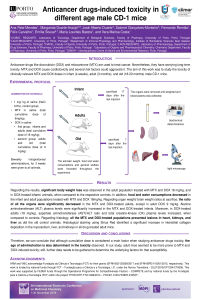
A. Reis-Mendes - Poster - 2019.pdf
Effects of Doxorubicin and Mitoxantrone in the brain of differently aged mice: in vivo chemobrain study
The main products of cyclophosphamide bioactivation exert a cardiotoxic effect at clinical important concentrations in AC16 cardiac cells