Event submissions
Published

This submission belongs to the session B. Posters of the event 5th International Electronic Conference on Medicinal Chemistry
Published date
01 Nov, 2019
Citation
George Nicolae Daniel Ion, George Mihai Nitulescu, Drugs and PAINs: A DrugBank analysis of pan-assay interference compounds, in Proceedings of 5th International Electronic Conference on Medicinal Chemistry, 1 November–30 November 2019, MDPI: Basel, Switzerland, doi: 10.3390/ECMC2019-06378
Share
Email
Facebook
Twitter
LinkedIn
Drugs and PAINs: A DrugBank analysis of pan-assay interference compounds
'%3e%3cpath%20d='M12.6647%2010.9104C12.4176%2010.325%2012.0589%209.7933%2011.6088%209.34485C11.16%208.89511%2010.6283%208.53653%2010.0432%208.28891C10.038%208.28629%2010.0327%208.28498%2010.0275%208.28236C10.8437%207.69282%2011.3743%206.73252%2011.3743%205.64907C11.3743%203.85423%209.92005%202.40002%208.12522%202.40002C6.33038%202.40002%204.87618%203.85423%204.87618%205.64907C4.87618%206.73252%205.40677%207.69282%206.22296%208.28367C6.21772%208.28629%206.21248%208.2876%206.20724%208.29022C5.62031%208.53783%205.09365%208.89287%204.64167%209.34616C4.19192%209.79496%203.83334%2010.3266%203.58573%2010.9117C3.34247%2011.4846%203.21128%2012.0987%203.19925%2012.721C3.1989%2012.735%203.20135%2012.7489%203.20646%2012.7619C3.21157%2012.7749%203.21924%2012.7868%203.22901%2012.7968C3.23877%2012.8068%203.25045%2012.8148%203.26334%2012.8202C3.27623%2012.8256%203.29007%2012.8284%203.30406%2012.8284H4.09012C4.14776%2012.8284%204.19362%2012.7825%204.19493%2012.7262C4.22113%2011.7148%204.62726%2010.7676%205.34519%2010.0497C6.08802%209.30686%207.07452%208.89811%208.12522%208.89811C9.17592%208.89811%2010.1624%209.30686%2010.9052%2010.0497C11.6232%2010.7676%2012.0293%2011.7148%2012.0555%2012.7262C12.0568%2012.7839%2012.1027%2012.8284%2012.1603%2012.8284H12.9464C12.9604%2012.8284%2012.9742%2012.8256%2012.9871%2012.8202C13%2012.8148%2013.0117%2012.8068%2013.0214%2012.7968C13.0312%2012.7868%2013.0389%2012.7749%2013.044%2012.7619C13.0491%2012.7489%2013.0515%2012.735%2013.0512%2012.721C13.0381%2012.0947%2012.9084%2011.4856%2012.6647%2010.9104ZM8.12522%207.90243C7.52388%207.90243%206.95792%207.66793%206.53214%207.24215C6.10636%206.81636%205.87185%206.2504%205.87185%205.64907C5.87185%205.04773%206.10636%204.48177%206.53214%204.05599C6.95792%203.63021%207.52388%203.3957%208.12522%203.3957C8.72655%203.3957%209.29252%203.63021%209.7183%204.05599C10.1441%204.48177%2010.3786%205.04773%2010.3786%205.64907C10.3786%206.2504%2010.1441%206.81636%209.7183%207.24215C9.29252%207.66793%208.72655%207.90243%208.12522%207.90243Z'%20fill='%235D1EE1'/%3e%3c/g%3e%3c/svg%3e)
George Nicolae Daniel Ion 1

George Mihai Nitulescu 1
1. Carol Davila University of Medicine and Pharmacy, Bucharest - Faculty of Pharmacy
Abstract
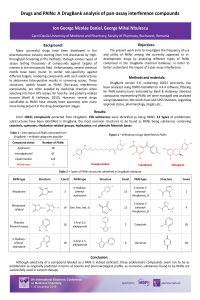
Background: Many successful drugs have been developed in the pharmaceutical industry starting from hits discovered by High-throughput Screening (HTS) methods, through various types of assays testing thousands of compounds against targets of interest in the therapeutic field. Unfortunately, several chemical motifs have been found to confer non-specificity against different targets, rendering compounds with such substructures to determine false-positive results in screening assays. These structures, widely known as PAINS (Pan-assay interference compounds), are often avoided by medicinal chemists when selecting hits from HTS assays, for toxicity- and potency-related reasons (Baell & Holloway, 2010, J Med Chem). However, several drugs classifiable as PAINS have already been approved, with many more being present in the drug development stages.
Objectives: Our study aims to investigate the frequency of use and utility of PAINs among the currently approved or in-development drugs by analyzing different types of PAINs comprised in the DrugBank chemical database, in order to better understand the impact of a pan-assay interference.
Methods: DrugBank version 5.0, containing 10631 structures, has been analyzed using OSIRIS DataWarrior 4.4.4 software, filtering for PAIN substructures indicated by Baell & Holloway. Selected compounds representing PAINs set were managed and analyzed using DataWarrior, Microsoft Excel and SPSS Statistics, regarding approval status, pharmacology, toxicology, etc.
Results: From 10631 compounds extracted from DrugBank, more than 200 substances were identified as being PAINS. 10 types of problematic substructures have been identified in DrugBank, the most common structures to be found as PAINs being substances containing catechols, quinones, rhodanine-related groups, and phenolic mannich bases.
Conclusion: Although selectivity of a compound labeled as PAIN is indeed deficient, these problematic compounds seem not to be as problematic as originally predicted in terms of toxicity and pharmacological profile, as numerous substances found to be PAINs are successfully used in current therapy.
Keywords
High throughput screening
drug discovery
assay
multiple targets.
Manuscript
Poster sciforum-028028.pdf
Poster
sciforum-028028.pdf
Drug (re-)design guided by biophysical characterization of interactions with biomimetic membranes
Design, synthesis and in vitro biological evaluation of acrylamide derivatives against Chikungunya virus