Event submissions
Published

This submission belongs to the session B. Posters of the event 5th International Electronic Conference on Medicinal Chemistry
Published date
08 Nov, 2019
Citation
Eavan Ciara McLoughlin, Niamh O'Boyle, Mary Meegan, Stories from Staudinger: Synthesis of chiral beta-lactams, in Proceedings of 5th International Electronic Conference on Medicinal Chemistry, 1 November–30 November 2019, MDPI: Basel, Switzerland, doi: 10.3390/ECMC2019-06402
Share
Email
Facebook
Twitter
LinkedIn
Stories from Staudinger: Synthesis of chiral beta-lactams
'%3e%3cpath%20d='M12.6647%2010.9104C12.4176%2010.325%2012.0589%209.7933%2011.6088%209.34485C11.16%208.89511%2010.6283%208.53653%2010.0432%208.28891C10.038%208.28629%2010.0327%208.28498%2010.0275%208.28236C10.8437%207.69282%2011.3743%206.73252%2011.3743%205.64907C11.3743%203.85423%209.92005%202.40002%208.12522%202.40002C6.33038%202.40002%204.87618%203.85423%204.87618%205.64907C4.87618%206.73252%205.40677%207.69282%206.22296%208.28367C6.21772%208.28629%206.21248%208.2876%206.20724%208.29022C5.62031%208.53783%205.09365%208.89287%204.64167%209.34616C4.19192%209.79496%203.83334%2010.3266%203.58573%2010.9117C3.34247%2011.4846%203.21128%2012.0987%203.19925%2012.721C3.1989%2012.735%203.20135%2012.7489%203.20646%2012.7619C3.21157%2012.7749%203.21924%2012.7868%203.22901%2012.7968C3.23877%2012.8068%203.25045%2012.8148%203.26334%2012.8202C3.27623%2012.8256%203.29007%2012.8284%203.30406%2012.8284H4.09012C4.14776%2012.8284%204.19362%2012.7825%204.19493%2012.7262C4.22113%2011.7148%204.62726%2010.7676%205.34519%2010.0497C6.08802%209.30686%207.07452%208.89811%208.12522%208.89811C9.17592%208.89811%2010.1624%209.30686%2010.9052%2010.0497C11.6232%2010.7676%2012.0293%2011.7148%2012.0555%2012.7262C12.0568%2012.7839%2012.1027%2012.8284%2012.1603%2012.8284H12.9464C12.9604%2012.8284%2012.9742%2012.8256%2012.9871%2012.8202C13%2012.8148%2013.0117%2012.8068%2013.0214%2012.7968C13.0312%2012.7868%2013.0389%2012.7749%2013.044%2012.7619C13.0491%2012.7489%2013.0515%2012.735%2013.0512%2012.721C13.0381%2012.0947%2012.9084%2011.4856%2012.6647%2010.9104ZM8.12522%207.90243C7.52388%207.90243%206.95792%207.66793%206.53214%207.24215C6.10636%206.81636%205.87185%206.2504%205.87185%205.64907C5.87185%205.04773%206.10636%204.48177%206.53214%204.05599C6.95792%203.63021%207.52388%203.3957%208.12522%203.3957C8.72655%203.3957%209.29252%203.63021%209.7183%204.05599C10.1441%204.48177%2010.3786%205.04773%2010.3786%205.64907C10.3786%206.2504%2010.1441%206.81636%209.7183%207.24215C9.29252%207.66793%208.72655%207.90243%208.12522%207.90243Z'%20fill='%235D1EE1'/%3e%3c/g%3e%3c/svg%3e)
Eavan Ciara McLoughlin 1
Niamh O'Boyle 1

Mary Meegan 1
1. School of Pharmacy and Pharmaceutical Sciences , Trinity College, University of Dublin, Dublin, Ireland
Abstract
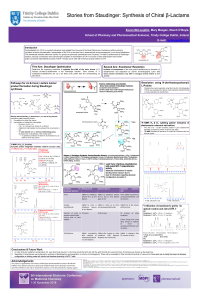
Combretastatin A-4 (CA-4) is the most potent antimitotic agent of the Combretastatin A series; a group of diaryl stilbenes isolated from the wood of the South African tree Combretum caffrum. [i] It has significant anticancer activity through inhibition of tubulin polymerization and microtubule assembly. [ii] While cis-stilbene structures demonstrate superior biological activity[iii], the corresponding trans derivatives are inherently more stable. Isomerization of cis CA-4 to the trans form is observed both during storage and in vivo during metabolism which dramatically reduces antitumour activity. [iv] Our group has previously employed the Staudinger reaction to synthesize novel 3-hydroxy-1,4-diaryl-2-azetidinones. The problem of CA-4’s Cis- Trans isomerization has been overcome via chemical manipulation of CA-4’s alkene bridge; utilizing a beta-lactam ring to induce cis restriction. A number of analogues have shown potent nanomolar antiproliferative activity in MCF-7 and HL-60 cells with enhanced activity relative to CA-4. [v] Typical Staudinger reactions form mixtures of cis and trans isomers depending on reaction conditions employed, and additionally; at the 3-hydroxy position’s chiral center; racemic mixtures of R&S enantiomers. Trans isomers of 3-substituted-2-azetidinones have been shown to be up to 50 times more potent than the corresponding cis derivatives[vi] emphasizing the requirement to optimize the Staudinger approach to minimize yields of the undesirable cis isomer. Levo- and dextro-rotatory enantiomers hold potential to display lesser or greater biological activity relative to one another.
Our current work aims to:
- Improve the available yield for chiral resolution by determining the necessary conditions to achieve stereoselective synthesis of trans 3-hydroxy-1,4-diaryl-2-azetidinones in the Staudinger reaction;
- Purification of racemic mixtures using N-(tert-butoxycarbonyl)-L-Proline as a chiral resolving agent to afford optically pure enantiomers for further biological evaluation.
Trans 3-hydroxy b-lactams have been separated from cis derivatives using chromatographic purification. We have since optimized the Staudinger reaction to return relative yields of 95:% relative ratio of trans: cis isomers; as indicated by integration of protons at position 3 and 4 of the beta-lactam on 1 H-NMR. Diastereomeric resolution using flash column chromatography followed by hydrolysis of chiral resolving agents has successfully yielded enantiomers of EMCL001&2. Preliminary biochemical data for the enantiomers in breast cancer cells will be reported.
References
[i] Watt, J. M.; Gerdina, M., The Medicinal and Poisonous Plants of Southern and Eastern Africa. E. & S. Livingstone Ltd: Edinburgh and London, U.K., 1962.
[ii] Pettit, G. R.; Singh, S. B.; Hamel, E.; Lin, C. M.; Alberts, D. S.; Garcia-Kendall, D., Isolation and structure of the strong cell growth and tubulin inhibitor combretastatin Experientia 1988, (45).
[iii] Pettit, G. R.; Singh, S. B.; Hamel, E.; Lin, C. M.; Alberts, D. S.; Garcia-Kendall, D., Isolation and structure of the strong cell growth and tubulin inhibitor combretastatin A-4 ~. Experientia 1988, (45).
[iv] Ohsumi, K.; Hatanaka, T.; Fujita, K.; Nakagawa, R.; Fukuda, Y.; Nihei, Y.; Suga, Y.; Morinaga, Y.; Akiyama, Y.; Tsuji, T., Synthesis and antitumor activity of cis-restricted combrestatins: 5-membered heterocyclic analogues. YNTHESES AND ANTITUMOR ACTIVITY OF CISRESTRICTED COMBRETASTATINS: 5-MEMBERED HETEROCYCLIC ANALOGUES Bioorg. Med. Chem. Lett. 1998, 8, 3153-3158
[v]N.M. O’Boyle, M. Carr, L.M. Greene, O. Bergin, S.M. Nathwani, T.McCabe, D.G. Lloyd, D.M. Zisterer, M.J. Meegan, Synthesis and evaluation of azetidinone analogues of combretastatin A-4 as tubulin targeting agents, J. Med. Chem., 53 (2010), p. 8569
[vi] Azizah M. Malebari Lisa M. Greene, S. M. N., Darren Fayne, Niamh M. O'Boyle , Shu Wang , Brendan Twamley , Daniela M. Zisterer , Mary J. Meegan beta-Lactam analogues of combretastatin A-4 prevent metabolic inactivation by glucuronidation in chemoresistant HT-29 colon cancer cells. Eur. J. Med. Chem. 2017, 130, 261-285
Keywords
anticancer
b-lactam
combretastatin
CA-4
isomers
chiral synthesis
staudinger
tubulin
anti-tubulin
DNA inhibitors
VDA
vascular disrupting agent
cancer
breast cancer
triple negative breast cancer
anti-angiogenic agents
angiogenesis
Manuscript
2.ecmc-5_ecmc-5_Poster_template.pdf
Poster
2.ecmc-5_ecmc-5_Poster_template.pdf
Nanotechnology mediated bee venom: Applications in rheumatoid arthritis
Tryptophanol-derived oxazoloisoindolinones: Novel small molecule p53 activators with promising antitumor activity